Goodnight, milk.

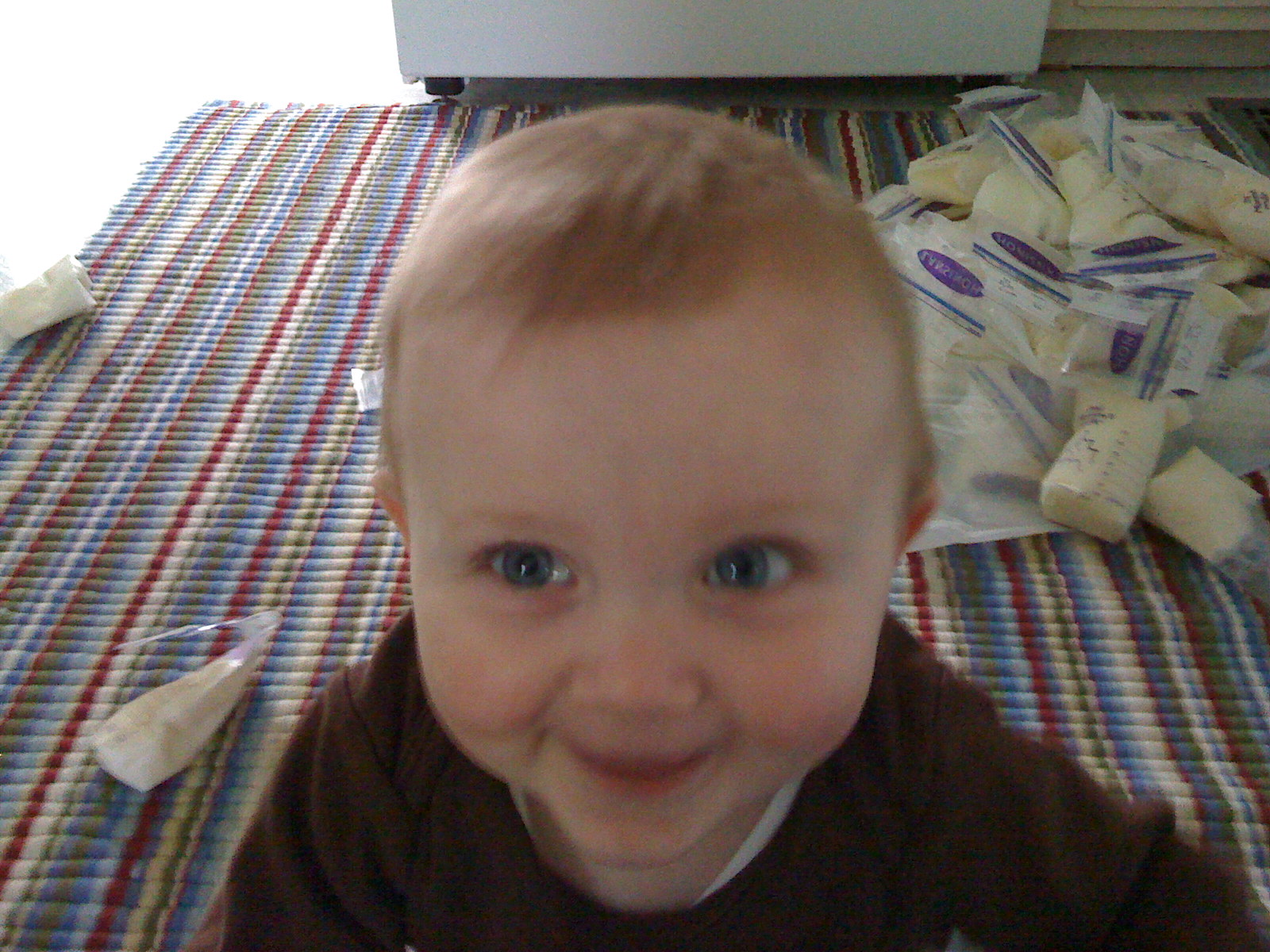
Stella wasn't sad to see the milk go. In fact, she was delighted.

Stella wasn't sad to see the milk go. In fact, she was delighted.

A couple of weeks ago, I threw out 341 ounces of frozen breastmilk. That was just the bottom shelf. I still need to clear out the top one.

It has been six months since the last of it was pumped, rendering my precious milk expired. At the beginning, every half ounce was sacred. Toward the end of my pumping days, I didn’t bother saving the milk. It sat out for hours, until I forced myself to pump again at which point I would dump the previous yield down the drain. I was so bitter. So exhausted. I’d had it with pumping. Stella had been diagnosed with cow’s milk protein intolerance and fed hypoallergenic formula through a tube for a good month, and still I pumped. The odds of returning to breastfeeding seemed grim at best. Still, it was hard to stop. I didn’t want to give up. I wanted her to have “the best.”

I’d been meaning to throw the milk out for some time now, but couldn’t let it go.

When I stopped breastfeeding, when Stella had her NG tube, I was an emotional wreck. But I was consumed with tube- and bottle-feeding my baby and completely focused on getting Stella over her feeding aversion. I never really allowed myself to think very deeply about the loss. So I never got to grieve my milk or my vision of breastfeeding and what it represented to me. I never really embraced the choice that I made–the only choice that seemed logical, the one that enabled Stella (and me) to thrive. I want to accept it completely and I’m not sure why it’s been so hard to do.

I’ve thought about this a lot lately, since dumping those 341 ounces. And perhaps the answer is simple. Formula-feeding is not what I wanted for Stella. I failed. Or that’s what it feels like. And a very small, insecure part of me wonders if there is simply something wrong with me. My milk made Stella sick. It didn’t protect or nourish her or do anything it was supposed to. I used to joke to myself, in the weeks just after Stella was born, that my breasts were being both destroyed and redeemed by breastfeeding. They were being stretched to the limit with the influx of milk, so I knew I could say goodbye to any perkiness. On the other hand, they’ve always been small and had really only been a source of ridicule from about fifth grade on, so I found it quite astounding that they had the amazing power to nourish my baby. To help her grow! For me, it was empowering. Unfortunately, that didn’t last.

I wrote about our attempt to give her a dairy-based formula. I never followed up on how it went. Let’s just say that the switch was not successful. Her intake started to drop slightly and she developed a couple of red splotches on her face.  We were very quick to switch back to hypoallergenic Elecare,  so we can’t be 100% sure if the milk protein was really bothering her or not. But my gut tells me something was off. It helps a little bit with the recurring thought that maybe, if I’d kept avoiding dairy and soy for just a little while longer, and kept trying to feed her, she’d have come around to enjoy nursing, and get the benefits of breastmilk without all the pain she’d been experiencing. Of course, that’s simplistic thinking, and dismissive of the severity of the issues we faced at that time. But the idea lingers.

So. yes. I’ve been reluctant to throw out my milk. I kept hoping that maybe someday, I could give her some.  My brain kept whispering, annoyingly, “You know, you could add a bit to each of her bottles and she’ll get the benefits!” But it’s clear now that, no, she will never have my milk again.

Every time I read about yet another benefit of breastmilk, I cringe. Each time I read some judgmental comment or article by some zealot who equates formula with poison, I seethe. (For that reason, I can no longer read Mothering magazine.)

Perhaps that’s why I painstakingly calculated the total number of ounces. I needed some proof, some evidence of how hard I tried. I will get the final number soon, when I gather the courage to toss the rest. Maybe then I can finally let go.

Open wide

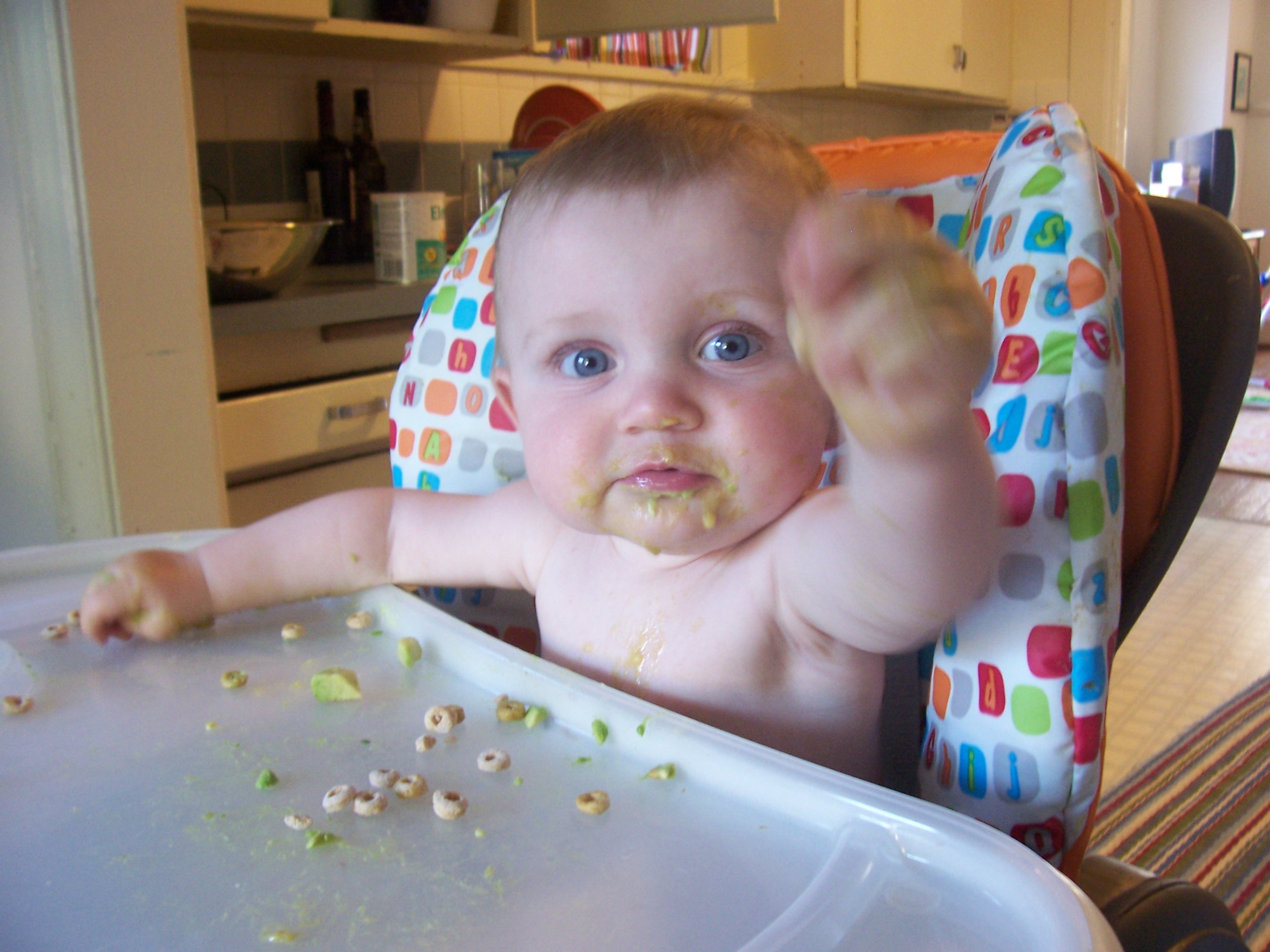
So, as I reported earlier, we visited Seattle Children’s Hospital this week to see Robin, Stella’s wonderful and very wise occupational therapist. We wanted to check in and see how Stella is doing with solids. We were worried because she wasn’t eating as much as a nine-month-old is “supposed to” by now. She had not been showing any aversive behavior, and once in a while she’d chow down on bananas, avocado or toast, but overall, her intake of solids seemed pretty low–maybe 1/4 of a cup for an entire day and a few bites of finger food. And it was taking *forever*.

Well, Robin assured us that Stella was just fine. In fact, Stella has no feeding problems anymore, at all. I knew this deep down, but it was an incredible relief to hear it from our trusted expert.

We realized that the problem was us–not Stella. Robin gave us some very valuable pointers on how to feed Stella more effectively. It turns out that we’d been so afraid to push Stella, based on early battles over breastfeeding and bottle-feeding, that we weren’t offering her enough via spoon. We were way too timid. Stella doesn’t need to be coddled. Ever since our meeting with Robin, we’ve pretty much been “shoveling it in” and Stella has been enjoying 1/4 to 1/2 cup of baby food plus a few bites of finger food at each of her three meals. Just like she is “supposed to.” It’s amazing!

She seems to really enjoy my homemade blueberry puree mixed with a bit of cereal, and that makes me so happy! That said, Stella has a nasty cold, which is making food less appealing to her–especially chunky things like finger foods. She’s thrown up immediately after some of her meals due to coughing fits, but it’s tapering off as the worst of her illness appears to be over. It hasn’t slowed her down too much, but I’m interested to see how eating goes when she feels better.

Stella had been taking enormous bottles, up to nine ounces at a time for a total of 30 ounces of formula a day. Contrast that to the days when when 3 and a half ounces was HUGE! So in the two and a half hours before her first nap, she was getting 400-450 mls (that’s up to 15 ounces in the first couple hours!). No wonder she wasn’t into solids. She was full! As a result, we’re in the midst of a schedule shift. I’m almost embarrassed to admit this, but it’s made me anxious.

We had our old schedule *down.* I knew roughly how much she would eat when, and it created a nice comfort zone–for me as much as Stella. Well, as she grows we need to adjust, and that’s what we are doing now. But a low-level panic infiltrated my day. By fitting in these larger meals of solids, we are messing with the timing and amounts of her bottles. She doesn’t seem hungry enough to take a bottle RIGHT after solids. I don’t know exactly when she’ll get her 24-30 ounces for the day and it makes me nervous. I have to watch for hunger cues more closely. So, I am officially out of the comfort zone, and am figuring out what works and what doesn’t. It’s a bit of a throw back to when Stella had her tube and when we were weaning her. I never really knew when she would want to eat. I just had to pay attention and wait–not my strong suit.

I’m giving myself pep talks, and they are effective.  They sound a little bit like this:

“If I can survive the anxiety of a newborn that won’t eat, pumping around the clock, mastering the use of a god damned supplemental nursing system, navigating the complexity and chaos of hospitals and healthcare, inserting and maintaining an NG tube, getting no more than three hours of sleep at a time for two months, weaning my baby off of the tube and curing her aversion without (completely) losing my mind, I think I can figure out a new feeding schedule. Damn it, I can do just about ANYTHING.

And so can Stella.”

Return trip

It’s not an emergency. Nothing is really “wrong.” But we’re about to head back to our old stomping ground: Seattle Children’s Hospital. We’re going there to see Robin, Stella’s occupational therapist. Stella isn’t warming up to solids the way all the charts and books say she “should” by now, at the ripe old age of nine months, so we’re looking for some reassurance and perhaps a few tips on how and when to best offer food to Stella–without getting pushy. As we learned with the bottle, pushing only makes her want to eat less.

This morning, a vision from the past won’t leave my brain. I’m not sure why. It brings me back to our first appointment with Robin, before Stella got her tube and back when my entire day was consumed with the struggle to feed Stella. That morning, Robin filled me with hope. She watched Stella scream at the prospect of eating, she watched us spend a half an hour battling with Stella to get her to take three ounces. And then she said, “I’m going to see you through this,” and I suddenly felt a lot less helpless. But that’s not the moment that’s been on my mind.

I remember departing the room where we’d met with Robin, and walking down the hall toward the waiting room with Robin at our side.  Coming toward us at a brisk pace was Robin’s next appointment, a new mother accompanied by her own mother and arduously lugging her baby, left hand gripping the handle of the car seat. She walked with her entire body at an angle, as a counterbalance to the weight of the baby and her seat. She swung the seat forward a bit with each step, lurching along. The baby was peaceful but alert, with an NG tube taped to her right cheek. That terrified me at the time–I didn’t want Stella to wind up with a tube. But it was the mom who got me. There was such determination in her face and in her stride.  She was clearly focused on the task at hand, eager to learn more about how to help her baby. Eyes locked on her destination. Moving awkwardly, but forward. I’ll never forget that mom.

We’re off. I’ll let you know what happens.

Behold: Tube weaning research and guidelines

Invigorated by our walk

Back in her tube days.

When is the last time a research paper made you cry? Around the time of Stella’s wean, and since then, I’ve come across information that moved me on many levels. I’d like to pass along these sought-after papers to as many parents (of children and babies with feeding aversions and NG tubes or g-tubes) as possible.

Supremely helpful insights and guidance are offered in the article, “Prevention and treatment of tube dependency in infancy and early childhood.”

Details and analysis can be found in the research paper itself: “Standardized tube weaning in children with long-term feeding-tube dependency: Retrospective analysis of 221 patients.”

Update: Also, from Spectrum Pediatrics in Virginia, check out this pediatric feeding tube weaning case study! This case study breaks down exactly how a well-managed and supported wean takes place.

It is with great excitement that I share with this research on tube weaning. When Stella’s NG tube was placed, I immediately started researching the topic online and only found horror stories. I went into full-on panic mode immediately, because there was no helpful information. No hope. Only desperation and despair.

This is now.

Lean but healthy, and happily eating, just months later.

These resources seemed to illuminate our world, bringing light to what was previously a dark informational void. They completely validated my feelings and my husband’s feelings–our whole struggle, our crazy experiences, our obsession–surrounding Stella’s feeding aversion and tube placement. It’s fair to say that in this case, reading was healing. It’s so helpful to understand how calories are reduced and what a respectful, child-centered wean looks like.

Why are these papers such a big deal? Because so little research on tube weaning exists, and therefore most parents and doctors are really just “winging it.” Yes, some children require tubes for long-term survival and the authors of these papers fully acknowledge this, of course. But many children who are capable of eating on their own, whose core feeding or other issues have been addressed but who remain *unwilling* to eat, are tube-fed for years, which needlessly and often dramatically lowers quality of life and impairs development. There’s a better way, and we need to spread the word.

Children and their parents are sent home from the hospital with feeding tubes in place, but without anything resembling a clear time-frame or plan for tube-feeding, and certainly no plan or support for weaning. Children and families deserve better than that.

I find these two excerpts from the tube weaning article and research to be particularly powerful:

“Tube dependency is a distressing and unintended result of tube feeding in infancy. The condition of tube dependency can be defined as active refusal to eat and drink, lack of will to learn or the inability and lack of motivation to show any kind of precursors of eating development and eating and drinking skills after a period of gastric feeding. It is characterized by overt disinterest, food avoidance and active refusal, gagging, vomiting, oversensitivity, fussiness and other oppositional and aversive behavior. It may influence the quality of life of the affected infants and their families to such a degree that all other troubles fade into insignificance besides the nightmare of a child who will not eat or drink. Nevertheless, tube dependency is not recognized as a problem by many pediatricians.”

“Parents of tube-fed children feel unhappy about their plight. If the duration of tube feeding exceeds the predicted period of time, they will wish to start tube weaning but lack the means to do so. A vicious circle of insecurity and desperation may result. Pressure and adult expectation build up, causing the child to resist any steps towards autonomy. Parents report feelings of anger, guilt and sadness at the sight of other children eating normally. In earlier studies (Lit 42,43) we reported that 86% of parents of tube-fed children suffered from overt depressive symptoms that disappeared after their children had begun to eat normally.”

The following excerpts should give you a quick, high-level view of the study (its purpose and outcome) as covered in the papers:

“Results: 203/221 patients (92%) were completely and sufficiently fed orally after treatment. Tube feeding was discontinued completely within a mean of 8 days, the mean time of treatment was 21.6 days.”

“The rationale for this retrospective study is to specify a successful tube weaning program in infancy. Many children remain tube dependent after successful healing of their underlying disease. Tube dependency often is accepted as ‘unintended side-effect’ of the treatment.”

“The main hypothesis of the study is: specialized treatment is highly effective and allows weaning severely impaired children even when numerous previous attempts had failed. The primary objective was complete weaning from long-term tube feeding based on sufficient, self-regulated oral intake.”

“The most important point of the model is the concept of full oral autonomy of the infant from birth and the implementation of this concept into the daily handling of parents and caregivers dealing with eating disorders, feeding disorders and tube-fed infants. Hunger is the main motivation for the attainment of self-regulated eating behavior.”

“[Tube] Placement must be preceded by clear criteria and a decision as to the indicated nutritional goal and time of use. The placement of a temporary tube must generate a plan covering maintenance issues including time, method and team for weaning. Aspects of tube feeding that go beyond purely medical and nutritional issues need to be considered in order to minimize the frequency and severity of unintended tube dependency in early childhood.”

In Spectrum Pediatrics’ detailed case study, you’ll see many references to honoring and respecting the child and being attentive to the child’s cues. The goal is to allow hunger while minimizing stress, and to create a situation wherein the child chooses to become an eater by mouth:

“The team members utilized intuition and developmental knowledge in order to read the “cues” of the patient to know what the child wanted to eat, as well as with whom and where. All of the eating scenarios were very relaxed and focused on fun and play. The tube weaning program team members were cognizant of ensuring an eating environment that was comfortable and low-anxiety. If the child was ever afraid to eat, the therapists and parents would return to enjoyable play activities. He was able to cope with his post-traumatic feeding disorder and its negative effects through play in the low-stress, enjoyable environment.”

“The patient continued to exhibit changes in his hunger and sleep cycle on the third and fourth day of the tube weaning program. He had difficulties with sleeping based on his new sensations with hunger and self-regulation. The team continued to make the eating situation as comfortable as possible for the patient by “following his lead”. This led to feedings of his most desired foods and in a variety of locations, including outdoors, indoors, on the floor, in the bathtub and in the car. The team also continued to provide water-dense foods, such as melon and cantaloupe, in order to ensure that he was keeping well hydrated. It was evident that he was growing in his familiarity with new sensations, foods, and oral motor skills.”

I hope these resources are as helpful to you as they were to me! Best weaning wishes.

Nine months

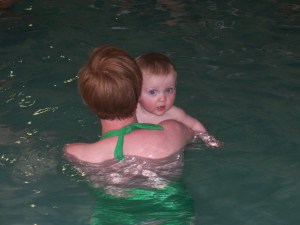
Stella's a little shy in the pool--at first.

Stella's a little shy in the pool--at first.

So, Stella has been outside the womb for just about as long as she was in it. This seems like a big milestone to me and my uterus.

Stells (that’s not a typo–it’s one of our nicknames for her) celebrated her nine-month birthday on Sunday. The occasion was marked with a Waterbabies class (with a stop at Bellevue’s Downtown Park beforehand), and a walk to Gasworks Park. The next day, we went in to Dr. N’s office for her nine-month check-up. Ah, yes. Time for those dreaded percentiles.

Cody and I let out a sigh of relief and our shoulders dropped about six inches upon seeing the number on the scale: 19 pounds, 2 ounces. We knew that if she wound up at 19 pounds or so, she’d be at or above the 50th percentile for weight. I know, I know. It doesn’t even matter. One look at Stella tells you how happy and healthy she is. But we’ve got a nasty, lingering case of feeding aversion/tube-induced PTSD  and are grateful for any extra reassurance.

After the measurements were taken, the doctor came in, shook our hands and started tapping away on his touchscreen. He’d plugged in Stella’s stats in order to show us her growth curves, charted electronically.

“Look at this beautiful curve, ” he said, highlighting the fact that Stella’s weight was right between the 50th and 75th percentiles, just as it had been at her six-month check-up. He continued, with a bit of sing-songy positivity in his voice (which I loved), “And this curve looks great…” We saw that, for length/height, she was in the 75th percentile, just like last time. We were flying high.

Then, pointing to a dot, adrift above the highest percentile curve, he noted, “And this is how smart your baby is.” He was kidding, of course, but her head size was clearly “off the charts,” as they say. Last time, it’d been on the highest curve. Her head circumference has risen by a few percentiles between each check-up apparently. It’s not uncommon, really, and not a concern. Unless it keeps going, of course. In which case learning to walk will be a lot more challenging.

In short, Stella is thriving. Her doctor told us to feed her solids three times a day (I’d limited it to two, fearing that she might not take enough from the bottle otherwise), and to stop tracking how much formula she takes outside of that. He also suggested changing her formula to the normal 20-calorie-per-ounce concentration, which we have done. At one point, in the wake of all this, I stuttered, worriedly, with what I’m sure was a look of concern and confusion, “Um, so, like, h-how much f-formula does she NEED now?” The doctor kindly told us that we’d worried enough, and that we could stop now. Worry had become like air to us. So we are pretty much adapting to life on a new planet.

He also pointed out that, in a way, we are allowing Stella to wean herself off of the Ranitidine by not upping the dose as she grows. It reminded me of the progress she’s made int hese last three months. She’d been on two reflux medications until a couple months ago. We’ve lowered the amount of Simply Thick we put in her bottles, with the goal of soon weaning her off of that, too. She is back to the “normal” caloric density for formula–just like I’d predicted (boldy, it felt at the time) in her early tube-free days.

And that brings me to my point. So often, these days, when I look at Stella’s impossibly beautiful, beaming face, I can’t help but cry. Especially when she laughs. I remember, somewhere in the dark, dark days of December, bawling at most commercials. Our situation and those post-partum hormones were brutal–even bland Sleep Country USA ads opened deep, previously forgotten psychic wounds, apparently. But there was something especially gripping about the “Peace on Earth” spot for Pampers. Those soft, gorgeous baby faces! Those cherubic, chubby cheeks! Yes, those cheeks. Those cheeks, free from evidence of medical intervention. Those perfect baby lips, moving as if the baby is nursing in her dreams. They tormented me. Because to Stella, eating was a nightmare, not a dream, and our view of her angel face was obscured by two kinds of tape and a long yellow tube. Those babies were chubby and sleeping in a sprawled out fashion–not being force-fed while sleeping swaddled and strapped into a giant foam wedge. That commercial just seemed cruel to me at the time.

I go into her room and look at Stella every night before I go to sleep–despite that fact that by doing so I risk letting our super creaky floor wake her up. I have to do it. How could I miss out on the most beautiful sight imaginable? It is a triumph, a joy and a reminder to be grateful. I just watched the Pampers commercial again. And I have to say, Stella would fit right in with that bunch of sleeping angels–those arrogant bastards.

Yes, that’s a toothbrush next to the can opener.

This is not staged. It’s an actual mess that accumulated on our counter one evening last week.

How did this happen?

How did this happen?

Here is a list of all the things that do not belong here:

  1. Three wine bottles
  2. Half of an avocado
  3. Dirty bib
  4. Grater
  5. Onion, avocado and mushroom scraps
  6. Notebook
  7. Can opener
  8. Electric toothbrush
  9. Toothbrush charger
  10. Measuring spoon
  11. Bag of Simply Thick packets
  12. Empty tupperware
  13. Steak knife
  14. Drinking glass
  15. Baby washcloth
  16. Chocolate bar wrapper
  17. Rolling pin
  18. Wine bottle stopper
  19. Dirty paper towel
  20. Cheese rind

The impressively diverse clutter gives the impression that we were bathing and feeding Stella, cooking a Mexican feast, drinking heavily, baking brownies, brushing our teeth and taking notes at the same time. But no. This is not the result of intense multi-tasking. It’s the product of a Facebook addiction, tiredness from staying up very late to do some freelance writing, and chasing Stella around the house as she crawls from one room, cupboard or table to the next. I rest my case.