Stella’s weighty two-year check-up.

So Stella had her two-year check-up today. She received two shots, a delicious wooden tongue depressor, fabulous height and weight percentiles, and a small bit of forgivable misinformation. I’m not sure how I will broach the latter with the doctor, but I plan to do that soon.

To kick things off, he asked about Stella’s vision. I explained the high-level details about her glasses prescription, patching, and the plan to do vision therapy in order to get her eyes to work together. He nodded, remarked that his brother had ambylopia, and said that we’ll probably have to patch (and do vision therapy, I suppose) intensively for “a long time.” He said that the pressure is on and at the same time the road long because it’s an eight-year process. After age 8, he explained, there’s nothing you can do for the weak eye because the brain shuts down the associated neurons. Yet I just read in the extremely well-researched Fixing My Gaze that this is actually not the case for most “strabismics.” The idea of a critical early window for correction of ambylopia and other strabismus-related vision issues has been shot down by Dr. Susan Barry (author of Fixing My Gaze) and other experts. Don’t get me wrong–I’m not flipping out about this contrasting bit of medical advice. I know that treating eye issues early is an excellent idea that improves outcomes. I’m not at all upset with the well-meaning doctor but I want to offer him relevant resources so that he may better  guide and give hope to other patients.

Anyway… here are the numbers:

Stella weighs 27 pounds, which puts her between the 50th and 75th percentiles.

She’s 36 inches tall, which lands her at the 95th percentile.

I know it’s completely batshit insane, but both Cody and I got totally verklempt when we heard these numbers. I know. I know. They don’t even really matter. I know. And I also know you’re thinking, “Why? Why on earth would we still have such a reaction? What is WRONG with you people?”

Sigh. Actually, we’ve discovered a new diagnosis in our family and I will touch on that in a future post. It explains so much. But for now, I’ll expound upon our insanity regarding Stella’s weight. Worry lingered because many openly note how lean Stella is, and those comments can really come across the wrong way and reinforce old fears. Because sometimes she’s too busy to eat and we see that through a filter of our distant tube-feeding past rather than viewing it as the normal toddler behavior it is. Because she just went on a long trip to the east coast, started wearing an eye patch, had two pesky gastrointestinal bugs in the past four weeks, and has been known to throw eating pretty much out the window in the face of disruptions. Because despite our intellectual understanding that she has long been healthy and happily eating to fuel perfectly Stella-appropriate growth, we remained a little too vigilant.

To his immense credit, the doctor must have understood the essence of all this. He paused to celebrate her growth, acknowledged all we’d been through when she was an adorable but feeding-averse baby, and then he smiled at me and said, “It’s over.” Those words hit me like a truck. This is a new era. She’s two. She is three freaking feet tall! And she’s fine. Glasses, eye patch, temper, and all. I feel it in my bones now. Worry doesn’t ever go away when you’re a parent, but right now, for the first time perhaps since Stella was born, I know she is okay. We are okay. It’s all okay.

I get it. For real this time. Pinky swear!

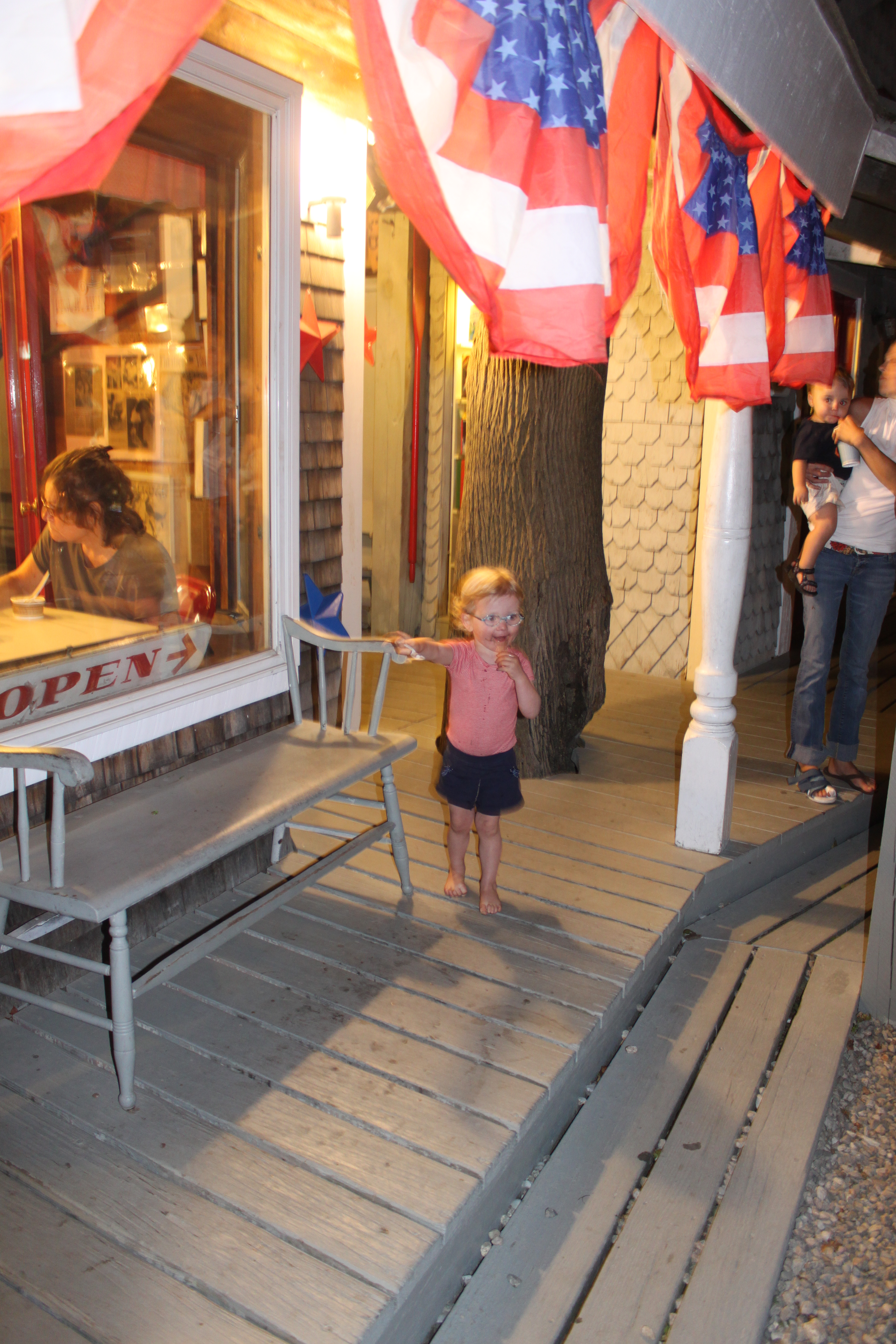
Stella at FarFar's in Duxbury

Stella ate her weight (27 pounds) in deliciously high-butterfat ice cream at FarFar's Danish Ice Cream Shop in Duxbury, MA.

More on the risks of NG tubes

A couple of things to share for now: A message I sent in an effort to get support for Stella’s wean, and an AAP study.

Below is the actual text of an email, including excerpts from research that I paid for, that I sent to Stella’s pediatrician and OT on January 4, 2009. The next day, they called to say that a two-week “trial” without the tube would be low risk and to go ahead with it. She never looked back and began eating large amounts at about the three-week mark. She would even have days in which she consumed 1,000 mls of 24-calorie-per-ounce formula. She was about four months old at the time, and before weaning had progressed to taking in 40-50% of her formula orally. But it was stuck there, and feeding her was still quite difficult. I simply don’t know how long tube feeding would’ve persisted otherwise. I’m thankful I was truly heard and that Stella was supported in learning to eat completely on her own.

***

Dear Tom and Robin,

Stella’s eating is regressing. The core issues seem to be reflux and difficulty swallowing. I strongly believe that the tube is worsening both of these, and that much longer use of the tube will cause more damage than benefit. Stella did not have this type of difficulty swallowing before the tube, I know that for sure. Her swallowing has gotten progressively worse over the last couple of months, during which time the tube has gone in and out many times. Her reflux is also still a problem and I strongly suspect that the tube is part of that. I found research which supports my intuition. See below. The cited papers are also attached.

*

From paper entitled, “Infants with swallowing problems” by Helen Cockerill, from Pediatrics and Child Health 18:12 (2008):

“The presence of a nasogastric tube may provide negative stimulation and impact on respiratory support for oral feeding. Long-term use has been associated with the development of later feeding aversion.”

From paper entitled, “Effects of Nasogastric Tubes on the Young, Normal Swallowing Mechanism” by Phillipa Sarah Huggins, MSc, Seppo Kalervo Tuomi, PhD and Christopher Young, MBBS, FRCS, FFRad(D)(SA), from Dysphagia 14:157–161 (1999):

“However, there are several disadvantages to nasogastric feeding, including nasal ulceration, laryngeal injury, and pharyngeal discomfort [5]. Nasogastric tubes may also precipitate gastroesophageal reflux, which can lead to aspiration [6]. Nasogastric tubes are frequently self-extubated, especially in elderly or restless patients. Reintubation is labor intensive and distressing for the patient [4].”

“Nasogastric tubes slow swallowing in young normal adults.” (My own thought on this: It seems logical that if it affects adults this way, babies would be as affected if not more so. Slowing of swallowing seems to be exactly what is happening to Stella–she is clearly uncomfortable swallowing now in many of her feeds.)

“Sensory accommodation to the tube may counteract the earlier pharyngeal response triggering seen in this study, whereas prolonged accommodation of the tube may delay triggering of the pharyngeal swallow. This may hinder recovery of normal swallowing patterns in people with swallowing impairments and increase the likelihood of aspiration.”

*

We are doing all we can to put weight on Stella to put us in a better position to go without the tube to see how she does. Are there any alternatives to the tube? Can we try cup feeding? Can we explore any other avenues (not including a G-tube which is not a route we are willing to go)? I believe that we treated her initial problems but that new problems may have arisen DUE in large part to the tube. Thank you for hearing me out and helping us resolve Stella’s feeding issue. You both have been so helpful.

I would like your honest thoughts on Stella’s progress (or lack thereof) and prognosis. We are very scared and want to know what we are up against. It’s starting to feel hopeless. We are doing out best to keep hope alive, but are desperate to seek out other ways of treating her.

Thank you,
Amber

***

This NG tube study, published in PEDIATRICS (The Official Journal of the American Academy of Pediatrics), is very telling, regarding of the distress caused by NG tubes. Some of the wording and terms used in assessing the pain are haunting: “Does Nebulized Lidocaine Reduce the Pain and Distress of Nasogastric Tube Insertion in Young Children? A Randomized, Double-Blind, Placebo-Controlled Trial.”

Stella is two.

Stella is two. She wishes she lived at the beach.

Stella is two. She wishes she lived at the beach.

Stella turned two years old last week, during our beach vacation. She’s still singing happy birthday to herself, talking about birthday cake, and reminiscing about blowing out candles and good times with her “Happy Birthday balloon with smiley faces.” The balloon was accidentally released into the sky, but the sight of it drifting to ever more impossible heights pleased everyone, including Stella, and somehow seemed appropriate and celebratory. I know what you’re thinking. “How nice!” and “Hopefully no sea animals were killed by the balloon remnants.”

So Stella’s two now. All of sudden, she talks in complete sentences, giving crucial information, and answering questions. (Yeah, she shouts commands, but mastered that long ago. I guess they’re just more specific now.) Though she can string words together like a champ, it’s the short one-liners I enjoy most. Must be the advertising copywriter in me. Some examples of dialogue:

Me, in response to her crying: “What’s wrong?”
Stella: “My belly hurts! And my knee.”

or

Me: “Where are your glasses?”
Stella (walks over to the table, where her specs sit): “Right there!”

or

Stella: “I’m running! I’m running down the street!”
Me: “Yes you are running! Running down the street!”

or

Stella (returning to room after leaving for 5 seconds): “I’m BACK!”

Now that Stella is two, she treats her glasses with more care. She usually takes them off with two hands and carefully folds them before handing them to me. We switched to using magic tape over her right lens, instead of a solid patch, at her ophthalmologist’s suggestion. That’s made patching harder, I think because her right eye is still getting input but it’s really bad input, instead of being totally blocked out. But overall, she’s patching like a champ. When she peeks over the top of the glasses, I say “No peeking,” and that usually stops it at least for a little while. I use screen time as the “patch game”… so if she peeks while watching say, “Here Comes Science” DVD, I say “No peeking,” and if she peeks again, I turn off the TV and say, “You’re peeking so the patch game is over.” It works pretty well! Stella’s doctor was very helpful in coming up with strategies like these.

Stella really likes to nap. She asks to nap often. I’ve heard patching causes strain that can make kids cranky and tired. Plus, we went on a long vacation that involved a three-hour time change. In any case, this kid knows when she’s tired, and I totally appreciate that.

Her raw/giant-carrot-chomping phase seems to have waned, but Stella is now eating lemons like they’re apples, waxy rind and all. Her current favorite foods are: chocolate ice cream, mac and cheese, vanilla ice cream, extra cheesy mac and cheese, sliced almonds, peaches, cheese in any form, ice cream, cottage cheese, bagels, and carrots. And ice cream and mac and cheese. We are so alike in some ways.

We gave her a really cute wooden play kitchen center thingee for her birthday. She loves it–washing dishes and putting lids on pots, turning stove knobs, and removing the faucet. I’ve been letting her play with dried beans and bowls and my large kitchen utensils for a while. She’s really kicking things up a notch now and pretending to cook. Though she hasn’t made anything but mac and cheese yet, I expect her to branch out soon, menu-wise.

Stella is completely, 110% obsessed with the aforementioned “Here Comes Science” DVD featuring music videos for science-centric songs by They Might Be Giants (TMBG). Against my idealistic intentions, I let her watch it every day, because it’s an effective way of launching the “eye patch game” (the game? wearing her patch). During vacation, she watched it two or three times a day. She watched more TV that week than the rest of her life combined. She was teething, jet-lagged, patching, and got a fever and gastro bug, so I just let her go nuts with it (though at times I really did just have to start cutting her off). It was all worth it because now I get to hear appropriately bespectacled Stella belt out scientific yet catchy gems such as:

“ROY G. BIV is a colorful man!”

“STEEEEEAM is a GAS!”

“Meet the elemeeeeeents!”

She is fiery and fabulous and has me by the balls. She’s sweet and strong and fast as lightening. She’s a ruthless tyrant and cuddly snuggler. A monkey and a mastermind. She’ll read book after book after book until the cows come home, then happily “moo” right along with them. I may be diagnosed with severe OCD for admitting this, but I say, mostly in my head but sometimes out loud, at least hundred times a day in the exact same way, “I sure do love my Stelly girl.” I really, really, really do.

***

For your enjoyment, in celebration of Stella’s 2nd birthday, here are the “music videos” (do they still call them that?) corresponding with the lyrics above:

ROY G. BIV

MEET THE ELEMENTS

SOLID LIQUID GAS

I’ll post a birthday pic

If you have a daughter, you’ll understand

Scares the living crap out of me: Fashion bras for four-year-olds. With defined cups. And no straps. (Video from Jessica Gottlieb.)

Gives me such hope: Chelsea Baker, a 13-year old Little League 65-mph pitcher. With a freaking knuckle ball. And stylish GLASSES.

P.S. According to ABC News’ “Person of the Week” story, Chelsea’s mom entered her into all kinds of pageants early on. “But Chelsea didn’t want to wear diamonds, she wanted to rule them.”

Free webinar by Susan Barry: How the system lets down children with vision problems

Here we go again. Like tube feeding, vision is an area in which children aren’t getting the care and solutions they need and deserve. Stella just started patching, because her brain was starting to favor her right (strong) eye. And it’s already become clear (fun with puns!) that without extra effort and research on my part, her outcome, even though we are patching as directed, would be far less than optimal. Thankfully, I have the time and ability and insurance coverage to make it all happen. But I keep wondering, what about the many parents of children with vision and feeding tubes and other health issues who don’t?

Luckily for us anyway, three recent and perfectly timed events have made me feel that I’m on the right track in terms of how to approach Stella’s treatment…

1.) We recently chose a new eye doctor for Stella (our third opinion became our number one choice!) who emphasizes vision therapy in treating eye issues like Stella’s (conditions like strabismus, accommodative esotropia, ambylopia, etc. etc.). She was vastly superior to the others in terms of her attentiveness to Stella as a human being, her ability to do vision therapy with the very young (our second opinion did vision therapy, but said Stella wouldn’t be eligible for years), and her support and tips on how to patch successfully. Seattle Children’s Hospital? They just handed me some adhesive patches to stick on Stella’s almost-two-year-old eyes, with almost no explanation or and certainly no acknowledgement of how big a deal it was, noting only that patching is “not that bad.” Bullshit.

2.) I’m currently reading a ray of hope in paperback form, Fixing My Gaze by neuroscientist Susan Barry. She couldn’t see in 3D until her late 40’s (she had strabismus from early on, like Stella). The ability to see in three dimensions affects life in a myriad of ways, including the abilities to read, drive and play most sports. The book is as much about neuroplasticity as it is about vision, and I have found most of it fascinating (some of it a bit dense and technical and hard to follow). It has opened my eyes (the puns are too easy to resist here, sorry) in so many ways.

3.) Yesterday, I received an email from Stella’s new eye doctor telling me (and all her patients) about a free webinar being given by Barry, author of Fixing My Gaze, on Thursday. I was thrilled! The email, besides letting me in on a great opportunity to learn from a true knowledge leader in the field, confirmed that we’d found one of the rare doctors who can help Stella achieve her own personal best in terms of vision.

The meeting’s name pretty much says it all: “School Crossings: A Neurobiologist’s View of How Our System Fails Children With Vision Problems.” I was so thrilled to find out about this, and again, to get assurance that we’d found a wonderful doctor for Stella. One of the rare few who are truly informed about vision therapy, the kind that helped Barry see the world in full, volumous beauty.

I have only a basic understanding at this point, though it’s growing all the time. But most opthalmologists (including the one we saw at Seattle Children’s) and optometrists seem to heavily rely on patching (often alone) to address situations where the brain is favoring one eye, as is beginning to happen with Stella. When the vision imbalance is left untreated, blindness in the weak eye is likely. However, patching is not a real solution or adequate treatment for many, as upon completion of occlusion, the brain slowly reverts to favoring the same eye. Both eyes are strong after months or years of patching, or have equalized (sometimes the strong eye deteriorates due its suppression) but the brain has not learned to use the eyes together. Vision therapy is needed to get the formerly weak  (“lazy” or ambylopic) eye to coordinate with the  strong eye and create a complete, stereopic view of the world. Proper therapy often results in a long-term cure, enabling 3D vision and other vast improvements. So many children are having to settle for significant, even quality-of-life-reducing vision impairment when in fact, they could see major improvement or perhaps complete resolution of their issues.

Many doctors still believe that there is a small window in early childhood during which eye problems must be addressed, lest be rendered irreversible. Barry’s research and personal experience shatter this falsehood. For the benefit of children like Stella, Barry is shouting her discoveries from the mountaintop, and I am extremely grateful. On the other hand, as we recently embarked on the patching journey, which I was not expecting at all–I was truly blindsided (ugh, another pun?), the book has scared me and made me cry. It’s made me realize the full scope of how Stella’s vision and life experience could be impacted if she is not properly supported. Seriously, I’ve been listening to Celine Dion’s “That’s the Way It Is” and bawling, about once a day. And I’m not a Celine Dion type of person. I’m a Neko Case fanatic. But, “it’s an uphill climb and I’m feeling sorry, but I know it will come to you, yeah” kind of hits the nail on the proverbial, three-dimensional head. I’m working hard and it feels like, once again, there’s a lot on the line and if I don’t stay vigilant and question everything every doctor tells me, Stella will suffer.

Anywho, I’ve signed up for the webinar and encourage other parents of children facing visual challenges to do the same! Virtual “seating” is limited. I will blog about the talk here, in case you miss it. The details, from the original email announcement from the College of Optometrists in Vision Development (COVD):

School Crossings: A Neurobiologist’s View of How Our System Fails Children With Vision Problems
 
Hear Dr. Susan Barry answer questions about difficult school experiences that resulted from her vision problems; how, for example, she was mislabeled as a low aptitude student and assigned to a special problems class, and what her mother did to help her child succeed. And more….. including what you can do to help your child succeed!

TO REGISTER FOR THE MEETING:  Go to www.joinawebinar.com, fill in the meeting ID number 547-423-251 and your email address, click on “CONTINUE,” then fill out the brief form that comes up next and at the bottom of that screen be sure to click on “REGISTER.” 
If you have ANY difficulty registering or any problems during the webinar, contact TECH support for gotowebinar.com at 800-263-6317.

Click here to read the full press release, including more information about Susan Barry (aka “Stereo Sue”).

Taking a stand against tube-feeding crimes and negligence

Someone needs to say it: tube-fed children and their families are being neglected and often outright abused by a dehumanizing, misguided health “care” system.

If you don’t believe me, read on. Or at the very least, get a glimpse of a far superior alternative by viewing this tube weaning lecture delivered at Seattle Children’s Hospital by weaning expert Markus Wilken, during his visit from Germany. This video is an invaluable resource, which I highly endorse, as you’ll see at the closing of this overdue rant.

Our tube feeding days are far behind us, yet memories haunt us. Like the time I inserted Stella’s nasogatric (NG) tube into her nose, only to have it come out her mouth, instead of going down to the base of her esophagus as planned. Of waking up every two hours to feed her at night, fumbling in the dark with a stethoscope and large plastic syringe in order to confirm correct placement of the tube before setting up the pump to run for 45 minutes–desperately trying to stay awake while it ran, so as to be able to respond in the event of a pump malfunction or choking incident. The blood that, after the first month of tube feeding, consistently encrusted the tube in her tiny nostril. And, in soul-crushing fashion, the bottles of outrageously expensive Elecare, not covered by insurance, that Stella triumphantly downed on occasion, only to re-emerge in projectile fashion thanks to tube-triggered gagging.

Crazily enough, none of these incidents were the turning point for me. None of them woke me up to the immediate need for the tube’s removal. Though I did often wonder how long this would go on, as there was no plan for weaning. I was doing what I was told because it was supposedly medically and therapeutically necessary. I have another mother to thank for my awakening–a mother who didn’t see such a need and whose child paid a huge price.

Back when Stella’s little baby face was accessorized by medical tape securing a thin but lengthy yellow NG tube, we made one of many trips to Seattle Children’s Hospital. This time for an abdominal ultrasound. In the waiting room, two women struck up conversations with me about, what else, Stella’s tube. “She looks so healthy,” said one, whose child also had feeding issues and was headed toward a tube. Then she asked the inevitable question: “Why does she have a tube?” I explained, and we commiserated about the misery of trying to feed a child who simply does not want to eat. The other, with empty eyes and a tired smile for Stella, commented along the lines of, “My son had an NG tube until he was five. Good luck. She looks great. I hope you get her off of it.” Suddenly, my stomach felt as though it were full of rocks. In that moment, I sank to a very dark place. But while down there, I resolved to never, ever let that happen to Stella. I decided to fight.

So, just to make this astounding fact clear, I’ll repeat it: I met a woman whose son lived with a nasogastric feeding tube until he was five years old. Five years of a thick tube through his nose (no doubt causing nasal ulceration), his esophagus irritated, the sphincters held open (encouraging reflux), food administered on some dietian’s strict schedule and chart regardless of what he thought or felt. It’s a perfect illustration of why I’m so angry. Really, really angry. I have been for a while.

I’m outraged at the treatment that many tube-fed children and babies are receiving from doctors and therapists. G tubes, the next step after NG tubes (if eating does not progress) and a much kinder solution in cases of long-term feeding, are not without problems. They require surgery, which when not done properly can cause extreme suffering and even when correctly inserted can contribute to excessive vomiting. I believe that there are many children with G tubes that do not actually need them, and that if physically able but still unwilling to eat, they should be given a chance to wean before surgery is considered. At the very least,  thoughtful, individualized approach should be taken by an interdisciplinary team of doctors, as opposed to the reckless, disorganized decision-making that is now widespread.

Based on my experience with Stella, I’m particularly concerned about those with long-term NG tubes, tubes meant only for short-term use. It’s not okay. Scientific evidence (which I will present in a later post) and common sense tell us that NG tubes cause extreme discomfort and difficulty (slowing of) swallowing. The frequent removal and reinsertion of this tube is traumatic and damaging for child and parent. No matter what kind of tube is used, a complete disconnect with hunger and extinguishing of the desire to eat is practically inevitable. The tube itself fuels eating refusal and aversion, long after the initial issues prompting the tube’s insertion have been addressed. (This is very different from children for whom tube weaning is not an option at all and long-term tube feeding a clear life-saver.) Families are plunged into despair, their lives shrunk down by the oppression of tube feeding (though, sadly, this comes to feel normal for many families), the incessant vomiting, the stunted growth that the tube was supposed to prevent, and the hopelessness that arises due an absence of a weaning plan. Or any plan for that matter. For most of these children, there is no way out. This is, with no exaggeration, a crime.

And then there is the so-called “therapy” provided to these children. When I hear stories of children being force fed, and there are a lot of them, I literally become sick to my stomach. It’s wrong. It’s a disgrace. Yet it’s happening at leading clinics and children’s hospitals across the country. One of the barbaric techniques used: Puree is shoved aggressively into toddlers’ unwilling mouths, which are then held shut for as long as it takes. As long as it takes for them to swallow–and it can take a very long time to swallow when you are terrified of food. What horror! Stella’s occupational therapist noted that some “graduates” of such programs later have to be desensitized after enduring such trauma, the process of learning to enjoy rather than fear food begins again but on even shakier ground. How can a brute-force approach possibly help a scared child discover the joy of eating? It can’t. If the child does eat, it’s not because they want to. It’s because they have no choice and no other way to make the torment stop. The children are sometimes called “obstinate” by therapists and parents who buy into the crazy, unbelievably misguided belief that kids are refusing to eat because they are, essentially, being manipulative little jerks. The children are blamed, their trauma and autonomy completely disregarded. Parents are pitted against children, forced to play coercive games. This is absolute insanity.

There are far better ways to wean children from tubes, to awaken their appetites, hearts, and minds. These methods are infinitely more effective and humane. They are based on respect and compassion, which every child needs and deserves! Beyond that, every child for whom it is safe (mainly, the many tube-fed kids whose initial issues are resolved) deserves to be given a chance to eat. For many families, weaning is never even discussed! Because the child is not eating orally. But why would they? Why would they suddenly enjoy eating when every three hours, formula is pumped directly into their stomach, sometimes only to come back up again due to nausea and rampant overfeeding? When Stella had her tube, our pediatrician said she’d just “turn it around.” As if by magic. That was never, ever going to happen.

I’ve been perusing blogs and boards of parents with tube-fed children and my goal has been to offer support whenever I think my experience with Stella could be relevant. It feels good to provide support and resources, to help bring about positive change based on such a negative experience. But I’m not sure I can do it anymore. There are too many heartbreaking stories of renowned hospitals directing parents to disregard their instincts and squash the dignity of their child. It’s overwhelming. I’ll start to type a reply to certain posts, ones that reveal that a child is being forced to eat in some fashion, only to delete it, because my thoughts are all over the place. My words too angry.  I wonder where to begin. How can I convince someone that the entire medical establishment is harming their child on a root level, rather than helping? There is too much ground to cover, too much fundamental education and changing of minds to do–more than can be conveyed in a comment box. I’m at a loss.

I have such compassion for the parents, yet feel such angst when I see the failure to question the clearly ineffective and detrimental status quo. You have to stand up for your child. No one else will. You have to call bullshit on doctors’ cavalier attitudes toward tube feeding, not to mention their lack of actual knowledge on the subject. You have to challenge therapists whose tactics perpetuate the feeding battle, rather than bringing it to a peaceful end.

But I know. I know these parents are ground down by the stress, loneliness, and sorrow that comes with not being able to nourish your own child—the nightmare that is tube feeding. I know from my own experience that some parents become so desperate that they no longer trust themselves and find themselves willing to follow whatever directions they’re given, perpetuating their own hell, despite the nagging voice inside that tells them it’s all wrong. Or who are tossed back and forth from one expert “opinion” to another, with no one ever offering a real plan for moving towards normalcy and health. Parents are victims of unnecessarily extended tube feeding as well, and the failure to recognize the deep trauma of both parent and child, and how it contributes to disordered feeding, is another gaping hole in the “care” received.

I have by now heard about, and even helped in some small way through this blog to bring about, dozens of successful tube weans. I know some children require tubes for survival. But many others are simply trapped with no visible exit. In particular, I am intimately familiar with three tube weaning success stories: that of my daughter Stella, and those of Zander and Heath, the children of women who have become dear friends. These amazing triumphs were achieved thanks to parental intuition, constant and fearless questioning, and plain old ignoring of bad medical advice, plus exhaustive research and the shaken but intact inner belief that if given a chance, “my child can eat.” These weans required a lot of belief and trust in the child, not the doctors. They required a process of “letting go.” This is hard to do, not only for parents, but for a broken health care system that insists on monitoring and controlling every milliliter pumped through the tube, in order to cover its ass, all while ignoring the impact on quality of life.

Thankfully, there is an alternative, explored in the video below. Upon viewing it, I cried. They weren’t happy tears in response to the wonderful, validating, rare, evidence-based wisdom on tube weaning that the video unveils. I bawled because the speaker, a child psychologist and tube weaning expert from Germany, describes a higher, enlightened quality of care given to children in his country—a standard and mentality that simply does not exist here. Unexpectedly, I was overwhelmed with grief. By and large, Stella did not receive the respectful, mindful, effective and individual care that she deserved. And thousands of children are needlessly suffering right now.

If you’re angry too, looking for a way out of tube feeding, or want to follow your desire to treat your child with more compassion during their feeding journey, please grab a cup of coffee and watch this eye-opening, heartening lecture given by child psychologist Markus Wilken. He has past, direct experience with the Graz method, which he’s incorporated into ongoing weaning and tube management work in hospitals and clinics in Germany. Astoundingly, Markus has successfully weaned a diverse set of over 400 children. Perhaps, within his presentation, you’ll find the encouragement you need to believe in yourself and your child. To live a tube-free life! You can do it. Your child can do it. It’s time to fight.

********************

Here’s the link (some find that removing the “mms” prefix is necessary for successful viewing):

mms://seattlechildrens.wm.internapcdn.net/seattlechildrens_vitalstream_com/Rehab_5-27-10.wmv
Back into battle! I think I’ll call it “Operation Shark Patch.”

I’m not even going to pretend to be positive right now. I’ll get there. But not yet. Because I’ve just been asked to do the equivalent of putting mascara on a shark. For hours each day.

Yesterday we found out that Stella is starting to favor her right eye–her left eye is just ever so slightly starting to be tuned out by the brain. So we have to patch Stella’s right eye for three to four hours daily, to force her slacker eye to work harder and get tuned back in. My first, very gentle attempts at encouraging patch use reminded me of the horrors of inserting Stella’s NG tube into her nose when she was three months old. The screaming and utter rage and fear and defiance. She will not let me stick that thing to her face–not even if it’s pink and red with music notes and hearts on it. No. Way. So I’m taking a step back and re-grouping. Ordering books about patching and pirates. Buying her a pirate costume and a DVD featuring a cast of patched puppets. Ordering five different types of patches–namely, a pirate-style patch, two styles of cloth patches that go over the glasses, and two styles of cloth patches that go under the glasses. Anything but adhesive on Stella’s skin. Seriously, F THAT. Been there, done that, and have pictures of redness and irritation to prove it. I’m not even going to TRY to patch Stella again until my patch propaganda has been absorbed, and the non-sticky patches are in hand.

Yeah. So I’m just going to go ahead and say that this blows. I was blindsided by this news in yesterday’s follow-up appointment at Seattle Children’s ophthalmology. I didn’t think this was on the horizon for Stella. Yes, a military metaphor is probably wildly inappropriate in this situation but I can’t help it: I thought we’d won the war. I had a “MISSION ACCOMPLISHED” banner hanging in our living room. Through much “strategerizing”, focus, effort, and expenditures, we got her to wear her glasses! Her eyes stopped crossing! But holy crap there is a huge battle is ahead. Could it be our toughest yet? Doesn’t matter. We have no choice! To save Stella’s vision, particularly that of her weaker left eye, we must patch her strong eye. No effing way am I going to let her eyesight and quality of life go downhill. Not when there is something I can do about it! Even if it’s as insane and seemingly impossible as putting an eye patch on the eye of a small tornado.

Guess I better set my ring tone to “Eye of the Tiger,” smear on some war paint, and do some push-ups and wind-sprints and shit. Oh wait–this is the new type of war. Where brute force is obsolete. I must infiltrate the mind and culture of my target (check! i.e. puppet DVD, books, pirate garb) and win her heart. Again. Possibly with chocolate and a new play kitchen. War really is expensive and good for the economy.

May God have mercy on our souls.

Finally, a set of wheels!

Stella's new wheelsMy sisters and I had a shiny purple tricycle that became a neighborhood legend. Everybody wanted to ride it. But if Danny, a baseball-obsessed boy who lived a few houses away, ever took it out of our driveway and into the street, I’d become irrationally nervous about the potential for damage or theft. It was totally classic in build yet had a unique violet hue and metallic sheen that gave it some edge. It looked and handled better than my first car, a 1979 Pinto with ironic racing stripes. (Side note: I graduated from high school in 1995.)

While strolling and devouring a Flipside pie this morning, during which time Cody and Stella were off on grand adventures to both Gymboree and the zoo, I spotted a little beauty on the sidewalk outside the consignment store down the street. Made in Germany by Kettler, with a price ($60)  I couldn’t refuse, it seemed very sturdy and well made–destined for Stella’s fast and often furious feet. Cody and I had previously browsed new Kettlers at the toy store around the corner, where they sell for around $200. There is one big advantage of the newer models: as a parent, you can lock the pedals and navigate the stroller yourself (for faster, stroller-like transportation) thanks to a push bar attached to the back of the bike that now comes standard. I could buy a push bar separately (Kettler offers this and many other accessories) and attach it, but the pedals won’t lock, so I’m not sure that would work so well. As a result of this realization, I felt a touch of buyer’s remorse.

But then I remembered our fantastic old-school trike which we managed to navigate ourselves just fine. I never once though, “Gee, I wish I could just sit back and let mom take over. I hate being in control.” So I figure this one should work out just fine for Stella. She loved it immediately and can even use the pedals to a limited degree. Clearly this is another three-wheeled legend in the making!

Proud of my veggie rebel

One of the many reasons to shop at PCC (Natural Markets), besides tons of carefully selected fresh, local organic produce? Their Kid Fruit Program, described on their website as “Free fruit for kids! Kids ages 12 and under can choose a free serving of a fruit or vegetable to eat while their parents shop. Kids are occupied with eating a delicious snack and parents feel good about establishing healthy eating habits.” Brilliant, I know.

Earlier this week, Stella and I ventured to PCC for what has become a weekly ritual: Slightly-less-angst-ridden-than-before grocery shopping followed by a walk to the “chocolate store” (Theo Chocolate‘s showroom and factory, just down the block and around the corner from PCC in Fremont, where free chocolate samples are abundant and the atmosphere is welcoming) then a walk back to our car along a portion of the Burke Gilman Trail that abuts the canal. After some Hazelnut Crunch and Coconut Curry milk chocolate bites, we wander and wave to friendly boat captains, watch the boats’ wakes ripple out and tumble and splash against the rocks at our feet, and occasionally spot fish taking breaks in the nooks and crannies along the edge. Also, and this is less quaint, I have to physically restrain Stella from launching herself into the water and divert tantrums by pointing to birds.

During this last trip, we meandered through PCC’s produce section as usual, in terribly inefficient fashion because neither my list nor my head are remotely organized. Well, Stella’s mental/verbal tractor beam locked in on the carrots. So I handed one of the massive, bright, slightly dirty spears to her, expecting her to wave it around like a wand or imitate a bunny rabbit as she’s known to do. I figured I’d slice it up and saute it for her later. But no. She proceeded to vigorously munch on that carrot throughout our time in the store (which meant she also sat contentedly in the seat of the shopping cart–unheard of! Thank you, brilliant PCC!), and all the way to the chocolate factory. On our way out, a cashier remarked, referring to the Kid Fruit program, “How cool to see a kid pick a vegetable instead of a fruit!” Stella finished at least half of the entire large carrot, Bugs-Bunny style, and her chin took on an orange hue. I so wish I’d captured that moment on film–my little twenty-three-month-old walking down the street in her chic blue glasses, with tiny pig tails in her hair and a giant carrot in hand.

Mind you, this  is the girl who, after a day of fun at a birthday party a couple of months ago, during which she only ate crackers, cookies, and cake, came home and demanded broccoli. I quickly steamed some and she devoured an entire bowl of the green stuff. This is also the girl who, upon spying a fresh white bag or box from Trophy Cupcakes in the grip of a passerby, recognizes the logo and goes absolutely bonkers, breathlessly demanding “birthday cupcakes!” Her “intake” fluctuates, like most toddlers, but this girl loves to eat.

Stella’s feeding issues are so far behind us, I can barely see them in my proverbial rear-view mirror. But, when I saw her eating that carrot, I was lifted up. I remembered and I realized. We are such a long way from hypoallergenic formula through an NG tube. So close to two years old. Beyond lucky.