Eye on Stella: Strabismus Watch 2010 Continues
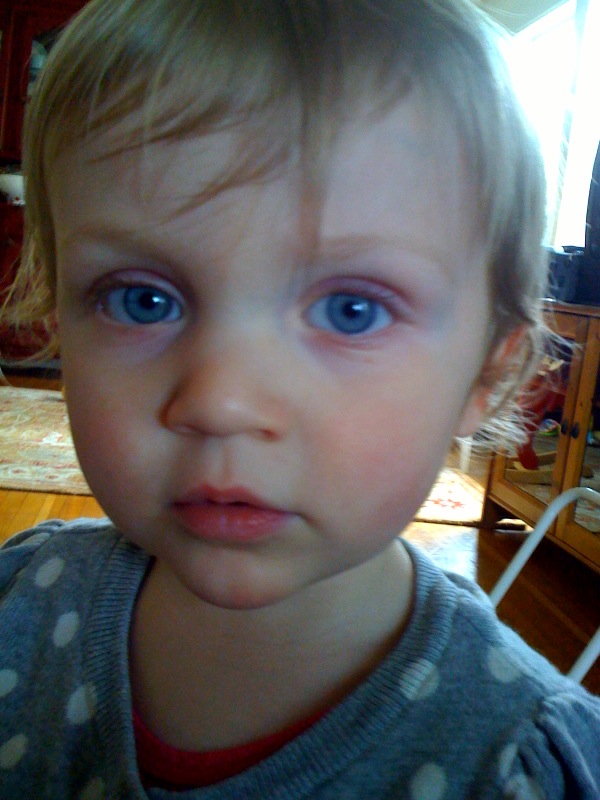
They say that the eyes are the window to the soul and that the face is the soul of the body. Crap, now I'm confused. Anyway, if Stella gets glasses, they will just magnify the power of her soul, highlight her beautiful eyes, and possibly, shoot lasers to fend off bullies.

I’ve been hearing that many are concerned about Stella and wondering what’s up with her big blue eyes. To be honest, I keep sitting down to write about it, only to bail out and head directly to gossip blogs or pediatric eye health websites. The latter are now just as addictive as the former–but thankfully they don’t erode your soul. There are just too many details to convey! Too many questions! Too many nuances! Nuances can be real nuisances, you know.

Several weeks have passed since Stella’s ER visit during which doctors witnessed her eyes crossing and ruled out scary causes via a head CT scan. They stamped the nebulous “convergence spasms” n0n-diagnosis in our brains and promised they’d go above and beyond to help us to get in to see the head of ophthalmology at Children’s, Dr. Weiss, as soon as possible. As I fully expected, this never happened. They arranged for us to see another ophthalmologist, at a clinic that’s further away, after a two-and-a-half-week wait. All appointments are double- and triple-booked, so Stella is clearly not alone.

During our appointment, the ophthalmologist-who-is-not-Weiss and some other person, whose name and role I should certainly have noted, did a very thorough exam of Stella’s eyes. They dilated her eyes, with drops that nearly caused Stella’s eyeballs to unhelpfully shoot right out of her head due to sheer force of rage. They directed Stella’s gaze through lenses, at animatronic stuffed puppies and stickers, and on flicking, fast-moving fingers. They peered into her eyes through goggles that seemed to meld “space-age mind-reading device” with “old-timey miner helmet.”

Then, in very matter-of-fact fashion, the ophthalmologist told us that Stella is farsighted, and that they “think” she has accommodative esotropia, a type of strabismus (yep, I called it, and the ER can suck it). The doctor wrote a relatively strong prescription for glasses. This was big news in a way, but we took it well, considering the many worse scenarios we’d been ruminating.

Backing up. All toddlers are farsighted. They naturally outgrow it as their eyes get bigger and their vision develops. (By the way: Farsighted eyes are short eyes. Nearsighted eyes are long. Now you know.) Stella’s farsightedness is slightly above average for her age. Stella’s left eye is a bit more farsighted than her right, but the difference is not enough for concern. If her eyes never crossed, we were told, glasses wouldn’t be a consideration. The whole point of the glasses, we’re told, is to decrease strain in order to prevent her eyes from crossing. Because if Stella’s eyes start to cross more and more, her vision will suffer. Her brain, in an attempt to see clearly with two eyes that don’t cooperate with one another, would likely shut off one of her eyes (a condition called ambylopia). This would cause problems with depth perception and peripheral vision, among other potential worries. (Update: She totally wound up with amblyopia. Check it.)

Above all else, of course, we want to prevent problems with Stella’s vision–she gets frustrated enough already, trust me! Glasses are certainly nothing to cry about (though I have). But they will greatly impact her vision, for better or even possibly for worse. At this point, Stella rarely crosses her eyes. The last time I saw it, a couple weeks ago, it happened for about two seconds while she stared off into space–her right eye drifted in a bit, but snapped right back into place when I said, “Stella! Over here!” With accommodative esotropia, the crossing is expected to happen when looking at things up close. I think it’s possible or even likely that she has accommodative esotropia and needs glasses, but when I consult my gut, it doesn’t quite add up. I need a little more convincing before we move ahead with glasses. Yes, Stella’s doctors probably view me as a giant hemorrhoid. I am a second-guessing, question-asking pain in the ass that erupts at inconvenient times and makes it hard to sit down and relax. And proud of it. Pass the Preparation H.

I found a developmental optometrist via strabismus.org, and Stella and I ventured downtown for a second opinion. We only went to one wrong building and I only placed one out-of-breath phone call before we arrived seven minutes late at the correct destination–not bad! As suggested, Cody arranged for Children’s to send over the charts and notes from her previous exam. The optometrist reviewed them and conducted her own, less intensive exam with Stella, to see for herself how Stella’s eyes behaved.

Turns out that doctor number 2, after warning me that she has a “very different philosophy” from that of Children’s, strongly recommends holding off on glasses, and coming back to check Stella’s eyes in two months. A “wait and see” approach. (How’d that pun get in there?) Her opinion is that a strong glasses prescription is too aggressive at this point, because Stella’s eyes cross so rarely. She couldn’t get Stella’s eyes to cross during the exam–though she thought she may’ve seen one of them drift in very, very briefly at the end, while I got our stuff together and a tired Stella stared into space. During the previous exam, they put things right in front of Stella’s eye, moving to the center of her face and flicking quickly back out to the side. Again, far more aggressive. So, in the previous exam, Stella’s eyes did cross, but as I found out from doctor number two’s reading of the notes, only small number of times despite the intensive effort to get them to cross.

Here’s the thing that keeps me up at night. There is evidence that early intervention with strabismus reduces the risk of vision loss and other problems. Other studies inform me that glasses can inhibit the natural decrease in farsightedness that occurs at Stella’s age. We have a doctor on either side, for and against glasses. We also have solid research on either side, for and against glasses. I don’t know what Stella needs, and that isn’t a good feeling.

In a foll0w-up call with the ophthalmologist at Children’s, the one who prescribed glasses, I asked a lot of questions. During this chat, she tossed in, casually as an aside, “Stella has great vision in both eyes.” And that’s when confusion overload caused my own eyes to roll in and then drop out of my head. Turns out Stella’s visual acuity (acuteness or clearness of vision) is above average for her age. And she can track objects with her eyes very well. She, like most toddlers, has incredible focusing power. Stella can bring images into focus that adults with similar farsightedness just couldn’t sharpen. At the end of our talk, this doctor did reluctantly suggest that we could hold off on glasses but that she believes Stella’s eyes will start crossing more and more in the months ahead. (Update: This doctor was spot-on. I feel silly for delaying glasses at all. But you know what they say about hindsight: It’s a manipulative bitch!)

The consensus is that a short period of waiting is l0w-risk. Stella has great balance and her gross motor skills have always been ahead of schedule, she knows all the letters of the alphabet and numbers up to ten, and loves to read with us and page through books on her own. These are all reassuring signs that even if there is an issue requiring glasses, her vision is not hindering her at this point. On the other hand, Stella rubs her eyes a lot, and sometimes I wonder if the rubbing is really also “covering,” a behavior consistent with accommodative esotropia in which she is blocking one eye in order to help focus. She also stares into space quite often–but don’t most one-year-olds do that, especially when tired? It’s all so unclear (another pun?), so I find myself staring into her eyes all the time, looking for answers. Sometimes I think I see her eyes misaligned for a fraction of a second, but I’m never sure.

The optometrist told me that Stella is too young for vision therapy (eye exercises to correct vision problems), but that I should get Stella outside as much as possible, encourage her to crawl, and do “eye tracking” activities like rolling a ball back and forth. We’re going to get one of those collapsible fabric tunnels to get the crawling underway, and we’re spending even more time at the playground than before. I suspect it won’t make a huge difference, but you never know. And it’s something that, to some extent, I can control. Which is about as refreshing as a mimosa to my dehydrated, brunch-loving soul.

During that crazy ER trip when Stella was sick and her eyes were crossing severely–sometimes both at once, which is not really consistent with an early diagnosis of accommodative esotropia–I started blaming myself for this problem. Have I not made enough eye contact with her? Is it because she wasn’t fed in a “normal” fashion (bottle or breast) for some time as a baby, so her eyes didn’t get to “take turns” focusing during feedings? Is it because, despite our best intentions, we let her look at screens too much? Stella only crawled for two months–should I have encouraged her to crawl longer? Does she look at books too much at her young age?

During a session of my masochistic wondering, Cody made a remark that hit the spot. Among other possible sources for blame, and this is pretty ridiculous, I’d asked if we encouraged reading too much, if we rewarded that activity more than others without realizing it, because she sits in our lap to read. Cody pointed out that much of the time, she’s looking at books on her own. She’s always preferred books to other toys. She just loves books. He said, “That’s just who she is.”

He’s right. To the full extent possible, she calls her own shots. She has her own interests and preferences and personality that have little to do with me. I’m not, in fact, her. I’m her mom, and even at this early age, I only have so much influence over her. Stella is Stella. She’s an active little girl who walked at ten months. She loves to read, and cherishes her books above all other objects (except maybe Pup Pup). She couldn’t tolerate my milk but thrived on hypoallergenic formula while courageously overcoming a feeding aversion and moving on to develop a passion for cheese. She loves to do whatever we do, and that includes watching basketball when Daddy tunes in to a game and looking at pictures of herself on the computer and my iPhone at times. This eye issue, whatever it is and however it’s treated, is not so much a “problem” but just part of who Stella is. It’s not anyone’s fault. It just “is.” It’s something that needs to be addressed, yes. Something to lament or torment myself over? No.

After the initial diagnosis, I took Stella to several offices and shops to try on glasses. She hated it. I think the longest she tolerated wearing a pair was about four seconds, and that was with a very pained and confused expression on her face, and it required that I keep her fingers occupied–with a salted caramel cupcake. Yep, I really did resort to that. But since then, we’ve collected about six books featuring characters with glasses or getting glasses or finding amazing glasses. By the way, Stella and I absolutely love GOGGLES! by Ezra Jack Keats. As a result, her enthsiasm for glasses is growing, and it could come in handy. It would be great if Stella didn’t need glasses, to save us all extra hassle and to avoid inevitable battles over her having to wear them. But if after a third opinion (I’m working on that) and a few weeks of watching and waiting, Stella does need specs, we’ll figure it out. She’ll come around. She always does. My goal is to be ever positive, and as resilient as Stella.
All atwitter about bread, cheese, and other foods toddlers sometimes forget to reject

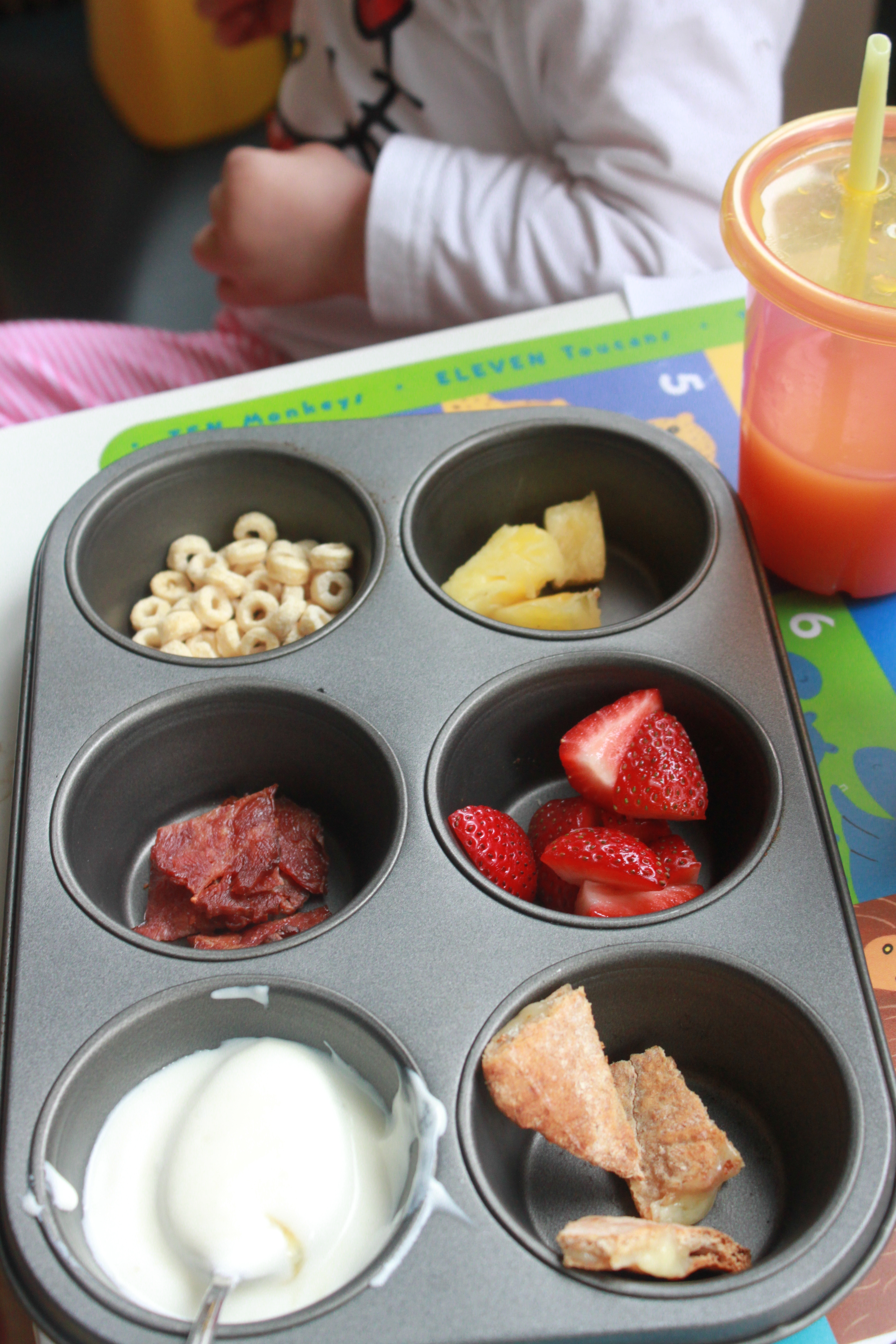
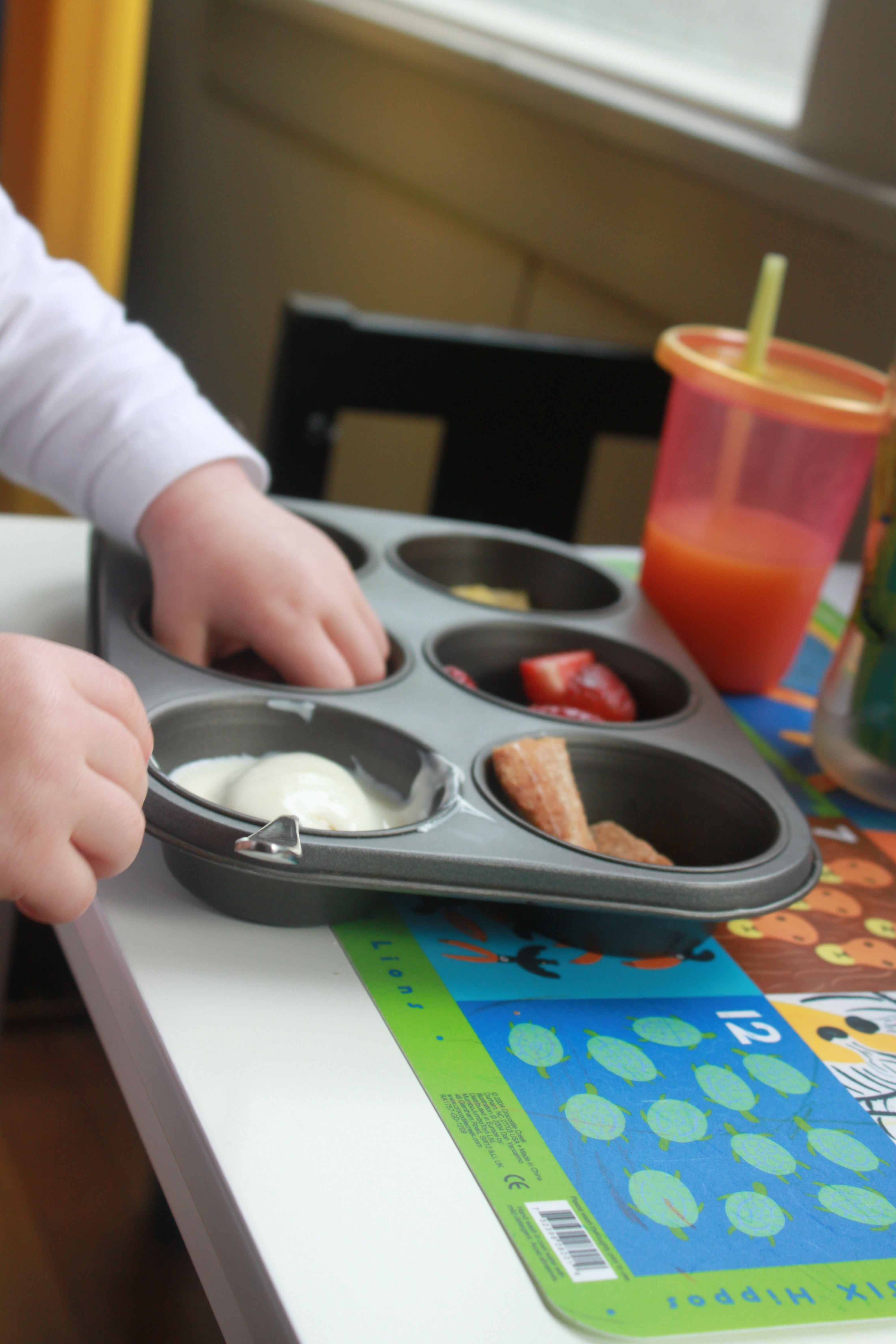
I turned her post-nap snack into a muffin tin meal as she'd refused to eat lunch. She's been sick, so I stacked the deck with things I thought she'd eat. She ate the pineapple, and quite a few cheesy pita pieces! I even had to reload. Despite adding a ton of honey to the plain yogurt, it was a no-go. Duh.

Stella’s best buddy is a sweetie-pie of a kid who sits peacefully in his high chair (or even a shopping cart) for long stretches. He is breastfed. He happily and without urging will eat anything that his very dedicated and health- and eco-conscious mom puts in front of him. He’ll use a toothpick to precisely nab chunks of plain, steamed broccoli or carrot and dip it into his little bowl of 100% healthy and amazing Almond Ginger Drizzle dipping sauce, and go back for more. Then he’ll eat plain yogurt as a side dish, and move on to polish off  the leftover avocado from lunch, and a few pieces of chicken and suddenly, he’s chowing down on brown rice.  He also wakes up several times a night. His mom is lucky to get one three-hour stretch of sleep each night.

Stella has about a five-minute highchair or shopping cart seating limit, won’t even touch a food that’s been offered to her previously the same day (even if she loved it), gets impatient with a fork (nevermind a toothpick) so will quickly resort to eating mac and cheese by the fistful, and regards plain yogurt as a form of shiver-inducing torture. She also (92% of the time) sleeps through the night. She and her bud are both happy and healthy. They both have areas that are challenging. I try not to compare them, but relish the sometimes hilarious differences. It’s hard not to smile in amazement at their wildly different temperaments, which somehow go together perfectly. Just like Almond Ginger Drizzle and broccoli.

Because I do have to put in a bit of an extra effort to provide Stella with an adequate, healthy-ish diet, and more so because I absolutely love to waste time, I actually have a second Twitter account. I use the ambitiously named Toddler Recipes Twitter front for the purpose of sharing any possibly helpful toddler feeding “tips.” It’s just that whenever I find a new snack or meal for Stella, or ways to make existing snacks and meals healthier or somehow better, I want to share such revelations. Instead of just dancing alone in my kitchen.

Some of my suggestions, all of which are based on my own feeding successes with one storied little eater, are really odd. Like, a couple times a week, I bake a sweet potato while Stella naps (poke holes in it with a fork, pop it in a 425-degree oven on a baking sheet lined with foil for about an hour). After she’s had some time to fully wake up and play, I peel it and pop it in the food processor and start handing her spoonfuls. It’s still warm. It’s incredibly sweet. And because of the way all of this unfolds, it’s an event! She asks for more, more, more. On Saturday, she ate most of an entire medium-sized sweet potato (or is it a yam?) and I was so pathetically happy I almost burst, but I didn’t, because I’d made a big enough mess already. I’d compare the pride and thrill I felt to that of getting a large raise. I wish I were kidding. I can now fill a ramekin with the puree and put it on her little table and she’ll scoop away, eating most of it with glee. The point? Toddlers are weird. Don’t be afraid to try random outside-the-highchair ideas. Whatever works, man. Whatever works.

Admittedly, many tips are really obvious but may be easy to overlook when you’re busy trying not to go insane. Cut up a 100% whole wheat pita pocket into quarters, pop a piece of cheddar into each (I often splurge on raw cheddar), toast for a few minutes, and voila! “Cheesy pitas’ that can be cut up into little, appealing bite-sized shapes, like pterodactyl, or the always-popular triangle. Use mozzarella and tomato sauce to transform grilled cheese into a worthy foe for pizza. If you’re feeling ballsy, throw some veggie in there! No, not all my ideas involve bread and cheese. Though I do think that good quality whole wheat bread and decent cheese can take a picky-ish kid far. Really, some of my tweets involve… (wait for it)… carrots! On rare occasions, spinach! Once in a while, I’ll just remind people to not force things, simply to “offer.” And definitely don’t obsess. Because I need to re-tell myself these very things from time to time.

Of course, she went straight for the turkey bacon. It's uncured, organic, yadda yadda. Just don't compare it to real bacon and it's delicious.

I have to retract at least part of my previous endorsement for Super Baby Food. It always felt like a bit too much work to be sustainable… too much thinking. The best ideas are fun, and don’t require spreadsheets for tracking and planning purposes. “Let’s chart Stella’s vitamin A intake, shall we?” UGH. Anyway, case in point: A long time ago, I stumbled across the idea of “muffin tin meals” on a friend’s wonderful craft-centric blog: Well I’ll Be a Monkey’s Mama. Now that Stella is old enough to not immediately grab any nearby container and dump its contents on the floor (usually), I decided to give it a try. I needed to do something, because we’re in the midst of a very rough eating stretch, due to nagging illness. During our recent ER visit, I learned that Stella lost a pound during her first cold in April.The 20-month-old girl whose 18-month-sized jeans are so baggy, I have to round up a search party to find her butt for diaper changes. Well, she’s a week into her second nasty affliction this month and that means that after weeks of weight loss, she’s still eating notably less than usual. Anyway, I think the muffin tin magic did help. At the very least, I felt better knowing I’d made a little bit of an effort without pressuring Stella to eat in any way. She didn’t polish it all off (no surprise there), but she actually sat down at her little table to eat, after noticing it and announcing her intention to “Sit DOWN!” I’m chalking it up as little victory–one of the many that I am too pumped about not to share on Twitter or with anyone who will listen.

In closing, a confession. Sometimes, I purposefully don’t put in too much effort when it comes to Stella’s meals. Especially with our feeding history, it’s incredibly deflating to spend significant energy and time on planning and cooking, only to have Stella eat zero point zero percent of what I’ve lovingly prepared. I pick my battles. I invest time where I think it will pay off. And once in a while, I take Stella out for ice cream and just enjoy life and eating without worrying or trying at all. Sometimes, that’s the very best recipe.

No acute abnormalities.

This is part of a new segment I’m calling “Eye on Stella: Strabismus Watch 2010.” Sorry. I just thought that was kind of funny. And I’m running with any humor I can find these days.

The ER, whose job it is to save lives and not provide conclusive diagnoses, called Stella’s condition “convergence spasms.” A quick google search on this term terrified me (apparently, in some cases it’s brought on by hysteria–Stella’s tantrums aren’t THAT bad), and thankfully led me in another direction. After some research, and due to the nature of what actually happens to Stella’s eyes on occasion, I’m convinced that they’re incorrect. My theory is that Stella has the treatable, relatively common condition known as intermittent strabmismus, known to flare up during times of stress, fatigue, or illness. Of course, last time I checked I was a stay-at-home mom and copywriter–not an ophthalmologist. Though, I did diagnose my husband with photography-induced crazy-eye. Nailed that one.

So, last Friday. It was:

The culmination of a week during which Stella barely ate and lost a whole pound of weight (at least), due to a bastard of a cold entailing massive congestion and a cough that could drown out a chainsaw.

The day Stella may have bumped her head on the window sill in the kitchen. I was making lunch, heard a scream, and only saw what happened out of the corner of my eye.

When her eyes rolled in severely, a total of ten times by 11pm for two to ten minutes per spell. When this happened, she couldn’t see remotely straight.

The evening we headed to her doctor’s office having snagged the last appointment of the day, waited as they paged neurology at Children’s, then headed to the ER, where they awaited our arrival and Stella was not allowed to eat or drink for several hours and underwent a head CT scan that showed “no acute abnormalities.”

Since that day, I’ve been carrying around a feeling that threatens to burst my chest. It ebbs and flows. It makes me cry, sometimes. It makes me think about what-if’s and the meaning of life. It makes me wonder, once again, if I’m strong enough to survive parenthood. But I can’t quite pinpoint it. It’s too vague and all-encompassing to grasp. So I keep wondering what it is. I don’t think it’s as simple as “anxiety” or “fear.” It’s something to do with those. But more do to with love. It is absolutely huge and it is always there, probably in every parent, but right now it’s much too close to the surface. Which makes it hard to function.

On the other hand, after unthinkable tumors and lesions and brain bleeding were ruled out, I am obviously extremely relieved that the issue appears to be isolated to her eyes–or more specifically the muscles that control her eyes. If I’m right and it’s strabismus, early intervention ensures an excellent prognosis, ideally achieved through vision therapy (eye exercises) and maybe a patch to strengthen the weaker eye (which seems to be her right one). But I’m having a hard time as we navigate the two weeks that separate us from her ophthalmology appointment at Children’s Hospital. Every time she cries or screams in frustration or stares off into space or rubs her eye or refuses to nap or has a tantrum, I feel a contained form of panic rise up and I’m gripped by a question that is more of an all-encompassing mentality: What is wrong? This is a terrible way to live, really. A mode of existence encouraged by the worst-case-scenario culture of the internet, where I spend too much time. It’s a way of being that I am familiar with, as a worrywart by nature and having gone through Stella’s feeding aversion with her, but it’s currently heightened. Maybe there’s a touch of PTSD-like trauma from our tube days. Following Friday’s scare, I jump too quickly to the idea of wrongness. But! There are also times in which I see more clearly and with more appreciation everything that is right. The contrast between the two is sharp. It makes me ache.

I sometimes wonder what is wrong with me, and the way I see–the world and myself. Why is this all so hard for me? Why am I so jumpy around Stella since Friday? Why does it sometimes feel as if I walk on eggshells through life and motherhood?

As I sit here, I’m afraid of the radiation of her CT scan (ugh, do I remember correctly that they had to run it twice? why didn’t they work with us to keep her still in order to get it right on the first try?) and of an admittedly imagined potential for vision loss (could this nebulous eye issue make life harder for Stella?). Since Friday, I’ve seen her right eye drift in very briefly a couple times, and it jolts my entire nervous system like an electrical current. I’m disturbed when I see her eyes misaligned, not because she is any less beautiful or sweet for it, but because it’s a signal that something is likely amiss with my baby–something I don’t understand. What’s causing it? What does it mean? How will it affect her? My mind fills in the blanks, creating scenarios and possibilities with whatever is lying around: fear, anxiety, hope, and love so strong I can hardly bear it sometimes.

Back when Stella wouldn’t eat, I always felt 100% convinced that in the end, she would be just fine. Beneath all the panic was a kernel of certainty. It’s still there.

Confident Mom Interview #4: Roller derby mama Erin Clark

How about a little dose of “bad ass”?
I had the pleasure of meeting Erin Clark during my time as a copywriter at an ad agency. Erin managed a couple of the accounts I worked on. At that time, she was at a crossroads–dealing with the fallout from a divorce and wading further into the waters of single parenthood. She was always very honest and open, whether about what the client was actually saying and demanding (no sugarcoating, but no panic either), her addiction to designer jeans, or her motherly pride and concern about her girls, who were “tweens” at that time.

Unlike me, she doesn’t have a self-torturous tendency to jump to the worst-case scenario. She’s a stunningly positive person, as evidenced by her near-permanent smile. Inhumane deadlines and outrageous client demands couldn’t diminish it. And it turns out, concussions, bloody noses, and cracked ribs can’t either.Those are the three injuries she’s sustained in less than one year on the track in the Jet City Roller Girls, a flat track roller derby league based in Everett, Washington.

Here’s a woman who can push through fear, take a hit, and get back up again. A valuable lesson for any mom. (It’s a particularly well-timed message for me.) Here is my interview with the newly transformed Erin Clark, or as she’s known in the rink, Devilynn Syde (#666).

Life and Times of Stella: Motherhood is not so new for you. But roller derby is! Wow! What prompted the decision to become a derby girl and how has it affected you?

EKC:  Prior to derby, my hobbies consisted of watching TV and shopping on eBay.  Not very productive, and certainly not healthy or character-building.  I’d always been envious of those who had hobbies they were super passionate about, hobbies that were an away-from-work outlet… something that provided different challenges, and an opportunity to meet new people.  Derby has provided this–and then some.  It has, quite literally, turned my world upside down.  It is the best thing I’ve ever done for myself, and my girls, without question.

My interest was initially piqued by a friend of mine telling me that he had taken his family to a Rat City bout, and his comment, “I can TOTALLY see you doing roller derby.” I thought about it for a minute, and ultimately agreed.  The girls and I went to our first bout, I got some information about how to get started, and dove right in.  The toughest thing was deciding which league to try out for.  I ended up deciding to give Jet City (the Everett league) a try, for three reasons:  one, they had a boot camp coming up, Rat City did not.  Two, a friend from my childhood was on the league and had nothing but good things to say.  Three, Jet City teams practice twice a week… Rat City had up to five practices per week.  Not ideal for a single parent.  I went with Jet City, attended boot camp, and was picked up by Camaro Harem.

Life and Times of Stella:
How hard was it to enter the derby world? How were you tested and challenged along the way? Ever want to give up or were you 100% confident and determined the whole way?

EKC
:  “Booty” camp was HARD!  I skated a ton as a kid, and occasionally took the kids to Skate King for a public skate as an adult…but derby is an entirely different form of skating.  A whole new world.  There were nine girls in my booty camp.  Booty camp is eight weeks long, four practices per week.  I was one of the weaker skaters when I started.  I went to each practice feeling sick to my stomach.  I knew the entire league was watching me, and I genuinely felt like I sucked.  I definitely was NOT 100% confident, at any point, during booty camp.  There were several times that I considered quitting, due to not feeling good enough.  I was tested and challenged at every single practice.  I never considered myself a competitive person… derby has brought that out in me, in a big way.  Initially, my goal was to not be the worst skater in camp.  Towards the end, I strove to be the best.  Mostly, I just didn’t want to look like a dumb-ass.  Despite growing as a skater in that eight-week period, I wasn’t sure I was good enough to be picked up by a team.  The anxiety and pressure to succeed during that time-frame was probably the most intense and overwhelming experience I have ever had.

Life and Times of Stella: What lessons has derby taught you? Are there lessons or benefits that moms in particular can glean from derby?

EKC: The most important thing derby has taught me is to be patient, and always always ALWAYS focus on the positive.  Learning to play derby is an evolution.  It is impossible to be awesome right off the bat.  It takes time to learn the rules and master the skills.  Allowing yourself to get easily frustrated… or bashing yourself for all the things you are doing wrong… have a negative impact on progress.  I did this at first, and learned my lesson the hard way.  It is SO much more productive to focus on the things I am doing well, and recognize that there is always room for improvement.  This is absolutely something that can be applied outside of derby.  I’m typically a glass-half-full person anyway, but I definitely find myself using this philosophy more in my parenting now vs. my pre-derby life.

Life and Times of Stella: What do your daughters think of your roller derby career? Are they proud? Inspired? Jealous?

EKC: My kids absolutely LOVE the sport and are having a great time.  I sincerely hoped that would be the case, but of course you don’t really know until you try it out.  I didn’t jump into this lightly.  One of the main reasons I took on this endeavor is because it is family-friendly… and is something all three of us can participate in together.  I had many conversations with my daughters prior to trying out.  I needed to make sure they would be okay with the time commitment (which is huge), and an interest in the game itself, as I fully intended to drag them with me to all associated events and activities.  They are both very involved (Elly plays, too), and really enjoy the community aspect. Like me, they now have a wider circle of friends who love and accept them.  They are both very proud of me. They like to tell their friends that their mom is a derby girl.  I know it was my involvement that inspired my younger daughter to play.  My older daughter doesn’t feel it is a good fit for her (she doesn’t like the idea of hitting/hurting people) and has definitely expressed some jealousy as a result… but I try to shift her focus to other areas of contribution.  She is a fantastic photographer, for example.  So, she can take pictures of her sister and me playing. [insert big smile]

Life and Times of Stella: Best and most challenging aspects of roller derby life?

EKC:  The biggest challenge is by far the time commitment.  I’m skating five times a week.  In addition to my own team/league responsibilities, I’m also coaching a junior team (Elly’s team), which takes up even more time.  I love it, but as you can imagine, it takes a huge toll.  I’ve lost touch with my family and non-derby friends as a result.  Dating is pretty much impossible.  I have a hard time keeping up with domestic tasks.  I’m away from my daughters three nights a week.  I just don’t have enough time to get things done.  It’s hard.  The other big challenge is being okay with my skill level… accepting that I’m still a work-in-progress.  Staying positive, when I’m not nearly as good as I want to be, is a struggle.

The best part of derby is by far the support and encouragement of my teammates… and being surrounded by such a fantastic group of women.  I’ve never played a team sport before, so this feeling of unity, the pursuit of a common goal (outside of a work environment) is new for me.  It is truly hard to put into words how amazing this feeling is. But, suffice to say, I absolutely love it.

Life and Times of Stella: How old are your daughters, and what is the biggest parenting challenge you face right now?

EKC:  Emma is 14 and Elly is 12.  They are good kids overall, but of course there are challenges.  They are in their teen years, and they are girls.  In this day and age, that alone is a scary thing.  The way that girls dress and interact, and their accessibility via online networking tools, goes WAY beyond what I experienced at their age.  It requires close monitoring and boundaries.  Because I’m away from home quite a bit, I have to be extra diligent here… which is often hard.  I trust my girls, but don’t trust others.  I do what I can to keep them on the right path and, of  course, safe from harm.  I worry about both my daughters, for different reasons, but don’t want to be one of those paranoid parents, ya know?  In general though, I’d say the biggest challenge really is their access to things and people that should be off-limits.

Life and Times of Stella: You said that as always, you’re open to discussing anything. So, exactly how long ago was your divorce, and how did it affect you and the way you mother your daughters?

EKC: My ex and I separated in September of 2005.  Our divorce was final in February of 2006, so I’ve been divorced for four years.  We attempted to co-parent the kids, but had an exceptionally difficult time communicating, so never really got the hang of that. So, we pretty much each parented in our own way when the kids were with us.  When my ex moved out of the state (December of 2007), I retained sole custody of the girls.  The girls visit their dad a few times a year, but I am ultimately responsible for their parenting.  This was a bit of an adjustment, but we’ve managed and are doing fine.  It sometimes sucks to be doing everything by myself… but I like to think that I will eventually have a partner who will help balance things out.  That is a whole other topic, though.

Life and Times of Stella: Is there anything you worried about when they were little that you now realize was a total waste of time? Help us worry less!

EKC:  Hmmm.  This is a good question.  I’m not an excessive worrier by nature.  But there are two things that come to mind.  One: Don’t compare your child to others.  Just because someone else’s kid does something earlier than yours does NOT mean there is something wrong with your child.  All kids develop at different rates.  I remember that being a concern when my girls were younger.  Another thing… if your child wants to express herself/himself by wearing clothes or a hairstyle you wouldn’t be caught dead in, let them.  Trust me, you’ll have bigger battles later.  Your child is not you, after all.  Individuality is a good thing–even if you think it means your kid might be perceived as weird.

Life and Times of Stella: What is your biggest fear and biggest hope for your daughters?

EKC:  That’s easy.  My biggest fear is that my kids will be harmed in some way, or go down a bad path and be unhappy.  My biggest hope is that they will work hard and be successful and happy.  I could expand on either statement… but it really comes down to unhappy vs. happy.  I choose happy!

Life and Times of Stella:
Advice for other parents of girls? Especially those of us with ones that are wee and, try as we might, can’t predict all that’s in store.

EKC:  I think the biggest thing is teaching them how to be safe and use good judgment at all times.  I encourage openness and honesty in my house, something that wasn’t truly valued in my upbringing.  Remember what it was like for you as a child or teenager, and recognize what options are available for your child in this day and age (specifically, things that could get them in trouble).  Assume that they will want to experiment and stretch boundaries.  Be available to guide them in the right direction when they are tempted to try things you disagree with.  Be willing to talk about things that make you–or them–uncomfortable.  When they are old enough, be honest about the challenges and temptations in your past.  Allow them to learn from your mistakes, and expect that they will make their own.

Just, wow.

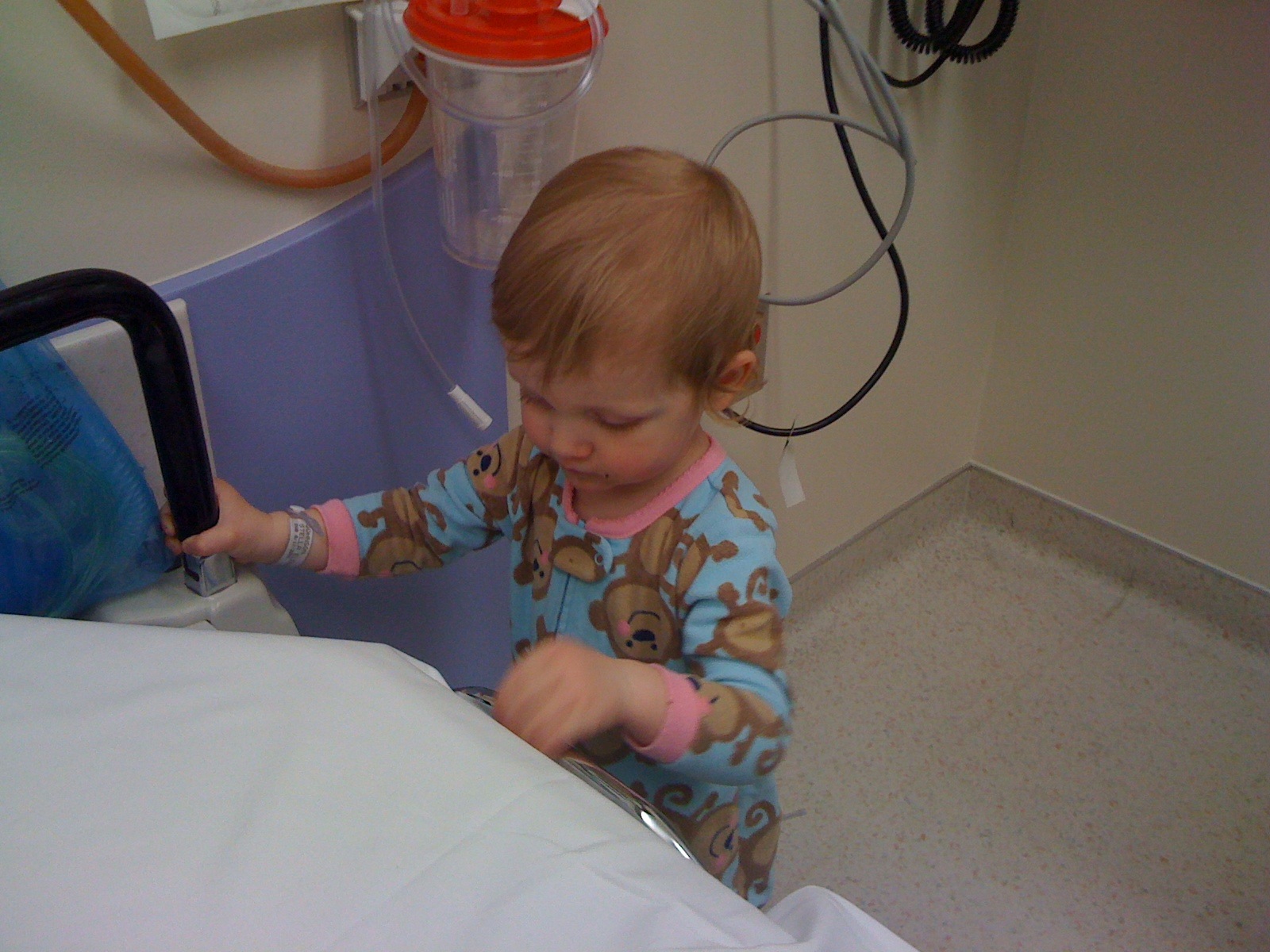
Stella keeps busy at the ER. Thankfully, none of the many available tubes were used during the ER visit. (Sorry, inside joke.)

We were back at the ER at Children’s Hospital last night, our old stomping grounds. It’s a long story that I will tell soon. But all I can right now is “wow.” All the things I thought were so hard lately, all the things I’d been tired and complaining about, my occasional shortage of patience with Stella during a terrible cold, my lingering fear about her eating, my lack of perspective despite Stella’s earlier health challenges… they’re all punching me in the face simultaneously. And I’ve made the mistake of using Vicks tissues on my eyes while crying. Bad move. It feels like my eyes are radioactive–Cody tells me they’re not glowing but I’m pretty sure I just saw some sparkly green stuff shoot out of my pupils. I was a fool. Now I’m just scared.

A head CT scan did rule out some horrifying stuff. Which is great. But serious questions about my sweet Stella’s eyes remain. A nebulous initial diagnosis hangs in the air. Simply put, this is a rare situation. As one doctor put it: “Odd.” As another doctor put it: “I don’t like it.”  My mission for now is to get Stella an appointment with the head ophthalmologist at Children’s Hospital. As soon as humanly possible. I find myself sinking back into old habits, from the days of Stella’s feeding aversion, spending any free moment researching, grasping for answers, even though we’ve yet to see the proper specialist.

I feel like such a jerk for not appreciating more how well Stella has been doing. IS doing! This is just one more challenge she’ll overcome. I can’t overstate how incredibly lucky I am to have her. And no matter what the outcome or prognosis or course of treatment: STELLA IS PERFECT JUST THE WAY SHE IS. Always has been.

There’s so much to this story. I look forward to sharing it when I have regained a bit of composure.

Confident Mom Interview #3: Lenore Skenazy of Free-Range Kids

Lenore Skenazy, Free-Range Crusader

Do you remember the media hubbub from a couple years back, when a woman labeled by some as “America’s Worst Mom” let her kid ride the NYC subway all by himself? I thought so.

I chatted with Lenore Skenazy of Free-Range Kids one recent Sunday afternoon as she made chicken soup from scratch—and no. Sadly, I didn’t think to ask if the chicken was free-range.

On April 1, 2008, Lenore wrote a column for The New York Sun: “Why I Let My 9-Year-Old Take The Subway Alone.” She never imagined that it would land her on just about every talk show under the sun. Ever since then, she’s been taking hits and garnering praise as the bold leader of the free-range parenting movement.

She’s painted as a renegade in the media, but the woman I got to know over the phone seemed more like your average, concerned mom, just doing her best to stay sane like the rest of us. The only difference? She thinks the anxiety parents face today is out of control, detrimental, and largely out of place. And she’s doing her best to fight fear with fact, as seen in her book, Free-Range Kids: Giving Our Children the Freedom We Had Without Going Nuts with Worry.

Lenore certainly has some avid detractors. But to me, her message rings true.

The purpose and principles of free-range

I asked Lenore to quickly define the parenting style she’s helped champion, and the well-worn line rolled off her tongue. She called it “an old-fashioned approach to parenting that lets us give our kids the freedom we had.”

More explanation can be found on her website: “…we believe in safe kids. We believe in helmets, car seats and safety belts. We do NOT believe that every time school age children go outside, they need a security detail. Most of us grew up Free Range and lived to tell the tale. Our kids deserve no less.”

Her parenting approach, by the way, isn’t based on a hunch. Or nostalgia or laziness. It happens to be backed by a lot of research, which can be found throughout her book. Lenore points to the crime rate as a prime example. It’s much lower today across the board than in the 1970’s, yet kids have less freedom and parents more fear than ever.

Free-range, but not necessarily organic

Lenore has two boys, now 11 and 13 years old. I asked her if she was free-range from the start, when her first son was born. Her very honest answer surprised me.

“No, not at all!” She explained that while she’s an advocate for free-range parenting, she isn’t always able to put everything into practice. She recalled an incident from when her oldest son was one. He was in his car seat, with Lenore and her mother-in-law sitting by him, and her husband driving. “The boy was crying. My mother-in-law said to give him a bottle. I was like, ‘No! I can’t give him a bottle! What if the nipple lodges in his throat?’” She laughed, recalling how in that moment, she trusted all the baby books she’d read, rather than the common sense of her mother-in-law, who’d raised three kids.

Lenore acknowledged, “It’s hard to take a step back from the culture.” But there was something that came much more easily to her than it does to most people: “Trusting strangers more.” Lenore credits this trust to 20 years as a reporter in New York City. “I’m always talking to people in different neighborhoods from all different backgrounds. And everyone’s been great. I really do trust people… and I always felt like if you go into a Starbucks and you have to go to the bathroom, you can ask someone to watch your child.”

She realizes that this is radical stuff to many parents today. Because to so many of us, a stranger is “a predator until proven otherwise.” Luckily, according to Lenore, actual statistics don’t support this bummer of a belief.

What worries the anti-worry guru?

Based on what I’d read about Lenore, I knew there were a lot of things she didn’t worry about: her young son riding the subway alone, for starters. So I wondered, what does the free-range generalissimo worry about?

Lenore sighed, and the list began. “I’m worried right now that my sons aren’t reading enough.” She also worries about their level of communication or lack thereof—especially in regards to one of her sons in particular. “I asked him, ‘what’d you do on your camping trip?’ and he said, ‘Stuff.’”

She admitted, “I worry about their dependence on electronic amusement. Should they not be on the computer? Are they eating too much junk food? Are they nice to their friends? Do they have friends?”

Lenore paused and remarked, “The idea that I’m not a worrier cracks up me and my sister. We are such worriers.”

“I don’t come from pioneer woman, cavalier background,” Lenore continued. “I grew up with a stay-at-home mom.” Yet, she pointed out that her “child-focused” home environment never neared the “level of paranoia about the world that has been foisted on parents today.”

Keeping free-range kids safe

Lenore may be a legend among free-range parents, but she’s very concerned about safety. When her youngest son turned ten, he had a football-themed party. The sole item in the goody bag? A mouth guard.

Free-range parenting isn’t a free-for-all for kids. She explained that, of course, “You’re responsible for them. You teach them how to cross the street. You teach them to be where they say they’re going to be.”

Lenore stated her belief that, no matter how many people are placed on the sex offender registry, “It’s safest to teach your kids to say no to whatever creeps them out,” and to make sure they know that they can always tell you. Lenore emphasized that it’s absolutely crucial to say to them, “I won’t be mad at you.”

“It’s incredibly important to keep the line of communication open. That’s going to help them a lot more than telling them don’t talk to strangers and keeping them inside… Besides, most sexual predators are people they know.”

According to Lenore, the most important message to kids isn’t “Don’t talk to strangers,” but, “You’re allowed to say no and you should tell.”

The goal, she says, is to build confidence in kids. “The confidence to say no—to predators or bullies—comes from doing things in the real world and feeling pretty good about yourself.”

Nothing to fear but fear-mongering?

I’ve often wondered, in regards to myself and other parents I know, “Why we are so scared?” So I asked Lenore to explain the forces undermining parental confidence today, and why the free-range mentality doesn’t come naturally for most.

This is Lenore’s hot button issue, and I could tell by the way her voice changed—slightly higher and faster—when she responded. This is clearly an area she’s studied in-depth, and in her educated opinion, it boils down to “media saturation” and the “safety industrial complex.” Profit-driven messages are messing with our vulnerable parental minds.

The Law and Order phenomenon, she explained, sears graphic images and story-lines of victimization into our brains on a near-daily basis. Coincidentally, Law and Order went on the air in 1990, in the period when parental and general fear was soaring to new, paranoid heights. Our parents simply weren’t bombarded with terrifying and disturbing stories and imagery of sexual and physical violence in the way that we are today, which helps explain our more fearful, mistrusting mindsets.

Lenore said that when you follow the trail of fear, it leads directly to a giant dollar sign. “It all comes from the money to be made via advertising on TV or money made in selling products.” Parental fear is profit-driven, from TV ads to “class-action lawsuits about a drop of lead in Barbie’s eye.” Take a closer look at all the protective measures that at first seem instinctual, “and there is money behind it.”

Lenore highlighted a few products that may seem innocuous at first glance: knee pads, infrared baby monitors, and bath water thermometers. She noted that their very existence and widespread availability have heavy implications for parents. The message: You aren’t capable of keeping your kids safe without the help of products from more knowledgeable companies and experts. For that reason, it can be very hard to walk away from Babies ‘R Us feeling remotely confident as a parent, unless you spend a lot of money.

She explained that the knee pads imply that your baby isn’t safe even when doing a fundamental activity like crawling. The bath water thermometer suggests that “you’re about to scald your child.” The infrared monitor tells us, “At no time is your child is safe and sound.” Lenore pointed out that until recently, when your baby was asleep, you could take a break and “breathe a sigh of relief.” Parents today are afraid to let down their guard for even a minute, and it’s exhausting.

Lenore sees these products and their relentless proliferation and promotion as posing a fundamental question: “Don’t you care enough to save your child?” Of course, our instinct as parents is to say yes. And we spend a lot of money in order to do so. But no purchase is ever enough to take away the fear that has been planted.

My jaw dropped when Lenore told me about perhaps the worst fear-based money-maker she’s ever seen–an ad for a GPS device that’s also a 911 phone. In this short commercial, a kid is lured away from his bus stop by a remote control car. The next thing you see is the kid in the trunk of a strange man’s car, followed by a highly suggestive scene in a dark alley. If you watch closely enough at the end, when a SWAT team arrives to rescue the boy, you’ll notice that the stranger is pulling up his pants. I wish I were kidding. Honestly, I’d hoped Lenore was exaggerating. She wasn’t. See for yourself, but don’t say I didn’t warn you, and don’t take their misleading stat at face value:

Yikes. No wonder fear is so rampant, Lenore commented, despite the fact that crime is down, child abduction is rare, and that when abuse and kidnapping does happen, it’s usually at the hands of an acquaintance or estranged parent.

Lenore pointed out that whenever something does happen to a child, from a bump on the head to something more serious, parents are attacked or blamed to the fullest extent possible. She lamented, “We’re so afraid these days. Fate used to be part of the bargain. Now, anything that happens to the kid isn’t blamed on fate, it’s blamed on the parent. ‘Why did they let her eat that grape? How did they break their arm?’ It’s all traced back to negligence on parents. We’re blaming them because we’re scared and if we can distance ourselves from that parent’s disaster, it gives us a sense of control.”

Lenore added, “Our litigious society makes it seem like everything that happens has cause or blame.” In other words, there are no accidents anymore. It’s always somebody’s fault.

“Everything is now seen in terms of cause and effect. If we turn our backs for a second, then we will be blamed.” As a result, we’re always looking for possible ways our kids could be hurt, and willing to spend money on products—previously non-existent or considered unnecessary—claiming to protect them.

It’s hard to be a confident, free-range parent today because our commercial culture is constantly feeding our fears.

Sheltered kids lack coping skills

Lenore explained that today, some college administrators refer to incoming freshman as tea cups, “because they’re so delicate.” Sure, they’re “beautiful and perfectly made” but take them out of their protected display case and they break. They don’t stand up to everyday wear and tear, because they’ve always been shielded.

Lenore noted that college students are using mental health services in record numbers. “More college kids are depressed now than during the Depression,” she said.

“The point is,” she continued, “self reliance doesn’t just spring up out of nowhere. Sometimes you have to figure out your own route home because you missed the bus and can’t get a hold of your mom.” Unfortunately, most kids are bailed out and don’t get the chance to build confidence by overcoming obstacles.

How to worry less? See adversity as opportunity

I asked Lenore what she’d say to a parent who wants to stop worrying, but can’t let go. She said that parents need to take the pressure off of themselves. When her best friend read her book, she told Lenore how much she appreciated “whole chapters telling you to relax.” The fact is, Lenore explained, “Not everything you do has a big impact on your child’s development.”

“It’s a big relief when you realize it’s not all up to you. Not every synapse is up to you to connect in the brain. Not every day has to be perfect. They’re going to fail and that’s probably good in the long run.”

Lenore believes that when adversity strikes, we as parents have the opportunity to say, “Okay this is the punch, and now we learn how to roll with it… Life isn’t going to be perfect. The sooner they realize it, the better they can handle it.”

As for a specific strategy to get nervous parents started, Lenore suggests leaving your cell phone home for a day, giving your child the opportunity to problem-solve on his or her own. (More concrete free-range parenting ideas can be found in the FAQ section at Free-Range Kids.)

It’s a wide, enriching world for free-range kids

I asked Lenore to think of an incident—something her kids said or did—that affirmed her free-range parenting style. I wondered if she’d seen behavior that let her know that the freedoms she’d given them were fruitful investments in their character.

She thought for a minute, and then perked up. She explained that her youngest son takes the subway to school and transfers in Manhattan. Along the way, her son has befriended, as Lenore put it, “the guy who gives out free newspapers.”

The man’s a fixture at her son’s stop. “The guy has been through some hard times,” Lenore said, adding that he’s likely been “homeless or incarcerated… and doesn’t want to see my son go the same route.” This man has not only become a friendly acquaintance of her son, he’s become interested in and invested in her son’s future.

In fact, this man wrote her son a letter, amounting to a pep talk on paper, urging him to stay the course in life. He also gave her son a book about John F. Kennedy, meant to inspire.

Lenore shared her feelings on the unusual relationship. “It made me proud that he [Lenore’s son] connected with another person, that the person is looking after him… and that the man feels good about it.” Lenore, the seasoned reporter, couldn’t help but add, “And it makes me happy that my son reads the newspaper.”

Lenore is delighted to see that her son is “not writing people off because they’re a different color or poor or hard up.” It’s just one of many lessons he’s free to learn.

Lest ye be judged

Hi all, I’m super tired and have been working (freelance writing) like crazy, during naps and until midnight most nights, and I need sleep and definitely shouldn’t be blogging right now. Just wanted to check in, I suppose. By the way, I am almost done editing my interview with Lenore Skenazy, and will post early next week! The free-range parenting guru is still popping up in big-time media a lot these days, and I felt honored that she spent close to an hour on a Sunday to chat with me. It was a delight. Also on deck for my Confident Mom Interview Series are a roller derby mama I once had the pleasure of working with and Cody’s 90-ish year-old grandmother Torie, who is sharp as a tack and one of the most open-minded, least judgmental people ever. Which brings me to my thought of the night.

I read a blog post today, in which bedtimes like Stella’s (8:30pm these days) were deemed inappropriate. You know, it was just another mom, blowing off some steam, admitting that she judges moms who are out with their babies past 6pm or so. My first response was to laugh so hard tea came out my nose. Then I got annoyed and even a little bit mad and defensive. I wasn’t afraid to post my response. And my response to her response. And then I realized it was karma.

Not too long ago, I left a slightly jokey, gentle, but still essentially critical comment on a certain blog by a certain “crazy mom” (those are her words–the very ones I use to describe myself). She’s pretty well known (not in Dooce’s league, but way above mine) and wacky and brutally honest and I’d be amazed if she didn’t wind up with a reality TV show. About five minutes later, I felt mildly sick to my stomach. I knew it was wrong to judge her. I knew it wasn’t my place. Yet I’d given in to the urge to judge, something I usually try hard to suppress. I thought about the lactivists who have posted hurtful judgments on the Fearless Formula Feeder‘s site, as if just to shame moms who have already made their feeding choices, and realized I was no better.

The much-more-popular-than-I blogger that I’d criticized responded to my judgey remark, and in the very succinct, reasonable message she sent me, it was confirmed: I was an ass. I didn’t really know that I was talking about. Be ye not so stupid. Do not judge another mom’s choices (or any person, for that matter)–you know, the kind that don’t affect you at all and you have no business contradicting? Especially not based on a small snapshot of their life. That’s arrogant. You are most likely 100% incorrect. You haven’t walked in their shoes. You may, in fact, be doing it to feel superior or secure yourself. It probably has little to do with the judged, and a hell of a lot more to do with the judge.

To the certain someone that I judged: I am so very sorry. You were right. I was wrong. Won’t happen again. To the person who inadvertently judged me: Get ready–the cosmos are currently concocting a serving of of judgment for you. Wait for it… wait… for… it…

I feel better now. Good night all!

Unladylike ladies

Neither Stella nor I are particularly dainty. Except when Stella runs on her toes, which is quite graceful and precious. (I do it, too, even when playing basketball, but it doesn’t have the same effect.) She looks like a tiny fairy ballerina prancing about, excitedly granting wishes, instead of a toddler, running around wreaking havoc. It’s a good cover.

“Ladylike” is not a word usually associated with me, for sure. I’m pretty sure I often eat with my mouth open. I sometimes sit with my legs sprawled. During important work meetings. I don’t do the kind of heavy-lifting, when it comes to socializing, that people expect from true ladies. You know, those women who instinctively smooth out every social situation with such grace, especially in regards to men who lack their skills, making everyone feel wonderful and engaged and the center of attention, all while re-filling their glass of freshly squeezed lemonade and maintaining constant eye contact. Not me. I halfheartedly try, sometimes, but my energy is so quickly drained by extended attempts at extroversion that soon I’m the one alone, in the corner, at my own party. And I’m fine with it.

It’s too early to tell what her true inclination is, but at the current moment at least, Stella is a bit of a tomboy, like me. The last time I put a dress on her, she almost tore her arm muscles in a futile attempt to rip it off. Her eyes were popping out of her head from the strain of the effort to remove the flowly, intrusive garment by simply pulling it directly away from her chest. (After just a moment’s entertainment, I took it off, of course.) She won’t let me put clips in her hair. She immediately ruins all her pretty, expensive shoes with massive dirty scuffs. I always find it puzzling that so many toddler boy shoes have protected or reinforced toes while little girls’ footwear is left with butter-soft leather on the toe. Might as well throw a heel on it as apparently, shoe manufacturers don’t expect little “ladies” to be as active as boys. And don’t get me started on sippy cups. So boys get to gaze at dinosaurs and imagine about and perhaps imitate what these prehistoric creatures  may’ve been like while girls get to look at bright pink flower and dot patterns? Humph. I purchased the dinosaur cup but haven’t been so bold as to opt for boy shoes. Soon, she’ll make that call. But I digress.

You could not describe Monday’s incident as ladylike. We were at a friend’s house, attending a get-together of about seven of Stella’s peers and their parents. Music, both kid- and parent-friendly, filled the air. People noshed on lentil stew, veggies and an assortment of cookies. Kids played happily all over the joint. The vibe was jovial. When all of a sudden, the loudest, most blood-curling scream in the history of anger pierced the air like a butcher knife. Everyone’s eyes bugged out, jaws dropped, wide-eyed children froze in fear, and soon all parents within a ten-mile radius had rushed to the scene to administer CPR or otherwise address whatever life-threatening injury had been sustained, to hopefully keep the toddler alive until paramedics arrived. Okay, EMTs weren’t summoned, but I’m pretty sure I saw someone grab their phone. I, on the other hand, didn’t move. I waited until the sustained, eardrum-shattering, horror-movie-style scream at last ended, because I needed to collect myself. It was Stella. She was not dying. Her pathway had been partially obstructed by a chair.

Deep. Breaths. I’m pretty sure that any time Stella feels boxed in, her frustration skyrockets immediately. She expresses it with a primal scream. This has happened in response to the fit and snag potential of dresses. Those with an empire waist can fit snugly around the middle, which she loathes. My mother recalls very clearly that I too raged against remotely tight-fitting clothes, so really, Stella’s behavior may be simple karma. Anywho, this “boxed in” theory of Stella’s frustration has als0 been proven at Gymboree. Once, she stopped mid-slide to just hang out there observing Gymbo’s antics, and some sweet kid has the audacity to try and pop a bubble at the bottom of the slide. She screamed and kicked at him, and I swooped in to prevent her from making contact.

Yes, she got it from me. I have unladylike responses to frustration. (Cody is almost impossible to frustrate, which is infuriatingly frustrating.) But exactly how was this inclination transmitted from me to her? My outbursts during her feeding aversion probably didn’t help. Her frustrating 32-hour birth, wherein she basically got stuck because her head was sideways, wasn’t a great way to start life as a content little lady. Going back further, all the very unbecoming road rage I experienced while pregnant could be the problem. Maybe all that beeping led to all this screaming. Pretty sure I could find a study to confirm this in five seconds of googling. But the other likely cause is toddlerhood. Toddlers, both girls and boys, do scream. Not surprising for her age, Stella’s very active and feels way more comfortable when she has a lot of space. I have to say that she’s not always doing flips and wind sprints–she is also social and sweet, darn close to ladylike. She gives a good hugs, and often puts her arms around her playdate buddy, Cooper (they hugged each other this week, actually–a first). Those two dance together (okay, sometimes Stella tries to drag him to the dance floor, but still). They get excited about seeing each other! But God forbid he ever get in her way. I bet Cody (my husband) knows how he feels.

So, it was with trepidation that I purchased a truly beautiful, only-one-of-its-kind dress, designed and sewn by a local woman from cheerful, mostly floral vintage handkerchiefs, for Stella to wear to this coming weekend’s wedding in NYC. Cody’s cousin is marrying her charming British beau. The bride just so happens to help create the beauty that appears in the pages of Martha Stewart Weddings. That’s right. She works for Martha. She helps envision beautiful weddings for a living. So. I was not going to let Stella wear fleece pants and a dirty onesie to this particular event. I was also not going to let myself wear stained jeans to this fabulous occasion,and purchased a comfortable but stylish vintage-inspired shift dress (say that ten times fast) for myself.

My hope was that for one night, at least, we could fake it. I’d chat up strangers, cross my legs, and chew with my mouth closed. Stella would wear a compliment-magnet of a dress and gracefully and quietly navigate her way around chairs and people, and we would look back at the pictures one day and marvel at what pretty ladies we were. If only for a moment.

So imagine my surprise when I put on my own dress, and Stella took notice immediately. She perked up and grabbed at the hem, as if to admire the fabric. “Dress” instantly became part of her exploding vocabulary. I seized the moment and asked her if she’d like to try on her very own dress. She put her arms up, ready for it. I pulled it over her head, zipped it up and tied the bow in the back. She smiled, and pranced away while tilting her head to the side, the very pleased way she does when she looks in the mirror, a move that translates to, “Aren’t I adorable?” I figured it was a fluke and took it off a couple minutes later, wanting to preempt a frock fit. She demanded it be put back on. WHAT? Perhaps I sold the dress thing a bit too hard. Remind me to applaud when she asks to wear jeans. You know, for the sake of balance.

But. Our flight to JFK was canceled on Thursday. Then it was canceled again today. I was not surprised at all, because our flights are canceled about 75% of the time. This is not exaggeration. Our terrible travel luck is the stuff of legend. Further, the more prepared and excited we are, the more likely it is that we’ll be staying put. Here’s a typical pre-trip email conversation: I write, “Hey, family! We’re on a direct flight on Alaska Air. Can’t wait to arrive on Sunday!” Family: “Great! See you Tuesday, if at all!”

So, we will not make it to NYC for the wedding. I’m so sad to miss the chance to both celebrate the very happy nuptials of a wonderful couple and to spend time with our extended family. But it’s out of our control. I should probably just return Stella’s pricey frock, as she’ll surely outgrow it before she has an occasion to wear it. Part of me wants to keep it and let her wear it to Gymboree and the playground. Something about a dress of flowy vintage handkerchiefs on a tomboy rolling in a mix of dirt, sand and wood chips is incredibly appealing to me. I could wear my shift dress and gold heels while chasing Stella around the park.

Due as much to my demeanor as my apparel, there have been many mortifying incidents wherein I was mistaken for a boy–even into my teens! And unless Stella’s wearing head-to-toe pink, people tell me how cute “he” is. (That’s a whole other post.) So maybe we’ll make a statement next time we’re out. Ladies? You want us to be ladies, world? We got dresses and we’re not afraid to use them. We’ll show you how REAL ladies roll–and skewer your rigid gender stereotypes. Believe.

18 months

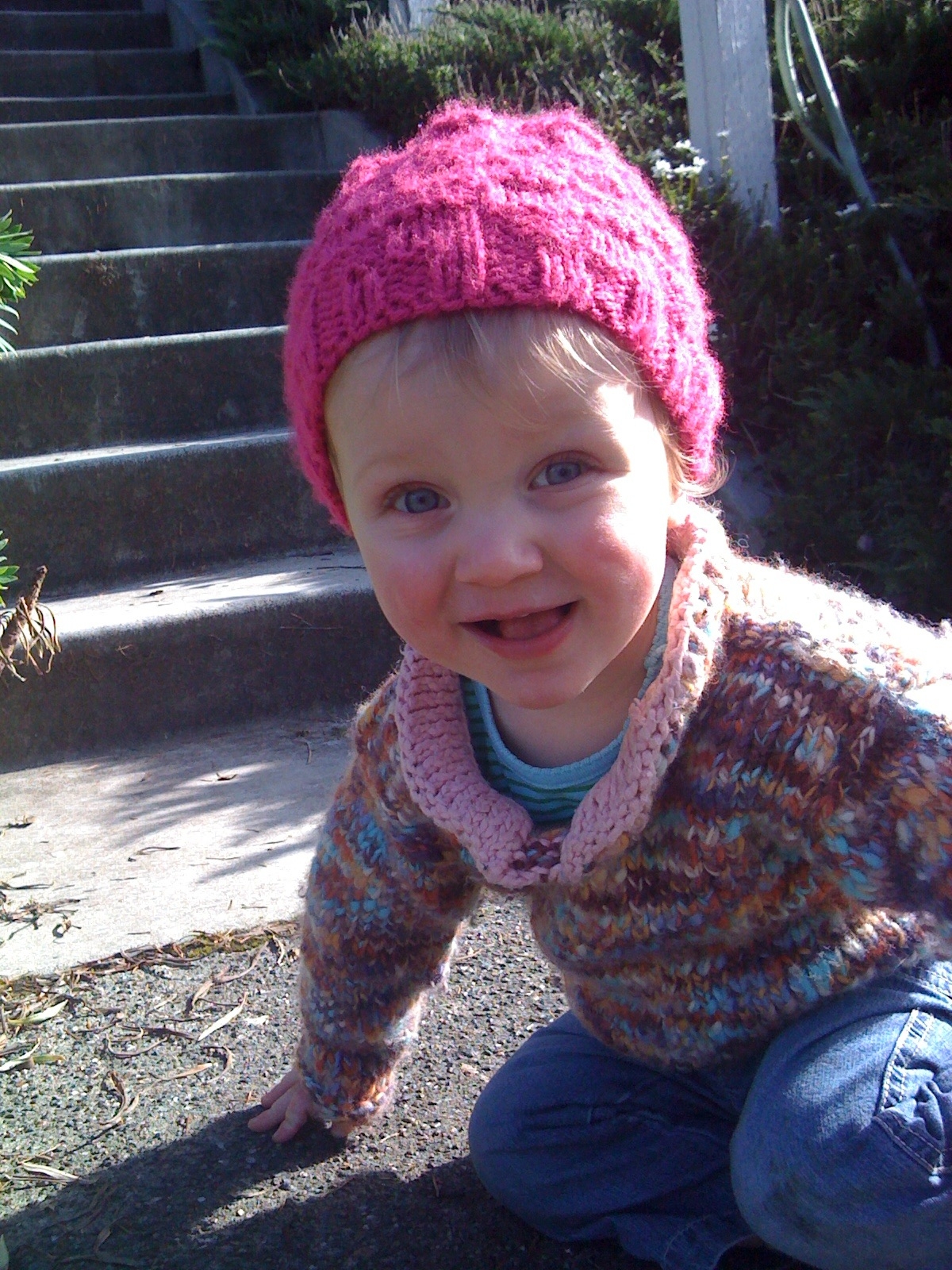
This is what an 18-month-old cutiepie with a 110th percentile head looks like.

On Saturday, Stella demanded “more pie.” Then on Sunday, after spying the gleaming white Trophy Cupcake bakery box, she shouted “CUH-CAKES!” Today, she’s been crying out for “BAGEL!”

I’d read in The Scientist in the Crib that “around 18 months” is a time of unbelievably fast development, including a “naming explosion” wherein the child can hear a word once (used as a label for an object) andsay it with ease forevermore. I knew it was coming. I just didn’t expect Stella’s language explosion to be so intensely focused on desserts and carbs. And I’m actually quite proud of it–her love of eating is beautiful to me.

Of course sweets aren’t the only emerging area of identification and communication. She knows at least several each from the shape, color, number and letter families.  Some more reliably than others, of course. She’s all, “Seven? What the HELL is that alien scribble?” but “Two and Five? Hell yeah, I can spot ’em from across the street!” “Diamond” was the first shape she could easily say and identify, which I find funny for some reason. She’s starting to string words together, and the phrase of the day is “Buckle up!” Feeling really proud and curious, I tried to count all the words she knows, and gave up when I got to 125. She’s adding more each day. This blows me away. Now that there is so much to report on, the first thing I tell Cody when he comes home is, “Here are literally all of the things Stella said, ate, did, thought about and looked at today!” And then I don’t shut up for about 90 minutes. Dinner is always done way too late.

The way Stella views the world and her place in it is clearly different now, and you can see it in the way she plays.  The playground, two blocks away, is her domain. But she’s oh-so-boldly venturing out into previously uncharted territory.  She’s no longer content to run over the toddler bouncy bridge, go down the big slide, climb the stairs, or even to scale and descend the steep rubber mounds lurking beneath the tallest playground structure. For many months now, from the safety and comfort of the bucket swing, she’s intently observed adventurous, dirty-kneed boys and girls hiking and climbing amid the boulders and tree-root-studded dirt path that make up the strip of elevated land along the edge of the playground. She now deftly explores this rocky frontier without fear, making me nervous and proud at the same time. By the time we left today, the knees and butt of her pants had dirt ground into them. There were wood chips on her sweater and hat, and sand in her shoes. She looked like a full-fledged KID.

Today we hit the pediatrician’s office for Stella’s 18-month check-up. The weigh-in that used to fill us with dread is now just a point of curiosity, a nice bit of reassurance about her continued growth. The doctor, GOD bless him (he’s seen me at my worst), always seems so happy to see Stella. He’s just so thrilled to see her thriving after those tough early months. He “gets” how hard it once was for us, and how momentous a seemingly routine and uneventful check-up is. He seems genuinely proud of all of us, happy to show us her “beautiful” growth curves, charted electronically on his fancy tablet. Stella’s now in the 40th percentile for weight and the 90th percentile for height. Her head is still off the charts, having drifted just a touch further away from the 100th percentile, which is probably why it’s such an effective counterweight for hoisting herself onto ottomans, coffee tables and assorted off-limits areas. She’s lean. She’s tall. She’s healthy. She’s fabulous. I could not ask for more in a daughter than Stella, just as she is.

The point. Right. She’s not a baby anymore. I’ve teared up (okay, maybe even wept pitifully) about this fact numerous times, of course. Because it’s all too short. Unfairly short. As a parent, just when you get the hang of babyhood, it’s over. Just when you settle into the knowledge of  “16 months”, she turns 17 months old. Then, before you even realize that she’s outgrown all her pants, 18 months. All you can do is be glad you squeezed her all those extra times, just because you couldn’t resist, and that you read her those board books a billion times even though you really would’ve preferred to watch Ellen while eating a bar of chocolate the size of a small couch. All you can do is hold on–while letting go.

But I’m not sad. Babyhood is over, but full-fledged toddlerhood is just beginning, and if the past couple weeks are any indication, it’s going to be fun–challenging, but really funny and fun and crazy. I’m proud of  how far we’ve all come. Amazed and impressed by her new independence and communication. And in awe of her passion for dessert and dirt alike.

Three cheers for Zander! Oh yeah, AND HIS MOM.

Today isn’t just another Tuesday. It’s a very important day. Today, February 9, 2010, is the day Alexander (Zander or Zandy to those who love him) left his G tube behind. For good! I can’t tell you how huge this is.

Due to one of the most severe cases of frank aspiration ever seen at Seattle Children’s Hospital, Zander required a feeding tube for a year and a half (very close to his entire life). Early on, it was discovered that most of the milk he swallowed ended up in his lungs. He started off with an ND tube (like an NG tube that goes further down, indicated only for short-term tube feeding), but it soon became clear that a longer-term J-G tube was needed. At that point, he couldn’t handle a G tube, inserted into the stomach, because food that high up in his system could be regurgitated and cause aspiration. The food had to go directly into his intestines, via G-J tube, to avoid the threat to his lungs. (Much later, though, he transitioned to a G tube.)

Any type of swallowing put sweet Zander in danger. When he got a mere cold, respiratory distress was pretty much inevitable. It was a terrifying journey for the whole family, with a most uncertain destination. They didn’t know where it would lead. They were stuck, in so many ways. Tube feeding has a way of cramping one’s mobility and social life and sanity.

Then it happened. Late last summer, Zander passed a swallow test. Finally. It was his fifth one. He’d failed the four prior, because he was still aspirating. Amazingly, he at last demonstrated the ability to swallow. But could he really EAT? Did he have the willingness? Not at first. He needed to build oral motor skills. He needed to learn to not be afraid of food. He needed to feel hunger, which tube feeding obscures or annihilates. He still had a road ahead of him. So they forged ahead. Unbelievably, there were just two occupational therapy sessions. The work was done at home. They made food “sexy,” conscious of being happy when they ate and letting Zander see them happily eating. They allowed him to touch, and — until he got teeth — gum at flavorful food. They dipped his pacifier into gravy, sauces and juice. Still uncertain, they were hopeful and proactive, even after all they’d been through.

Slowly but surely, Zander began to eat. At first, just a sip from a straw or a bite of a cracker. Breakthroughs seemed to happen when they were behind schedule, when hours had passed since his last tube-fed meal and he was overdue for his next one. On such an occasion, he grabbed his mother’s Jamba Juice and guzzled three ounces in what seemed like mere seconds. Confidence and ability grew in tandem. The percentage of his diet enjoyed orally grew ever so slightly over time, until it hovered at 50%. (That’s as far as Stella ever got, by the way.) That’s when Alexander’s mother, based on research and gut feelings and a few supportive voices, took an incredibly brave but wise leap of faith. She just stopped. She stopped using the tube, and let Zander take flight.

Thirty days later, that would be today, Zander had a check-up with his wonderfully thoughtful, appropriately cautious, yet totally reasonable pediatrician. She saw that since commencement of weaning, he’d gained a bit of weight, and grown taller. She looked at him and saw a happy, healthy, NORMAL boy. And she said that the tube could go. Zander’s mom removed it this afternoon. She still feels a bit dizzy. Makes sense, though. Her world is  spinning, in the best possible way.

Yes, I’ve met Zander’s mom and I liked her instantly. She’s got wisdom and laughter in her eyes. Yep. A killer sense of humor, and a shrewdness that could put any seasoned lawyer to shame. So, as big a day as this is for Zander, I find myself just as happy, if not more so, for her. She got him here. Her strength. Her determination. Her unwillingness to settle. Her ability to take a hit and get back up, in the face of anxiety. Oh, the anxiety. She didn’t let it stop her, and that’s something a lot of parents could learn from these days.

She’s been to hell and back, probably saved her kid’s life more times than she can count, yet she’s got enough energy left to fight for other little ones like Zander. She’s become their much-needed advocate. She’s already inspiring others, and pushing for change. Better care is needed for kids on tubes, a technology that is outpacing our understanding of its impact on children and their development. And, as she and I both learned, there is no end in sight. Kids and babies whose core issues are resolved remain tube-fed for years, because no one knows how to wean them. So few in the medical community are brave enough to at least give them a chance to eat on their own. Well, she’s stepping up to the plate.  But that’s just business as usual for her. I’m going to support her however I can.

Zander now has two “belly buttons”, the last evidence of his medical journey. It’s a new, tube-free world for this family. A time of joy and nervous transition to an alien concept called “normality.”

The next time your child savors mac and cheese, or any favorite food, take a minute to appreciate it. And raise your glass–hold it extra high–for Zander and his mom!

(Much respect.)