The stubborn determination of hope

Good news. Stella is back to taking in about half of her daily calories from the bottle, just as she did before the recent regression.

However.

My feeling is that the tube is preventing her from recovering completely. I believe that it exacerbates her reflux and makes swallowing more difficult. I found and paid for two medical research papers that support my beliefs. I hope that she proves me wrong, and soon, but I am unconvinced that our current mode of treatment will enable Stella to return to 100% normal bottle feeding. I am ready to take urgent action. I am questioning the medical establishment and ready to try something else.

I learned about and have been in touch with a renowned feeding clinic in Austria. Their cold-turkey approach to tube weaning is radically different that what is practiced here in the states. They believe that the baby or child must drive their own intake, rather than the tube. They share my belief that tubes, over time, worsen aversions and lead to tube dependency. They have studied the topic for over 15 years and have a success rate of 92-95%, depending on the age group. The doctor who runs the feeding clinic told me that Stella’s age is ideal for weaning and that we may be able to achieve it through email coaching, rather than having to go all the way to Austria–although I am eager and willing to go to Pluto if that’s what it takes.

The drawback to this method, what is called the “Graz” approach, is simple. The babies and children treated may not gain weight for a month or two. I believe that Stella would be on the shorter of those timeframes, since she already takes half of her formula orally and the clinic treats many children who are 100% tube fed. Stella will be hungry and not fed until she asks for food. This may seem harsh to some, but I believe it makes sense. I believe that Stella, if able to have more control over her eating and freed from the discomfort and difficulties of the tube, would respond very well. But she would need some time to pull through once the tube is removed. Most doctors here are not willing to let a baby have low or no weight gain for any period of time, so the tube stays in. They, of course, have the babies’ best interests in mind, but they seem beholden to the tube and unaware of, or too willing to overlook, its detrimental effects in the name of weight gain. I believe that any short term weight gain delay would be more than made up for with the restoration of a healthy relationship with food and the resulting appropriate, baby-driven weight gain that would follow.

Stella’s life was never in danger. The tube was placed for therapeutic purposes, not just to help her gain weight. The tube was helpful in allowing Stella to say “no” and be heard, instead of constantly being force-fed, which must’ve been very traumatic for her. The tube took the fight away from eating. The tube has enabled her to make progress. But I believe that we have reached a point at which the tube’s negatives outweigh the positives. And I am ready to take bold action in the face of a lot of opposition in order to do what I believe is best for her.

Cody and I are going to consult with her occupational therapist and pediatrician on this. We will continue to bring Stella to a cranial osteopath. We are going to do some research into the Graz method and the Austrian clinic. And then we are going to decide how to proceed. Of course, in the meantime, we would love to see Stella down bottles left and right, thereby eliminating the need for tough decisions or new approaches.

Even on gut-wrenching days when Stella resists the bottle like it’s full of toxic waste, there is an incredibly wishful part of me that looks to the next bottle as a possible turning point. There is a clump of raw hope that sits smoldering in my chest like an ember in the darkness. It’s always there. And it’s going to light the way to a tube-free Stella.

The road to a tube-free Stella.

At long last, we see GI!

Yesterday, after waiting for weeks, we met with Gastroenterology (GI) at Seattle Children’s Hospital. They adjusted and increased Stella’s meds, since reflux still seems to be causing some pain and preventing her from eating more. We will also meet regularly with a GI nutritionist who can help us figure out how to wean Stella off the tube. I am so excited to have this extra help, to speed along the process of achieving a tube-free Stella.

They also recommended that we cut back from two to one tube feeding at night. That way, she should be more hungry during the day, and hopefully we’ll see her bottle intake rise. We THRILLED because it’s a step toward ending our reliance on the tube, and because we’ll only have to wake up once during the night! Being better rested should help our ability to cope with any ups and downs, and hopefully any improvements in our wellbeing and attitude will rub off on Stella.

Our hospital experience

We have benefited tremendously from the experts at Children’s, mainly on an outpatient basis, and I am so very thankful that we live so close to one of the best children’s hospitals in the world. On the other hand, as I mentioned in an earlier post, mistakes were made, during our four-day hospital stay in November, that diminished the value of our time there. I was recently reminded that I promised to explain what happened, and so far haven’t followed up. So here goes…

The decision was made to admit Stella to Children’s because her weight gain was slow and because she had such a strong, intense aversion to eating that it was requiring superhuman, beyond stressful, round-the-clock efforts to feed her. And even after my weekly, monumental feeding campaigns, she’d only gain two to four ounces per week at the MOST, when at her age she was expected to gain around an ounce per day. And she’d gained well until early October, around the time of her ER visit due to an incidence of vomiting and bloody diarrhea, when her rate of weight gain slowed to a near halt. Something was very wrong and it was clear that we needed more hands-on help.

During the check-in procedure during which they asked us all kinds of questions about Stella, while crying and watching a smiling Stella squirm on the oval, crib-like, hospital bed, I wondered aloud to the nurse, “She looks so happy. Why we are here?”

The nurse replied, with empathy in her voice, “We see babies like Stella all the time.” Somehow, this was reassuring. Besides, I absolutely knew that we could not continue living as we had been. It was becoming unbearable.

Blunder number 1

As you know by now, Stella’s course of treatment entailed placement of the NG tube and a switch from breastmilk to hypoallergenic formula. We had to feed her every three hours, trying by bottle first, then giving her via tube whatever she didn’t take (we basically still do this). The hospital’s first mistake was prescribing a level of formula intake that was insufficient for proper growth. In fact, they weren’t giving her much more than I’d been able to force her to take at home! I discovered this upon meeting with the nutritionist, who shook her head when she saw the level of intake that Stella had been given up to that point in her hospital stay.

No wonder Stella had been screaming in hunger a half an hour before the bottle was due. And even more upsetting was that her bottles were often delivered to our room late. I had to go out and remind them that it was time for Stella to eat. We were there because she wasn’t eating enough, and at times, she was more hungry than ever.

Blunder number 2

I detected the second unfortunate error during rounds. Before attending rounds that morning, when a flock of doctors gathered outside our room to review and discuss Stella’s status and progress, I’d asked one of the residents to bring her growth chart so that I could take a look. I’d heard three different doctors/residents cite three different growth percentiles for Stella, and I’d had enough. I wanted to know where she stood. Period. So I examined the chart after grilling the doctors during rounds, and immediately noticed that while Stella was not yet three months old, her weights had been plotted as if she were FOUR months old. Therefore, her growth curve looked like it had totally flat-lined, when, in fact, it had not.

They were taken aback by my discovery and tripped over themselves in the rush to reassure me about her course of treatment, reminding me that she needed to be there because “it shouldn’t be this hard to feed your child.” You think? I knew this, of course, but was alarmed upon realizing that the decision-making about my sweet Stella’s care had been driven by incorrect data. She hadn’t dropped, percentile-wise, in the drastic fashion they’d believed. And to make matters more mind-bendingly frustrating, I’d actually been purposefully proactive about preventing just such a misunderstanding. Soon after setting up camp in her hospital room, I wrote on the white board by her bed all of Stella’s recorded weights, listed in sequential order with all dates provided. There were at least a dozen weights listed, painting a damned clear picture of her growth for all to see.

During our initial meeting with the resident assigned to be our point-person, I showed him her weight history, scrawled on the wall in smelly marker. He glanced at it and said, “Oh yeah, thanks, that’ll be so helpful.” I don’t think he or anyone else ever looked at it despite my pointing it out to several people, making sure they knew it was there. If they’d given this information just a moment or two of real attention, as they said they would, the misunderstanding about her weight gain and percentile drop would’ve been avoided.

To this day, I can’t help but wonder if a more appropriate course of treatment would’ve been to both try hypoallergenic formula and give the reflux meds a chance to kick in before resorting to an NG tube.  I wonder, if they’d realized that her weight was just a bit low and not in some perceived “danger zone,” would they have treated her differently? I try not to think about this too much. I try to focus on how great Stella’s growth has been and applaud the progress she’s made in drinking from the bottle, despite the presence of the tube. But on tough days, after a feeding where she takes only half a bottle, doubt creeps in where hope should be.

Blunder number 3

The final mistake was perhaps most upsetting. Upon our arrival, stool, blood and urine samples were collected and a mind-boggling array of tests were run in order to get a baseline of how she was doing before the switch the formula. We were shocked when the resident told us that no lactose was detected in her stool, which meant that there was no reason to suspect lactose intolerance. One week earlier, stool testing had shown high levels of lactose in her stool. It wasn’t being broken down, suggesting lactose intolerance, or more specifically, that damage to her intestines had inhibited her ability to break down lactose (this would be temporary lactose intolerance that goes away when the intestinal walls are allowed to heal). I asked him and the head doctor during rounds and on at least two other occasions, “So she’s not lactose intolerant? Are you SURE?” I just found it hard to believe. But they kept telling us that the test was indeed negative so, while they couldn’t be 100% sure, they had no reason to believe she was lactose intolerant.

Because of this, we didn’t see a gastroenterologist during our stay, even though one of the main motivations for being admitted was to speed up the process of meeting with GI and getting to the bottom of whatever was bothering Stella.

You can probably guess what happened next. A few hours before we checked out of the hospital, we met with a very attentive doctor, Lindsay Fox, who ruly seemed to empathize with us and care about Stella. We shared with her all our concerns and points of confusion, and she actually listened. I mean, you could tell. You could feel in your heart that she really LISTENED. And then, because she actually heard what we had to say, she took decisive and thoughtful action.

After our talk, she reviewed all of Stella’s test results and discovered that her stool testing did indeed show a high reading for lactose, suggesting lactose intolerance! The computer program usually highlights abnormal values, but for some reason, failed to do so with Stella’s results. The normal reading for this test was .5, and Stella’s reading was .75. The doctor confirmed this when she called to talk to a GI doctor about Stella. The doctors had relied solely on the computer to interpret the results of her tests. This is perhaps not surprising or offputting. And hindsight is 20/20. However, when a specific result comes back and is surprising in some way or conflicts with another recent test result, and when the patient’s parents constantly question you about the result, it probably makes sense to take a closer look.

When the round of results came back, in addition to getting the surprising news that lactose intolerance was not an issue, we were told that the only abnormal reading was the presence of fatty acids, which meant that Stella had not broken them down. This had been mentioned to us, but then completely dismissed as if of little to no importance, mainly because there were no other red flags (as they’d missed the abnormal lactose  or “reducing substances” reading). They didn’t know why fatty acids were passing through, and didn’t suggest any further action. Thankfully, Dr. Fox thought about how we could investigate this further. So right before we left, she ordered blood testing to look at certain vitamin levels. I don’t understand the full details, but low levels of specific vitamins would give us some insight into whether fatty acids were being absorbed adequately. Dr. Fox also wrote an order for follow-up stool sampling, so that we could see if the switch to Elecare had helped address the malabsorption issues (answer: yes, it did).

I can’t tell you how much it meant to get this type of attention and follow-through. It’s no excuse, but my theory is that because Stella looked and acted pretty happy and healthy, she wasn’t a high priority. I did the best I could in being an advocate for her, but looking back, I wish I had pushed people even more. It didn’t help that we were so exhausted, waking up every three hours to try and feed her by bottle and then, when she didn’t take enough, to have to wait for someone to come in and help us give her the rest via the tube.

Children’s called their mode of operation “team medicine,” as if it were a positive, collaborative approach. But what it really meant, in our actual, hour-to-hour experience, was that you rarely see the same doctors or residents twice. Rarely was anyone on the same page. If they were truly a team, every new doctor or nurse that we saw would’ve been totally up to speed on Stella’s story and they wouldn’t have contradicted each other constantly. I would’ve have had to explain the same concerns or ask the same questions over and over. It was maddening at times. There we were, our precious baby girl now with a tube up her nose based on our trust that they knew what they were doing, and they were undermining that trust at just about every turn. I think that our experience in the hospital helps explain why to this day we remain fearful and skeptical of the tube. There’s a part of us that wonders if it was really the right thing to do.

The hospital stay is in the past, of course. We are moving forward! Stella is having a bit of a rough day but we know she will turn it around again. We’ll see her pediatrician tomorrow, and hopefully we’ll have another round of cranial osteopathy on Saturday. Stella has a huge team of talented doctors and other practitioners behind her. With their help, we will reach the tube-free promiseland. And soon!
Fear

Stella took a step back today. But I keep telling myself that it’s okay. That it’s to be expected. Just part of the process. And her total bottle intake today, on a decidedly so-so day, is higher than what we saw on an average day just a few weeks ago.

Of course, we can’t help but feel let down and look eagerly toward her next upswing.

At her first feeding, the nipple clogged four times (the thickener is likely to blame). She wanted to eat, but only had so much patience. The fact that she went back to the bottle three times in one feeding (after three nipple changes)  is encouraging. In the afternoon, I think her reflux was a major factor. I heard the telltale gurgles and gulping several times during the feeding, but she still managed to take 80 mls, which isn’t bad at all. This evening, after a very, very long nap, she “should” have been quite hungry but was fussy and only took 50 mls. We decided to skip the pump and try again with the bottle an hour later, at which time she took another 55, somewhat begrudgingly. After that, we had to give a bunch by pump as she’d fallen behind in terms of her caloric intake for the day.

It’s so perplexing to us how she can go from taking 135 mls in one feeding yesterday, to taking just 50 in one feeding today. While the overall trend is upward, it still feels like she’s all over the place, and the highs and lows are emotionally exhausting. I wanted to hurl the bottle across the room with all my might again this evening, but I didn’t. I guess I deserve a lame-ass pat on the back for that bit of restraint. *Overly dramatic sigh.*

Underneath all the pep talks and tears and thrown bottles and every other reaction and coping mechanism under our family’s sun is big fat ugly old FEAR. In just a couple of weeks, she’ll have had the NG tube for two whole calendar months. There’s a little voice inside my head, a tiny neurotic bastard, who keeps asking undermining questions and making incredibly stupid statements such as,”Shouldn’t she be further along by now?” “Wow, she really doesn’t want to eat this morning. We’re screwed.” “What if she never takes enough by bottle and has to have one of those surgically inserted tubes that goes right into your stomach?” “Is the NG tube making her reflux and swallowing worse and will it eventually ruin everything?” “That feeding didn’t go well at all–maybe she’s finally had it!”

The truth is that when I really stop and think about her feeding issue, I get very, very scared. So afraid that, at times, I can barely stand it. It’s physically uncomfortable. It takes the form of that deep pain in the pit of my stomach during some feedings and a stubbornly low appetite, which is so not me.

When I was pregnant with Stella, fear completely overtook me on more than one occasion. I worried that something I’d eaten or applied to my skin would hurt her. I also fell down our icy front steps one morning and proceeded to bawl my eyes out during a meeting at work. Yup. The shred of a thought of an inkling of a possibility of harm coming to her (combined with all the hormones) was too much to handle. Too many times, I became very concerned because I had not felt her kick in what felt like a reasonable time. But I swear to you that whenever I became really, really worried about not having felt her move, I would tell Cody about it, and at that very moment she would dance on my kidneys. It was absolutely uncanny. With her incredibly timely kicks, she was telling me to chill the hell out. I got the feeling that she could sense my worry and wanted to ease it.

In a way, she does the same thing these days. Just when we’re feeling sickenly worried and downright discouraged about her eating, she’ll go and polish off an entire bottle. And voila! All hope is renewed and there is light and justice and peace in the world. Birds and angels sing, rainbows appear, and for at least a little while, I am neither scared nor worried. I am free of all that heaviness, and we dance lightly around the house like the silly fools we are.

“We’re gonna need a bigger bottle.”

I said that this afternoon, when Stella finished a bottle and was sucking on the empty nipple. We were flying so high. (I apologize in advance for a less than sparkling post. I’m very tired and a bit grumpy, and lack the patience required for halfway decent writing, something I really care about and aspire to provide.)

This weekend. Stella took bottle after bottle–sometimes not finishing completely, but close enough. We weren’t even using the tube, except during the night feedings.

But then, a few hours ago, she pulled out her tube, even ripping the tape off of her cheek, leaving behind a pink patch. The feeding after that was a little rocky. She took 88 mls, still quite good, but during the feeding that followed, she was barely sucking and only took 20. To feed her, I still lightly swaddle her to keep her calm and stand up, with her in my right arm. After weeks of practice, I know how to use my hip to support a lot of her weight. But I often get a terrible pain in the pit of my stomach while feeding her. I don’t know if I’m developing an ulcer or it’s simply a matter of still having an unhealthy amount of hope and emotion and fear hinged on each feeding such that it affects me physically.

I’d let my hopes and expectations get so high that this setback (the 20-ml feeding) felt like a crushing blow. I jumped to the worst case scenario and wondered if the tube coming out was some kind of disastrous last straw that irritated her throat and erased her seemingly new and positive attitude toward eating. Cody urged me to step back and see it as the tiny blip it was. I’m actually embarrassed for getting so upset about it, given how incredibly well she is doing overall. Clearly, I still haven’t come to peace with the tube’s presence, as much as I try to accept it as the helpful and temporary tool it is. Then again, emotional raggedness and impatience comes with sleep deprivation and stress. I know that I need to be gentle and patient with Stella as she progresses at her own pace. And it just dawned on me that I need to treat myself the same way.

We just put the tube back in and as usual she was upset for a couple minutes, but settled down quickly. I can’t help but hope that this is the last tube. That we’ve put it back in for the last time. It’s quite possible. She has come so far. But we can’t rush this. She is where she is with feeding, and to fight that or be at odds with it is ridiculous and helps no one.

We took a walk in the snow tonight to show Stella some of the more dazzling Christmas light displays in our neighborhood, from decked out palm trees to a grand, electricity-hogging envisioning of Santa’s workshop. She was mesmerized.

During our stroll, we came across a sweet, sociable adolescent boy playing alone in the snow. His excited energy was in stark contrast to the tranquility of the dark, quiet, snow-filled streets. He encouraged us to make snow angels, informed us of the week’s weather forecast (more snow on Christmas eve? Awesome!), and told us how much fun he was having. I wanted to kidnap/adopt him. I’m not sure why, but as we went on our way, he wished us, “Good luck!” He had no idea how perfect a farewell that was.

Stella’s four-month shots made her a bit crankier than usual for a day or two. But, in the middle of a diaper change, she had her first bout of real laughter on Saturday and we captured some of it on video. Enjoy!

Hold please.

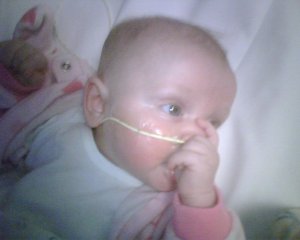
Stella finds her thumb.

Stella finds her thumb.

This was a day when we didn’t fall behind, or get ahead. For the most part, we were simply on hold. And that was okay. Stella did have a first, and she was delightful company as usual.

Stella’s first appointment, with our occupational therapist, was cancelled. I was not disappointed to miss it,  as we’ve been seeing progress and therefore want to continue with the strategies that are working. I received another cancellation call from Dr. Devorah’s office. The news that Stella’s cranial osteopathy appointment will need to be moved from tomorrow to next week left me feeling a bit crestfallen. My hope is that they will fit us in on Monday, or as soon as possible.

Her ultrasound appointment was not cancelled and went smoothly. Somewhat concerning to me was how well she handled several hours without eating–we were given strict instructions to ensure that she had an empty stomach. She’s definitely come along in the hunger department. Having self-limited her own intake for weeks, before the tube, she’d happily go for long stretches of time without eating (despite my best efforts). These days, she usually does get hungry every three to four hours. So I’m trying not to worry about it.

While in the Radiology waiting area at Children’s, a woman struck up a conversation with me. She remarked on Stella’s cuteness, and politely inquired about why Stella has a tube. I explained the whole situation, and she nodded knowingly. Her son had severe reflux that wasn’t treated until he was nine months old! He only weighed ten pounds at that age, and therefore required a tube for a long time. Another woman, sitting across the room, piped in, “That’s exactly what’s happening with my son!” He is four months old and his doctor only just recently diagnosed and began treating his reflux. She described the enormous struggle involved with feeding him, and it was as if she were telling Stella’s story. He was a lot smaller than Stella. He did not have a tube. Though I did wonder about how they were treating his aversion, I didn’t pry. We simply discussed our shared frustrations and took comfort in talking to someone who really “got it.” Both women said they were impressed with how healthy and big Stella looked, which made me feel great.

All in all, Stella did okay with the bottle today. Just okay. She ate with less enthusiasm. In fact, she seemed a bit bored, which made me wonder if I’d made the formula too thick and therefore too slow. On the bright side, she wasn’t upset about eating. She was relaxed. And she took about half a bottle while we were at Children’s–the most she’s taken away from home–even though she kept getting distracted by her surroundings. She stopped eating a couple of times, then continued, which is always encouraging. But her head swiveled as she ate and I had to move the bottle in an attempt to keep the feeding going. I could almost hear her thoughts unfolding one right after the other: “Whoa, what was that noise? Who’s that funny-looking guy? What’s that shiny thing in the corner? They call that a gift shop?”

While the ultrasound technician stepped out of the room, Stella did something with much enthusiasm, for the first time that I’ve seen. She sucked her thumb! That’s right. Stella has discovered her thumb and she loves it. Her Dad was a thumbsucker (if there was a hall of fame, he’d be in it) and it looks like she’ll be following in his footsteps. I captured this milestone on my cell phone camera. As happens so many times with Stella, I couldn’t stop smiling. Can’t wait to see what she does tomorrow.

Trials, tubes and tribulations

When Stella began to stop eating, so did I. Not intentionally, mind you. I just couldn’t. My appetite had left the building. Anxiety made it impossible to keep food down. I had to use juice, and the mantra “For Stella!”, to swallow anything. Besides, with dairy out of the picture, my go-to comfort foods were literally off the table. Stella and I were on disasterous parallel paths. As her weight gain slowed down, my weight plummeted. I wasn’t eating, and with all the pumping, I was burning hundreds and hundreds of extra calories. My lips were cracked and bloody and my skin rebelled. Of course, my declining health did not bode well for Stella. As one doctor put it, we are “a unit.” I needed to be strong and healthy for her and me.

So, on mornings like today when there is one tube-related fiasco after another, I think back to the days before the tube, and how terrified and helpless I was in the face of her eating refusal. At least now, with the tube, we can be sure that she is getting the nutrition she needs to thrive. Another important benefit  of the tube is that it takes the fight out of bottle feeding. As our occupational therapist explained, Stella has been trying to tell us something. And she felt like she wasn’t being heard. Despite her protests, we kept trying to feed her. We had to. But it was leading nowhere. The more we fought with her, the less she wanted to eat. With the tube, we can offer the bottle with less pressure and stress. We can allow her to eat comfortably for as long or as little as she wants, without having to force the issue. Each positive experience teaches her that eating is enjoyable. On our fridge, I’ve posted a quote by our occupational therapist: “If eating is fun, the volume will come.”

As I’ve explained, except for a couple feedings at night which we administer by pump while Stella is asleep, we always offer Stella a bottle before resorting to the NG tube. What exactly is involved with tube feeding? Before any formula can be delivered in the tube, we must check the tube’s location–to make sure that it is indeed in her tummy and not in a lung or otherwise out of place (scary, I know). We do this by attaching a small syringe to the end of the tube and squirting a cc or two of air into the tube while listening to Stella’s tummy with a stethascope. When we hear the whoosh of air, we know we’re clear. We pull the air back out into the syringe to help minimize gas. Stomach contents (watery-looking formula) usually come back out with it–while unsavory, this is actually okay and just another way to confirm that the tube is in the right place.

After confirming placement, we use the pump or “gravity” to provide Stella with the remainder of her feeding. The gravity method simply involves attaching a fat 60-ml syringe to the end of her tube, filling it with the formula and holding up the syringe as it slowly flows down the tube. Holding it up higher makes the formula flow faster, and holding it lower slows down the flow.

We usually choose the gravity method when Stella takes at least half of her bottle. When there is more than half of a feeding left, we go with the pump, and there’s more legwork involved. We have to fill a feeding bag (which unfortunately makes it sound like we are taking care of livestock and not a precious baby girl) with formula, “prime” the bag and its attached tubing to eliminate all air, hook up the bag’s tubing loop to the pump, program the pump so that the rate of flow and dosage are set, connect the bag’s tube to Stella’s tube, then hit “run” on the pump. It’s imperative that we stay with Stella during the pumping, for safety reasons. When a pump or gravity feeding is finished, we then flush Stella’s NG tube with a couple cc’s of water to keep it clear and clean. From start to finish, a feeding takes 45 minutes. We do this seven or eight times a day.

We had a tough morning today, and the tube felt like our enemy. Stella took only 5 mls from her first bottle. The pump malfunctioned twice, so she didn’t get her full amount of formula at two feedings. A feeding bag leaked all over the place. Stella threw up. And worst of all, Stella sneezed out her NG tube.

This means that I had to put a new tube back in. Frankly, this is something that no parent should have to do to their child. But I do it, because it’s less traumatic and disruptive than taking her to the emergency room where we wait around in a room full of sick kids until a strange person in a not-so-cozy environment shoves a tube into her nose as Stella lies on a flat hard bed under harsh hospital lights.

I wait until Stella is asleep. I measure and mark the tube so that it will sit right at the base of her sternum at the entrance to her little tummy. I dip the end of the new tube in both lubricating gel and water to make it extra slippery. I tear off pieces of pink medical tape and have them at the ready, for securing the tube to her chubby cheek as soon as  the tube is in. I take a few deep breaths, try not to cry, and do one of the hardest things I’ve ever had to do.

She wakes up a second or two after I begin inserting the tube, but I have a few more seconds before she realizes what’s going on. Then she starts crying. Really, really crying. I give her a pacifier, which calms her and helps the tube go down due to the swallowing action. Within seconds, the tube is in, and I can simply hold, rock and comfort my sweet Stella Bella. She only cries for a couple of minutes before, amazingly, I get a smile. I tell her that she is so strong. That she and I will get through this and be just fine. That I love her more than words can say. And that I could not be more proud to be her mom.

How Stella went from the boob to the tube.

Where to begin? Somehow, we moved from exclusive breastfeeding, the most “natural” thing in the world, to formula feeding through a nasogastric tube, a medicalized method of feeding that we’ve yet to make peace with and hope to leave behind soon.

Stella stopped wanting to eat sometime ago. It began slowly. Practically imperceptibly. At around 5 1/2 weeks, I noticed she’d cry sometimes while nursing. She’d gag or choke on the milk a bit. So I tried nursing her in different positions, in an effort to slow down the flow of milk. It seemed to help, but she wouldn’t eat for very long. Of course, we’d seen a lactation consultant early on who told us with much enthusiasm that Stella was an incredibly efficient nurser who managed to take in a lot of milk in a little time, so it seemed okay.

Then, there was the ER trip in early October when she was eight weeks old. She vomited and had blood and diarrhea in her diaper. After x-rays, blood work and a stool sample came back looking good, they suggested that I stop eating dairy as lactose intolerance was the most likely explanation. I would go on to give up dairy for two months. (As a friend put it, this was “a fate worse than death.”)

Soon after, at her two-month appointment, we learned that she wasn’t gaining weight as quickly as expected. She’d dropped from the 50th percentile to around the 25th. We were alarmed, but she seemed happy and didn’t seem have too much trouble eating at that point, so we didn’t panic. However, week after week of slow weight gain along with Stella’s increasing aversion to eating soon made it clear that something was wrong. We had to do something. But what?

Well, first we switched doctors. Her pediatrician was nice enough, but didn’t take our concern very seriously. He said, and this is a direct quote, “Just keep feeding her.” Sigh. I also met with two lactation consultants several times each. Meanwhile, I spent all day every day just trying to feed her. The stress was unbearable. My milk supply had gone down in response to her taking in less, so I was pumping around the clock as well. A typical day entailed monumental, constant feeding efforts. I fed her by breast, often with a leaky, pain-in-the-ass supplemental nursing system, by bottle (though she really didn’t accept it from me), and even one milliliter at a time via medicine dropper, all in a desperate attempt to provide her with adequate calories. I was on the verge of a nervous breakdown.

Finally, one of the lactation consultants witnessed Stella’s refusal to eat and was convinced that she suffered from reflux. Because Stella didn’t spit up or vomit, her reflux was harder to detect (it’s called “silent reflux”). Soon after, Stella’s new doctor prescribed Zantac to reduce the acidity of her stomach contents and therefore alleviate the pain of reflux. She also recommended that we collect a stool sample for a “reducing substances” test that could shed light on whether she was lactose intolerant. After weeks of trying, we finally got one, and testing showed that there was indeed lactose in her stool. The lactose wasn’t being broken down, indicating temporary (or secondary) lactose intolerance–the kind caused by damage to the GI tract, which babies outgrow by around one year of age. (Later we would learn that it wasn’t that simple, but it was nice to finally discover a big piece of the puzzle.)

Also at the suggestion of the lactation consultant and in cooperation with Stella’s doctor, we got in to see a feeding specialist–a renowned occupational therapist–at Seattle Children’s Hospital. She was struck by Stella’s intense level of upset and adamant refusal to eat. A few days later, after another week of low weight gain, we were admitted to Children’s for what ended up being a four-day stay. They placed the nasogastric tube (so traumatic!), through which she is fed hypoallergenic Elecare formula. Whatever she refuses to take orally, she gets through the tube. (Mistakes were made at the hospital which painted an inaccurate picture of her status and therefore resulted in less than optimal decision-making. I will explain all of this in a future post. None of the missteps were devastating, but I believe that sloppiness and inattention clearly diminished the value of our stay. )

The formula has helped. She is a lot more comfortable now. For several reasons, we moved on to a new pediatrician who has more direct connection and access to Children’s. He has seen this in many babies, and believes that Stella has a cow’s milk protein intolerance (simply put, dairy is one of the only things that passes through in breastmilk without being broken down), which irritated her gut and impaired her ability to break things down, including lactose and fatty acids, which were both detected in her stool sample. A stool sample taken after a couple weeks on the formula came back normal, so as emotionally difficult as it was to move away from breastmilk, we know the formula has made a clear difference.

At this point, reflux and eating refusal remains. During and immediately after her hospital stay, her intake by bottle had improved a great deal. But since then, it has regressed, a difficult reality for Cody and me to accept. However, her doctor, who is wonderful, says that many babies regress while on the tube, but that she should rebound and pull through in time. Our biggest challenge these days is to stay positive and to keep the faith even when eating doesn’t go well.

We see both her doctor and occupational therapist (who provides us with new strategies aimed at making eating more enjoyable for Stella) weekly. We will meet with a pediatric gastroenterologist at the end of the month. We are strongly considering allergy testing, craniosacral work, and an adjustment in her reflux meds. We track every milliliter that she takes and doesn’t take, enter it into an Excel spreadsheet and analyze it in graphs and charts. At night, we wake up every three hours to feed her by pump so that she can get enough calories and a good night’s rest. We are doing everything we possibly can. We have gone above and beyond since the beginning of all this in an attempt to help Stella thrive. There is a sense of peace that comes with knowing this.

People called me a warrior after Stella’s 32-hour, unmedicated birth. But, looking back, it wasn’t true. I didn’t become a warrior, or earn my stripes as a mom, until all hell broke loose. Until Stella struggled, and I proved that I would move heaven and earth to help her even just a little bit. I’m proud of that. I’m proud of Cody for his incredible sacrifice, support and efforts. And I’m proud of Stella. She’s happy, healthy and sweet as can be. She is doing the best she can given her early, unfortunate experiences with eating.

Her mom is as stubborn as they come. So it really comes as no surprise that our little girl is as strong-willed as can be. She is such a wonderful, strong character. As hard things are right now, one thing is for sure: she is going to be just fine.

Much more to come.