Blogging. Stella. Me me me!

Feeling anxious. It keeps being said in the media and whatnot (on blogs, probably) that blogging is extremely narcissistic. I’m worried that I’m not measuring up because this blog is only somewhat narcissistic so far.

You see, I need to write about things in addition to vision therapy but I’ve been afraid to. So I apologize to my optometrist and vision therapist readers in advance.

Obviously, it doesn’t get much more “niche” than this blog. I may not reach too many people but some of the ones who do come here find stuff that is very, very directly helpful or interesting to them or their child. I need to figure out a way to organize the site into clear sections so my three different audiences of subscribers (of roughly ten people each whom I ADORE) can find the niches (great word) that they’re looking for. Or maybe I’ll keep Stella and motherhood stuff going here and start a new blog for other stuff. We’ll see. Deep breaths, everyone. It’s going to be okay.

The three current subject areas are broken down as follows:

  1. our feeding tube weaning journey and associated learning (a ton of my traffic comes here for this)
  2. strabismus, amblyopia and vision therapy experiences, information and associated amazing breakthroughs and fearful frustrations (more and more of my traffic is being generated by this)
  3. random crap that I find interesting or amusing as a mom or writer or wife or human being (no one comes here for this stuff–even my humor is a niche)

I’ll try to figure out how to enable you to opt in only to posts about Stella’s eyes, or tube weaning (once in a while I still find tube weaning information and stories that I’d like to share here!), or random (entertaining, maybe, I hope?) crap. That way you won’t have to deal with the rest showing up in your inbox. Here’s a good example of something you may like to skip. I took it from my Facebook page but find it amusing enough to post here:

Navy Hibiscus Sundress on Zulily

Navy Hibiscus Sundress / Unicorn Butterfly Bait

I am considering this summer dress for Stella, but the product copy is just too cute! I’m too busy rolling my eyes to make the purchase. Am I just jaded? Here it is: “A just-right cotton poplin dress like this one has magical properties, inviting colorful butterflies to land on her nose in between twirls. And after that, maybe a strawberry ice cream cone appears in her hand.” Yeah, and after that, maybe a unicorn craps cupcakes in our backyard.

I love Stella. And I want to continue to share the oh-my-god discoveries (like prism goggles, thanks to Dr. T) that have made such a difference–first for her gastrointestinal tract, and now for her eyeballs. But frankly, she’s really thriving and therefore is not giving me enough material. So I’d like to share other stories involving Stella, but not too many because I want to protect her privacy, and non-Stella-related topics. I don’t really know what to write about at this point or how to do it but I will get there, damn it! I’m a copywriter by trade but want to do other types of writing again (I’ve flirted with “real” writing before). I need to write! About stuff! That I care about! As a whole person! Though I don’t think I’ve been 100% “whole” since those two months when I had to give up cheese in 2008. A small part of me died due to deliciousness deprivation.

The last thing I write will be typed through awkwardly teary eyes. Thank you so much for reading my blog. We (and by that I mostly mean me/I) had some dark times amid the wonderful ones these last couple of years, and sometimes, just knowing that people were reading our story and relating to it or cheering us on or somehow benefiting or even laughing at my desperate attempts at humor–it saved me from really plummeting. This story could’ve gone a lot differently. And the comments. Oh my gawd the comments. Soul-soothing and life-affirming, just like cheese! I’m making a really ugly crying face right now. I wish you could see it so you’d know how much I mean this. Okay maybe not. Phew.

And with that I’m going to go collect a cupcake from our backyard. I ordered the dress from one of those anxiety-inducing daily deal sites–and it’s already working its magic.

Re-entering the ring: Stella the Spella!

Just a few small updates for now.

Stella can spell her name and delights in doing so. I’m extremely proud of her, as you can imagine. I suspect she’ll start spelling other words soon. She’s making a habit of quickly rattling off the letters in the words she sees. I have to say that it’s encouraging, vision-wise, to hear her say the letters one after the other, so smoothly and accurately. Maybe I’m over-thinking it, but I’ll take it. Bam!

She’s turning into my little kitchen helper. Tonight she had cheese-sprinkling and cauliflower-tossing duties. She kept moving her stool from one station to the other, requesting to check on the dish in the oven, and nibbling leftover chopped onion, shredded cheese and avocado–oh and a slice of lemon. She’s proud of herself and the results, more invested in the meal, and I have less to clean up. Bingo!

Stella is a gymnast now. We go once a week to a nearby gymnastics academy, and many of the exercises we do there are identical to ones recommended by our vision therapist (like animal walks, donkey kicks, etc.). Of course it doesn’t feel like therapy. It’s just fun! And Stella is quite fearless and adept! She can walk the entire length of the balance beam by herself with her arms straight out, do somersaults down ramps, hop like a bunny down the bouncy track, launch herself into the foam pit, and pull her feet up under the bar when hanging from it. She’s so strong. Her enthusiasm overflows.

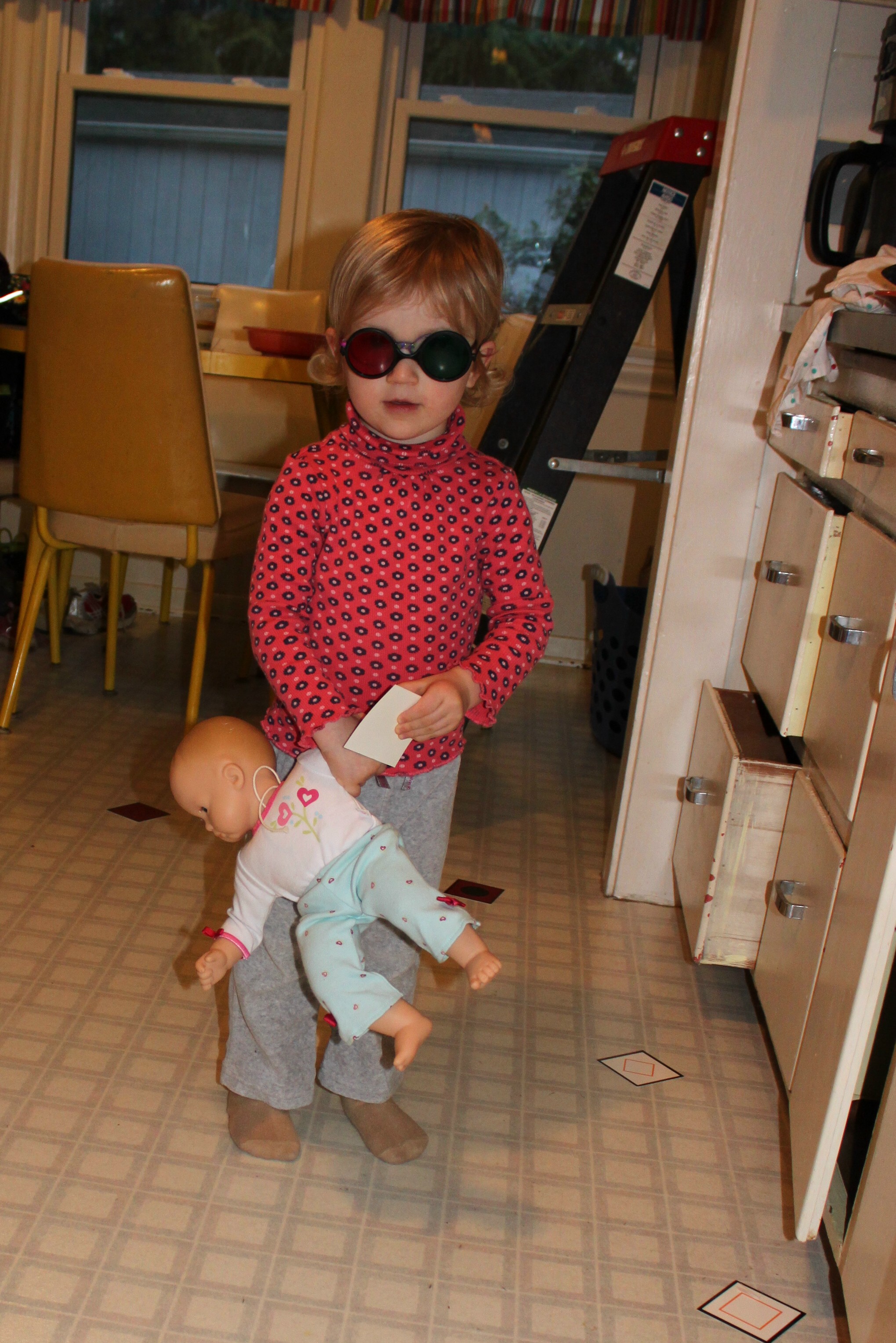
She’s owning her current at-home vision therapy, which includes use of flippers for near work (hand-eye coordination stuff) and red and green overlays side by side on the TV with red/green glasses (five minutes each way). Stella breezes through these. We work in vestibular activities here and there, too. My current goal is to purchase a toddler-sized pair of the yoked prism goggles. Having access to them only once a week is creating too much stress and pressure. Getting our own pair is the solution to the currently upsetting and unhealthy situation. Despite my efforts to stay neutral  during goggle time, I’m sure she senses my expectation and feels pressured–it’s time to take that away. It’s time to be reasonable and not expect her to tolerate them for a large chunk of time once a week and allow ourselves to break it down into more comfortable, age-appropriate pieces.

Tomorrow we return to vision therapy, in a new afternoon time slot after an illness-induced hiatus. I’m bringing a document I’ve typed up that outlines suggestions for making vision therapy more beneficial and less stressful for Stella, including the need to purchase our own pair of goggles. I know Stella best, after all. And I want to make sure I’ve done everything I can to make these sessions work for her, instead of producing such angst (for both of us). The new non-morning time should help, but there are more creative, thoughtful strategies we can implement, or at least try. I’ll share the ones that work, along with overdue descriptions of how creative solutions have helped make home-based exercises successful. You’d laugh if you peeked in our window and saw the silly things I do in the name of vision therapy. You’d be amazed if you could see how far Stella has come with specific abilities, how resilient she is, and how wonderfully willing she usually is when it comes time to play her “eye games.” And you’d be shocked if you could witness how such small adjustments can make all the difference!

There’s always hope if you ask me. We may get down after a rough appointment, but we never give up.


Sucker punched!

Well, today’s vision therapy could not have gone much worse.

She refused to wear the prism goggles for more than a minute or two at at time. Not only did she kick, throw and scream, she attempted to toss all the folders and paperwork off of Bethanie’s desk with several angry sweeps of her little but surprisingly strong arm. I had to fight back tears most of the time. I enforced a much needed time-out and we ended the session early.

All is not lost, certainly. We realized that on the days we’ve done vision therapy in the afternoons, we make more progress with Stella. Having to wake her up, rush her through her morning routine and have her start these exercises after only an hour of wakefulness seems to be problematic. Next week, we have an afternoon appointment.

Today, I’m getting myself a treat. Today, I’m doing what I want to do and Stella is merely coming along for the ride. I need to focus on myself right now, because the hope and energy I put into her may be too much at times. Like today. I was so crushed. I know it’s definitely not true, but it feels like she just crapped on my head, for kicks.

In closing, for a future in which my dear daughter reading this: I love you so much Stella, even when you were a ruthless tornado in toddler form. That’s why days like today are so hard.

How vision therapy is saving Stella’s toes, and then some.

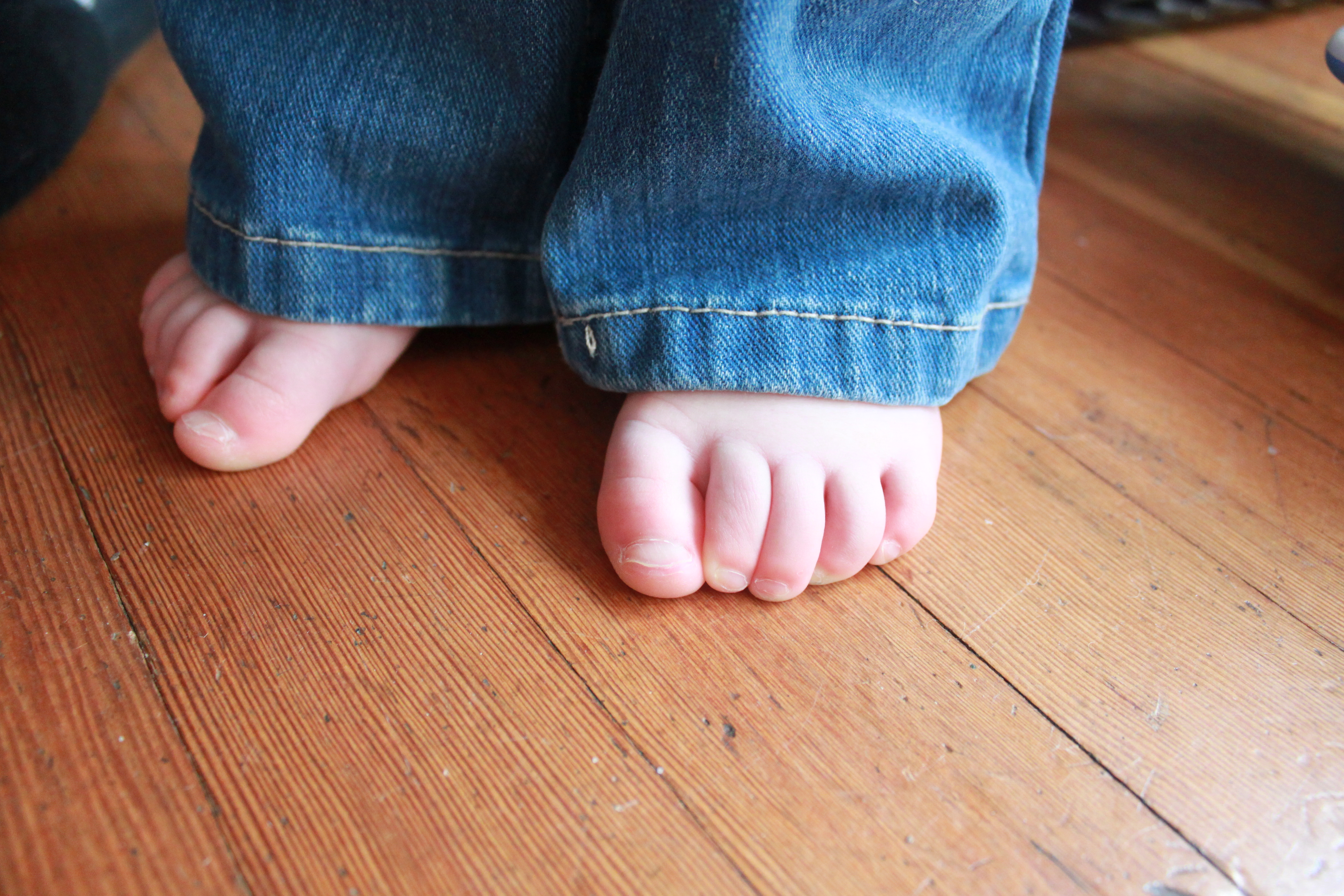
The hardest working toes in the business (of running around)

The hardest working toes in the business (of running around)

Stella is a toe-walker.

She’s been tiptoeing around for as long as I can remember. Prancing, really. Her gait has been so bouncy and adorable, so evocative of a little ballerina, that her physical effervescence has charmed even sour onlookers. I’ve been kindling a small flame of worry about her overworked and constantly clenched toes, despite an inner voice that told me to stop looking for trouble where there was none.

Early last year, I met up with Stella’s occupational therapist–the OT who helped Stella overcome her feeding aversion–to check in and discuss ideas for an article about our feeding experiences. I couldn’t help but ask for her expert opinion on Stella’s toe-walking. And just as I’d hoped, she reassured me. She rightly noted that Stella could stand on flat feet, bend her legs and pick something up with ease. Stella walked flat-footed here and there, and when she stood still, it was often on flat feet. Clearly, Stella was not incapable of walking flat-footed. Besides, she was less than 18 months old at that time, and toe-walking is relatively common in such little ones. In my heart and soul, I agreed with this assessment. I mean, really, do we have to make every little kid quirk into a problem to be fixed? It made me angry to think that something so seemingly age-appropriate and  harmless about Stella could be pathologized. Enough with the medicalization of childhood already! As my dad used to bellow, in Braveheart fashion complete with a raised fist before leaving to pick up our Friday night pizza, “Who is with me?!” So I stopped worrying about it. For a while.

Fast forward a few dizzying toddler months. Sail past the great eye-crossing incident of 2010 and whiz by the diagnoses of strabismus/accommodative esotropia, hyeropia, anisometropia and amblyopia. Jump to Stella’s first appointment with her developmental optometrist, Dr. Torgerson (“Dr. T”) of Alderwood Vision Therapy Center. (‘Bout time I named her–we’re very lucky.) Upon meeting Stella, having taken her hand in the waiting room and led her to the exam room, Dr. T noticed that Stella walks on her toes. (Note: Stella’s ophthalmologist never noticed, or at the very least never mentioned, this.) During that consultation, Dr. T placed yoked prism goggles over Stella’s regular specs. Stella’s toe-walking was completely eliminated. She walked flat, instantly. No. Joke. Stella seemed to be looking at everything with new eyes. Dr. T seemed interested but unsurprised and made a note that this was worth exploring. I was still a bit defensive, a bit reluctant. I tried to reason around it. As in, “Well, she was just walking very slowly and cautiously due to the weird distortion of the prisms and that’s probably why she wasn’t as bouncy or tiptoe-y.” Of course, while my focus at that time was beginning a course of vision therapy to address the aforementioned diagnoses, I did at least make a mental note about the prisms’ elimination of her toe-walking. In truth, I pushed it aside, not wanting to create another problem. Not wanting to accept that in addition to her feeding and vision challenges, Stella’s toe-walking was “an issue.”

Turns out that the toe-walking wasn’t so much a seperate issue as an unexpected (to me) extension of her visual one(s). Since that fateful day, Stella has worn the prism goggles many times during vision therapy sessions. After the first time Stella wore them under the guidance of our vision therapist, Bethanie, I was sold on their effect. There was no denying it! I was struck not only by how her gait instantly changed, but also her demeanor. With the yoked prism goggles (the stronger the prism, the more pronounced the effect), she not only walks “flat” but also seems more calm and able to focus. The stronger ones are pretty overwhelming, however, so we’ve scaled back to some less powerful ones with plans to work in the original stronger pair soon. It’s a mind-blowing work in progress, if you will.

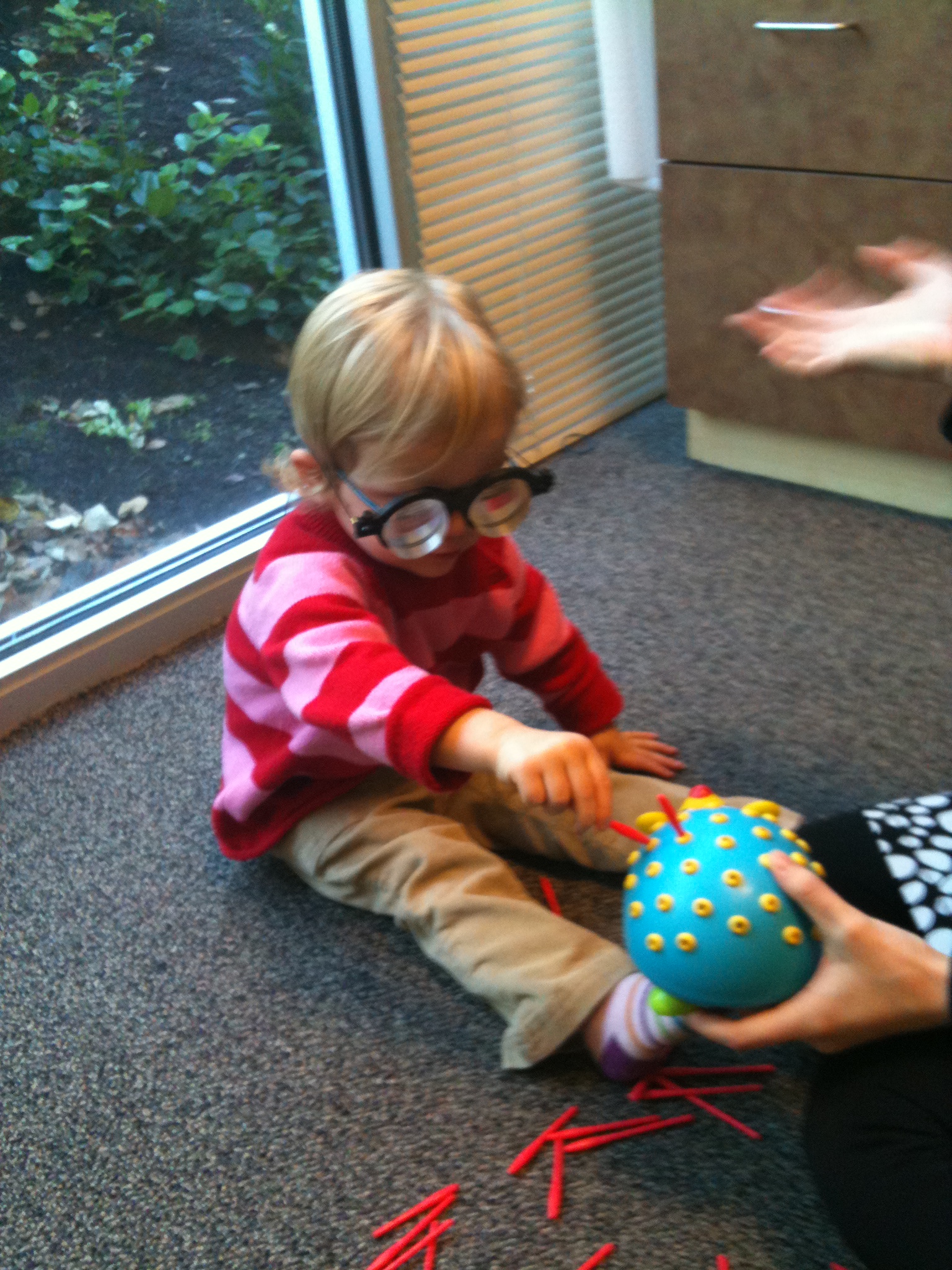
Stella's first run with the uber nerd glasses--I mean, yoked prism goggles

Stella's first run with the uber nerd glasses--I mean, yoked prism goggles

In essence, yoked prism goggles help re-wire the brain, forcing it to re-map spatial relations. Every time she wears them, they help her gauge the world more accurately. The repercussions are stunning. This isn’t just addressing Stella’s vision. Changes are happening in her brain, in how she perceives the world and her place in it. And that dramatically affects how she feels and behaves.

When Stella leaves those vision therapy sessions (wherein she wears the prism goggle, of any strength, really), she is more outgoing. She is open. Allow me to explain why that fact is so incredibly huge. I don’t label Stella as shy. I don’t want to presume, at age two, that “shy” is who she is and I don’t want to convince her that it is. But I will say that she is often quite tentative. We do see flashes of wonderful social interaction and friendliness–she’s very attached to her best friend, Cooper–so I know her social self is in there. But most often, she shrinks back under even the friendliest gaze from a stranger, or is daunted by mere proximity to people.

On the playground, Stella’s crowd avoidance is overt. She rarely uses structures if anyone else is there already. If someone playful soul is on or near the slide, instead of waiting for a turn or walking up with the understanding that they’ll be down soon, she avoids it completely. If people step aside and watch her, with a smile and friendly encouragement or quiet patience, she refuses to go down. She’s protective of herself. At music class, when the basket of instruments is placed in the center of the room, every other child in the room just flat-out goes for it. They make a beeline for the basket, and grab what they want, carefree! Stella immediately takes a step or two forward, only to halt as everyone rushes by. She waits for a big opening instead of squeezing in willy-nilly like the rest. Part of me has long wanted to push her into the fray. To tell her that she’s just as entitled and doesn’t have to wait for everyone else to take first pick. I just chime in with lighthearted encouragement, and a hand on her back.

Qualities like patience and shyness seem almost beside the point when I think about her vision, and the effect of the yoked prism goggles. I’m now convinced that such reserved, cautious behavior is due, at least in part, to the effect of her visual field–not just her innate personality. Crowded places (especially new ones) and chaotic situations can be so, so anxiety-producing for Stella. Thankfully, at long last, I now believe I understand why. She has trouble gauging her place in relation to a crowd. Per Dr. T and our vision therapist, Stella’s peripheral vision is likely limited, creating a type of tunnel vision that makes life more stressful. She’s always on guard because she’s learned that objects in her proverbial mirror are closer than they appear. She can’t quite trust her visual system in those situations. How startling that would be! And how draining and frustrating to be startled so often. So she takes extra precautions. Her separation anxiety, viewed through this lens of understanding, makes much more sense to me now. I’m her anchor amid the unfamiliar and unstable.

The same visual issues that cause this sort of defensiveness also give rise to her toe-walking. It’s not so much a problem as a solution Stella has come up with to better orient herself in the world as she perceives it. I get it now–the details may be hazy, but I am starting to understand a bit better how Stella sees, and how it affects her way of being.

Back to those yoked prism goggles! Despite some difficulty in getting her to wear them for extended periods, they seem to somehow relax her, and the results are stunning. After her last vision therapy session, during which the goggles are now a prominent therapeutic fixture, Stella ran out into the waiting room and strode right up to a much older child, looking him in the eye and beaming! I was elated. A few sessions ago, in the waiting area following one of her first (“full-strength”) prism goggle trials in vision therapy, Stella started chatting with another family. The mother was gently encouraging her children to put away the toys, and put on their coats, because “we’re going home.” Stella walked up to her, looked her in the eye and said, “We’re going home too! I’m going home!” She kept engaging them, over and over, as they walked out. They smiled and acknowledged her, probably regarding it as typical little kid behavior, but to me? I had to hold back emotion. On yet another such occasion, in between those two examples, Stella walked into the play area of the waiting room after goggle-clad vision therapy, waltzed up to the small play table which was closely encircled by older and taller children, and she confidently and without hesitation joined them. She nudged right in next to a 6 or 7 year old boy. She looked at him, started talking, and reached for the toys on the small table as the others played as well. She was unphased. I was awed. Deeply heartened. That was Stella, freed! That was Stella, no longer feeling caged in by her vision. Her world had opened up. She seemed lighter, less stressed, and more engaged with everyone around her. She carried an innate sense of security. I want her to feel that secure all the time (hek, I wish I did!), or at least more often. My hope is that continued use of the yoked prism goggles will get her there–in tandem with our other vision therapy efforts.

Already, Stella’s toe-walking is fading away. She isn’t so high up on her toes, and she uses her heels more often when getting around. Also! She used to flap her arms, especially when happy and excited, but we just realized that she hasn’t done that in a long, long time! Bear with me: Based on limited but fascinating reading, I’ve gathered that autistic children and others with tunnel vision (or other related visual issues in which ambient vision and/or depth perception are compromised) use arm flapping and toe-walking in part to help gauge their place in relation to their environment. Stella is not autistic, but there are clear parallels between Stella’s vision challenges, and even her behavior in specific situations, and those of autistic kids. Many of them would greatly benefit (not just visually but socially and emotionally and in all kinds of ways) from vision therapy yet never get exposure to it. Hopefully that’s changing as awareness of vision therapy grows. So much needless suffering could be eliminated or at least significantly reduced. I am the wanna-be Gandhi of vision therapy.

My view of vision therapy has greatly expanded over the months, along with Stella’s vision therapy regimen. At first, back in the dark ages, I viewed this work as the remedy for Stella’s amblyopia and probable accompanying deficit of stereoscopy. Plain and simple, just like the initial exercises: catching balloons, stringing beads onto pipe cleaners, and the like. Now, her exercises are centered around yoked prism goggles and vestibular activities. She’s using her whole body. Her brain is re-configuring the world. This isn’t an effort to “fix Stella’s eyes.” It’s a campaign addressing the myriad of ways her vision affects her physical and psychological wellbeing. And mine. Our stress reverberates between us, and can be overwhelming at times. I try to take a tip from Stella and just step back and be patient as we work through this, but sometimes I fail. It’s okay. We’re both doing the best we can. I get cupcakes for myself too often, but that’s a small and delicious price to pay.

The goal as I now see it? Stella won’t feel the need to tiptoe through life–literally or figuratively.

My own pilot study: Microwaves’ effectiveness in increasing compliance with vision training

The solution was there, sitting in the corner of the kitchen all along. My microwave timer has saved patching. The  obtrusive but helpful-in-a-pinch black box has also helped salvage the vision therapy we do at home. Cue an annoying series of loud, celebratory beeps!

It makes sense. The only reason women endure childbirth is because we know that it will end in a few (okay, maybe 32) hours. It’s a relatively short timetable. This is why, at the Cape Cod Bay Basketball Camp, I managed to swallow suffering and push myself to the limit of heat exhaustion and muscle failure during drills on sizzling hot blacktop that threatened to melt the soles of my black Nike hightops. It’s how I now carry my giant toddler home from the park down the street, when we’re running behind which is always, even when my arm is about to detach and my grimace nearly devours my face. The end is in sight.

Over recent weeks, Stella did her best to refuse to patch. Which meant I spent all day trying to eek out small periods of patching in order to accumulate two hours’ worth. But last week, the answer suddenly came to me. I took her hand and led her to the holy shrine of now-passe cooking technology that is the microwave, and said, “It’s patching time. So we’re going to set the timer for 90 minutes, and when the timer beeps, you can take it off yourself!” I said it the way you would say, oh, “We’re going to Disney World right now. When this timer goes off, you can eat ice cream while riding the tea cups with Mickey Mouse!” As if Tinkerbell had cast a magic spell, Stella quietly allowed me put the patch on the glasses and place them on her face without any fight or resistance or complaint whatsoever. It has been working ever since. Trust me this is just as miraculous as, say, seeing Jesus in a piece of toast.

So yesterday I tried applying this super brilliant countdown strategy to vision therapy. We are currently only doing very physical, “vestibular” activities (spinning, rolling, etc.), and they go fast (you know, when they go). I turned into Jack Bauer, set the timer for 15 minutes, and informed Stella that we had to do four eye games before the timer went off. I told her this with the urgency of a counter-terrorist expert called in to thwart an impending explosion. Only my voice was much, much higher, more enthusiastic. It helped! Though by about 10 minutes, we were significantly derailed by someone’s whining and avoidance tactics. So, I’ll split “eye games” up into two 10-minute sessions, spread apart, and see how it goes. Aaaaaand that sentence shows clearly how such mind-numbing minutia has officially taken over my life. Hey, we do what works, and you’ve got to celebrate the little triumphs (our children’s and our own), right? RIGHT? [Insert guzzle of wine directly from the bottle.]

Please excuse me while I go high-five Stella and snuggle with the microwave.

Two points of view. One big push forward.

Big girl

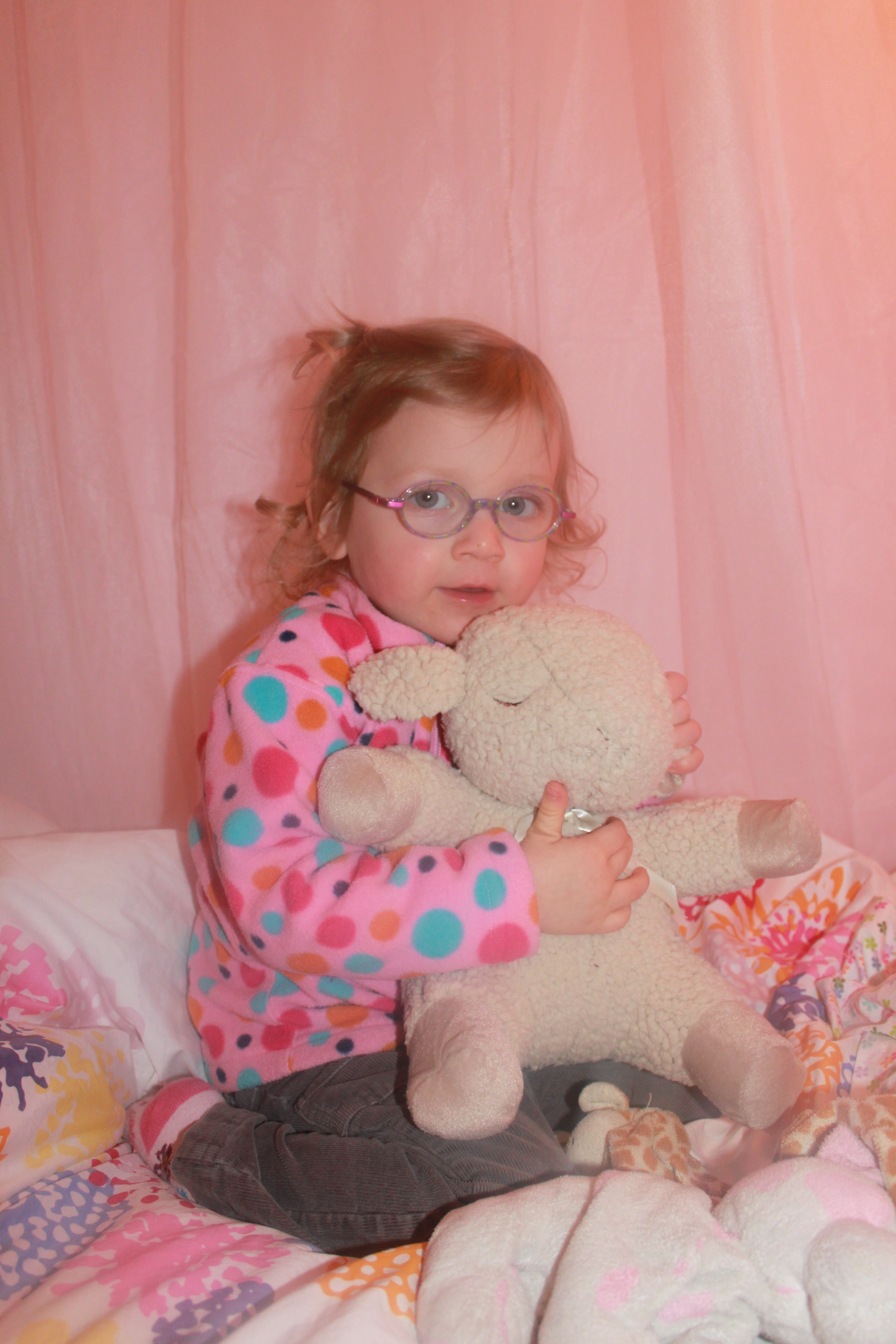
Big girl bed! New purple glasses! Happy Stella.

In the first chapter of John Gottman’s wonderful book, Raising an Emotionally Intelligent Child, my current daily life is illuminated: “Behavioral psychologists have observed that preschoolers typically demand that their caretakers deal with some kind of need or desire at an average rate of three times a minute.” Stella is officially two and a half, 38 inches tall and sleeping in a big girl bed. She has more demands and opinions and upset and glee now than even just six months ago. She’s in some sort of developmental transition period. At times I’m awed and at others, I’m borderline insane. This is a fun but challenging age requiring tons of patience. A tricky age indeed for vision therapy, which requires focus, patience and the tabling of those smaller demands in order to accomplish something she doesn’t fully understand. (I do think she gets it partially, though.)

Stella recently had two evaluations. One with her pediatric ophthalmologist and the other with her developmental optometrist, within about a week of each other. The conclusions by both were encouraging, overall, but quite different. Our intention was to use the results to gauge how vision therapy was going, especially since Stella’s been resisting more. We wanted to figure out whether we should take a break and come back to vision therapy in six or so months, or carry on.

The ophthalmologist determined that Stella’s amblyopic eye is 20/40 but bordering on 20/30. And that her other eye is 20/30 bordering on 20/20. They go with the lowest number, I suppose, in order to crush parents’ spirits–I mean, in order to be conservative and not overestimate visual abilities. (It does make sense.) She very cheerfully told us we could reduce patching from three to four hours to just two hours. I have not told her that we’ve been patching differently than she prescribed. Instead of patching three to four hours a day with an adhesive patch placed directly on Stella’s skin for complete occlusion, we’ve been patching two to three hours a day with Magic Tape over Stella’s glasses lens, and doing vision therapy, which they will hopefully remain ignorant of because I don’t want it to taint their assessment or treatment of me and Stella. It was reassuring to hear her, someone who said Stella may have to patch for a few years, say that patching was effective and that we could reduce it. At the end of the appointment, I asked her, “So, is there anything else we can do for Stella?” She hesitated for a split second and then said, ‘No. It doesn’t matter what they do while patched.’ And that was that.

Hold onto your hats. In our evaluation with the developmental optometrist, Stella showed 20/20 vision in both eyes. This is huge, and I haven’t really come to fully believe it yet–though I saw it with my own 20/20 eyes. It took Stella a tad longer to see the targets with her amblyopic eye, but not too much longer. She could see the chart’s 20/20 line far away and up close, with both eyes. Sometimes answering instantly, when the smiling doctor playfully sang “quickly quickly!” Why there is a discrepancy in performance between the two appointments, I’m not sure. The testing procedures and atmospheres were certainly different. Mainly, more time was taken at the optometrist, with more nuanced testing done.

Randot Stereo Test

Randot Stereo Test

While I was stunned when Stella identified the teeny tiny symbols (bird, cake, etc.) indicative of 20/20 acuity, I was just as thrilled when, during that same optometrist appointment, Stella was able to see three 3D circle images  in the top left section of the chart (the Randot Stereo Test at left). Last time, she didn’t get any of those and saw only one thing pop out at her–the 3D character in line A in the bottom portion of that left panel. Alas, she still only got one in that section. I suspect that her attention span complicates this, and the doctor did acknowledge that it’s possible Stella can see more than she is able to indicate. But perhaps not. As I’m known to say these days, after over-analyzing some Stella-related concern to the point of boring even myself, “Who the hell knows!?” I’m just grateful for the improvement.

The ophthalmologist’s 3D testing was much faster and simpler. Instead of a multi-layered chart with different lines measuring different degrees of stereoscopy, they used a single large image of a fly–the Stereo Fly test, which I learned about on Strabby (more on Sally and her blog in a minute). Stella seemed to try to pet the insect after some coaxing. They nodded approvingly. I wondered what Stella saw and thought and wished she could describe it to me.

I was crestfallen to hear, at the ophthalmologist’s office, that they saw no improvement in Stella’s vision. Yet they seemed incredibly happy with how she was doing. They noted that the acuity in Stella’s amblyopic eye is and has always been above average for her age. Her other eye’s acuity (with glasses, of course) is way above average. They said her vision was developing very nicely.

Both doctors concur that the eye crossing (esotropia), so far at least, has been eliminated by the glasses. Perhaps with help from vision therapy, as I believe the eyes did cross in exam with glasses earlier on in this journey. I haven’t seen Stella’s eyes cross in such a long time as they are aligned when she wears her glasses, which is all the time, excepting bedtime, bathtime and her weekly half hour of swimming (prescription goggles may be in her future) and occasional fits of toddler rage. Stella’s eyes did not cross in either of the recent exams, even after the typical attempts to break alignment. This is huge, often overlooked by myself and Cody, and worth celebrating with lots of wine. I have so many pictures from her babyhood in which I can now immediately detect the not-so-obvious difference in her eyes’ positioning. We also have photos and videos from her ER visit at 18 months of age, during which both eyes were severely crossed (seemingly out of nowhere, though again, we realize now that they’d been slightly misaligned, frequently but thankfully just “intermittently,” her whole life). We keep the ER images as a reminder of why we’re doing all of this. It’s very difficult for me and Cody to view them, because she looked so vulnerable and clearly couldn’t see anything except foggy blurs. But they’re powerful appreciation boosters, and quickly give me perspective when I’m stressing about Stella’s refusal to go to bed without getting up ten times to talk about Papa Bear’s porridge or flamingos or other topics meant to engage me and delay the train to Snoozetown by a good three hours. (And breathe!)

The bottom line is that her eyes–their refractive power and degree of slight astigmatism and as a result, their acuity–are different. It’s refreshingly simple. The two doctors agree on this. It’s the discrepancy between the two eyes that has led Stella down the path to amblyopia.

Both doctors, seeing Stella through their respective lenses, were very positive. Through the course of both appointments, I was amazed, disappointed, encouraged and informed on several levels. I walked away from these evaluations with some real reassurance, but also some points to ponder endlessly and inanely. Stella’s degree of stereopsis (3D vision) has improved wonderfully in just two months, but further improvement is needed. I wish I’d questioned the ophthalmologist more on their take on this. Do they think Stella has normal 3D vision because she tried to pet the fly (I think we called it a bee)? Are they settling by assuming, “at least she has some 3D vision,” or do they genuinely think she has age-appropriate stereoscopy? I wondered aloud to the developmental optometrist: When Stella has moments of experiencing 3D vision, does it freak her out and lead her to suppress her amblyopic eye? Our optometrist said that yes, this can happen. Which may explain why Stella frequently says, “Mommy I need a break!” But, the doctor explained, if I’m around, serving as Stella’s anchor and emotional safety net, it shouldn’t be an issue. For that reason and many others, I am so happy that I get to be with Stella during this time in her life. I get to be there to eat the pretend lunch she prepared and soothe her when her vision acts up (though I never really know for sure) and observe all the little things that indicate what she’s seeing and experiencing–which prove helpful to this process but might otherwise go unnoticed. I see how her peripheral vision is really good now. I see that puzzles are a breeze. I see her push her left lens closer to her eye. I hear her say things about her eyes that give me hope. I’m fortunate to have this time. Happy to take all (okay most) of it in.

Children's Eye Chart

These are the symbols Stella identifies.

These exams were more than just “let’s see how she’s doing” meetings. This latest evaluation, particularly with the developmental optometrist, was a crossroads. I was nervous. I feared Stella would feel my heart pounding as she sat on my lap in the big black exam throne. We came to this point of decision-making because it’s not only been increasingly tough to get cooperation from Stella for vision therapy at home, but also in the office at times. Some exercises are much more well received than others both at home and in the office. Some appointments are simply better than others and I still believe that she gets a lot out of all of them. At home, it can take over an hour to get 20 minutes of therapy done. (I find that time hard to fit in comfortably–but I suspect other, more normal and organizationally proficient moms might do a better job of this so I really don’t want to deter other families who have a child of two and a half who might greatly benefit from vision therapy.) We’ve been told to do the exercises earlier in the day, when Stella is less tired and there is more natural light, because we tended to shove them in at the end of the day. After a glass of wine, I’m a much more effective and relaxed vision therapist. But I am slowly getting better at overcoming my dread of possible screaming and infinite dawdling and learning to break therapy up into small chunks. A quick matching game (with the patch) before lunch. Sticking skewers intro straws while patched and eating dessert. That sort of thing. Did I mention that I’m not very organized? If The Container Store had a blacklist, I’d be on it. Though I do have a big green plastic box in which I dump all of our vision therapy games and tools, which is a true Martha Stewart moment by my standards.

In the end, due to her gains in 3D vision and acuity as witnessed in the optometrist’s office, and even the ophthalmologist’s thumbs up assessment of Stella’s visual status, we’ve decided to continue vision therapy for another few weeks, at least. With an emphasis on use of the yoked prism goggles, which merit an entire post (coming soon), and more physical exercises that engage the vestibular system and body as they relate to and inform vision, from what I gather, helping Stella’s brain devise a more accurate map of space and her place in it. Stella enjoys those activities more, anyway. Bouncing, rolling, running? She’s in! Donning red/green glasses and slowly scanning the kitchen floor for matches, MFBF style? She’s so done with that particular game. She used to get 15 matches in one shot, now I’m lucky to get five reluctant matches worth of cooperation and sometimes she refuses completely and we both end up in tears. So I have to roll with it and be more flexible than ever. Putting those cards on the wall over the couch and letting her bounce around while searching does help make it more novel and fun. But I’m not sure that exercise is worth it anymore. Stella’s vision therapist agrees and is going to move us along to some new MFBF exercises to build upon this work and mix things up. We really like her–she’s had letters thrown at her, cards torn out of her hands, and shrill, blood-curdling screams shatter her eardrums, yet she keeps a cool head at all times. Me? Not so much. I sweat during those appointments to the degree where I stash deodorant in the diaper bag.

So we are at the beginning of a big vision therapy push. Can I help Stella get to the next level? I sure hope so. We’re going to do our best. We’re seeing progress and it would kill me to break now especially with the promise of yoked prism goggles just starting to be a staple in her vision therapy buffet. If a break is needed after that, fine. But if so, we’ll be back at vision therapy as soon as Stella is ready. Do kids become more cooperative at three? Good lord I hope so because caring for a two and a half year old is like playing with fire. I’ll tell you what, though. I appreciate Stella’s strong will (the screaming? less so) and don’t blame her one bit for resisting patching and exercises, the purpose of which she doesn’t comprehend. Between that and patching, we ask a lot of her. She does amazingly well for her age, and knows her numbers, shapes, and letters better than many kids twice as old, which has helped make a lot of exercises possible. As they say where I’m from, she’s wicked smaht. Don’t even get me stahted!

It’s been twenty seconds since I’ve heard, “Mommy? MOMMY!?” So another Stella need will arise now and I must go. But first a shout-out to our comrade Strabby, who recently had a huge vision therapy breakthrough using a lot of the same therapeutic tools that Stella employs. It is so fascinating to hear her account of her first glimpses of “3D-ish” vision–I bet that’s what Stella was experiencing when she said, “I can see with both eyes!” Strabby gives me a better idea of what Stella might be seeing and going through, which helps keep me motivated. Thank you and congratulations, Strabby Sally. Keep it up. Lead the way to 3D-ville, baby! We’re right behind you!

An inevitable dip in the roller-coaster ride

When Stella gets really upset about anything at all, her immediate, go-to move is to tear off her adorable purple glasses with one hand (OUCH!) and throw them, with the force of every ounce of rage she’s got. Though to be fair, in the rare minutes when they are off, she will sometimes ask for them. And objectively speaking? Her specs simply handy during tantrums, as they happen to be the closest toss-able item. My point, I suppose, is that sometimes, despite my obsession with her eyes, it’s not all about vision. Not every fit or glasses-tossing, or vision therapy refusal has to do with her visual system! She’s a toddler, for crying out loud. Today, she’s getting a cold–her nose is running. She could be teething, as she’s complained about her mouth hurting and chewed through several pacifiers (disclaimer: we plan to get rid of them very soon!), too. Any of these things could explain her aversive behavior lately. Mind-boggling mysteries of the toddler mind abound, and I’ll never solve them all. But a pesky fact remains: Vision therapy has gotten tougher. Patching, too. I’m stressed out.

I fully believe in vision therapy, but as of this moment, I’m not 100% sure of our current ability to keep up the regimen with proper diligence. I always wonder if we’re doing enough. Some days–like, oh, TODAY–Stella resists patching and “eye games” like it’s a form of medieval torture. Of course I don’t blame her. If she doesn’t feel like being still or finding matches or attempting whatever task I’m presenting (though I always try to provide two options so she can CHOOSE), why wouldn’t she be annoyed? She doesn’t truly understand why we’re doing all of these exercises every day. It must be confusing and frustrating when I insist that she stick skewers into straws or put on awkwardly large red/green glasses (okay, I’ve taken out the lenses and taped them to her specs instead–am I a rebel or what?) and find matching shapes on weird-though-now-way-too-familiar cards, rather then go to the park, have a tea party, or paint.

To be clear, despite the bumps in the road, I have most often felt certain of Stella’s continued visual improvement. Like when she says, as I reported recently, “I can see with BOTH eyes, mommy!” Or when she does the balance beam, a two-feet high, 4-inch wide one at the playground, all by herself. Or when, early on in her vision therapy journey, she stopped during a walk we’d taken a million times, to feel the rocks that stick out of the concrete beneath our feet–something she’d never done before. We know that she made great strides during her first three months of vision therapy. But we’re well into our second three-month segment and it’s becoming more of a battle. I worry that her increasing lack of cooperation (corresponding with my increasing and decidedly unhelpful frustration) is a worrisome reflection of visual difficulty that should be resolved by now, and/or that this behavior may make real recovery impossible, at least in the short-term.

I’m not giving up. I’m just a bit worn down. The stakes are high. We invest a lot into Stella’s therapy, financially, emotionally and time-wise. The thing is, the stakes don’t need to be this high. They shouldn’t be this high. Vision therapy is supported by decades of evidence and research, and should be more widely embraced. This would take a huge burden off of families like ours, and improve outcomes for children.

I have a lot of anger about health care in this country. By the time Stella’s course of vision therapy is over, we’ll have spent somewhere around $20,000 on much-needed care for sweet Stella that was not covered by insurance. The stress and pressure created by our system does not help Stella, or our family as a whole, thrive. We don’t yet own a house. Our one car is a dented 2003 Ford Focus (tan and blah and not me at all but it works!). I still consider us lucky, but we are definitely and uncomfortably stretched. Outrage takes over when I think about Stella and other children, who by no fault of their own need extra help in order to survive and flourish. What if we couldn’t have used our nest egg to fund $1,000 in hypoallergenic formula each month to help Stella survive as a baby? Maybe they would’ve stepped in when she was seriously ill, having been forced to ingest formula (or breast milk) that was literally killing her. A letter from her pediatrician insisting that Elecare was a medical necessity did nothing. Formula was conveniently “excluded” under our plan. (It’s so abhorrent to me that I’m having a hard time writing about it without becoming extremely emotional.) Now, with vision therapy, not only do we lack support from the health care system but also most doctors. Maybe they’d help us out when Stella failed to learn to read? When she started rejecting school altogether? It’s the signs of progress and Stella’s happy demonstrations of new abilities that keep me going. They’re worth every penny and more! It’s her natural, toddler-appropriate resistance, combined with incredible pressure to see results due to exorbitant costs, that make times like this so hard. My reactions to her lack of cooperation may be overblown, due to the fear created by the situation. Maybe I push her too hard at times, out of desperation, making it all worse.

This is all really honest and dark. I’ll emphasize that on daily basis, we’re doing okay. I really, really try to make the exercises more fun and rewarding. In a forthcoming blog post, I’ll share the little successes I’ve had in that area, and explain the adaptations that have helped with gaining vision therapy cooperation with a two-year-old! No small feat. I totally enjoy devising solutions that make her exercises palatable. When it works and she has fun while doing highly beneficial therapy, I’m incredibly fulfilled and uplifted. It may sound completely insane but the idea of actually BECOMING a vision therapist has crossed my mind. So that I  can work with her long-term, at her pace, at a slightly older age when she is perhaps more able to focus her attention, without driving us into bankruptcy. I’m only half kidding when I say that a vision therapy education probably wouldn’t cost too much more than Stella’s vision therapy itself.

This morning, Stella really resisted patching. Which is what sparked this wave of doubt and prompted me to analyze why I feel so much pressure… why the stress is mounting. But it may have nothing to do with her vision. And my worried questions about Stella’s vision can be addressed to some degree during her weekly in-office sessions, which is immensely helpful. In addition, I’m trying to get help with her at-home therapy, stocking up on chocolate chips (the ultimate, last-ditch incentive for cooperation) and hanging on until her next progress evaluation next month, hoping to get the reassurance we need. Ideally through some sort of computer-based testing rather than reliance on Stella’s ability to call out what she sees during testing. Because LORD help us if she’s teething or tired.

To feel like we’re standing on semi-solid ground–that would be a gift. I know we’ll get there. I do. In the meantime, I hope that in some small way, perhaps just by sharing our story or calling out the lack of support, we can make it easier for those that follow.


Stella insists she can see with BOTH eyes

Yesterday was sunny and crisp. A Golden Delicious apple of a day. Okay, a frozen one. I’d recently read about how incredibly important and beneficial outdoor time is to kids’ eyesight, and was determined to whisk Stella off to the neighborhood park immediately after her nap. Stella woke up, and after wasting about 30 to 45 minutes doing absolutely nothing in particular, I removed the eye patch from her glasses and we headed out on foot.

Half a block into our walk, which was really more of a run, Stella seemed to have a revelation. I saw it before she said a word. She suddenly paused, looked around, smiled, and excitedly exclaimed, “I can see with BOTH eyes!” She went on to make this declaration at least twenty times. “Mommy! I can see with BOTH eyes! I can see the leaves. I can see the berries. I can see with BOTH eyes! Mommy! I see with BOTH EYES!” While she was having a great time, seeing with BOTH eyes, my mind raced to interpret this statement in relation to her amblyopia and strabismus and vision therapy. I tried not to let my hopes soar, and simply focused on the happiness of the moment. She was thrilled. I was spellbound and silent, mostly. I did say, “Yes, you CAN! You can see with BOTH eyes.”

What did Stella mean, exactly? It could be clear, simple, and run-of-the-mill. Even with her amblyopia, Stella does see with both eyes–with one more than the other, but still. I see with both eyes, as do most people, obviously. Was she simply making a smart, toddler-esque realization about the world and how it works? Or was a shift taking place in her vision? The whole point of our current vision therapy and patching efforts is to help her see with BOTH eyes, equally. Out of nowhere, she was expressing the essence of everything.

I mentioned the incident to Stella’s vision therapist today, and naturally, she found it very interesting. We both acknowledged that because Stella is two, it’s hard to know why she was saying that she can see with both eyes. But yes. Be still my beating heart! It could be that her eyes are working together better. Binocular fusion and increased stereoscopy (3D vision) could certainly create such an excited and interested reaction. On the other hand, it’s also possible that she’s seeing double–which isn’t necessarily bad. Sometimes kids in vision therapy see double here and there as their brains figure out the path to binocular fusion. But I don’t think that’s it, because she had no trouble grabbing small berries or pebbles, no difficulty running fearlessly up and down the small but steep slope that runs parallel to the sidewalk. She made eye contact with me frequently and purposefully.

When Stella’s eyes crossed severely on that day last April, the day that (thankfully) set us on the path to glasses and patching and vision therapy, she couldn’t see or do much of anything. Eye contact was impossible. She could walk, but not as steadily, and if told to walk to mommy, she’d miss me completely and sail by to my left,  aiming at one of the two inaccurate, fuzzy mommy images that she saw. Her arms flailed in front of her, grasping. She wasn’t scared. She seemed dazed and thoroughly amused, playing around in the blurry void. Nothing of this sort happened yesterday. There was a general feeling of clarity, in the way she spoke and behaved. Regardless of what Stella was actually seeing and experiencing, I view this small but striking incident as positive development. Even if her vision was not being transformed in that moment, it was still wonderful to hear and behold.

Due to a rough night of broken sleep, today’s vision therapy session was challenging. Stella was tired, and her fuse was short. But we did some solid work, and learned some new exercises. During the long-ish drive home, again I noticed something out of the ordinary. I looked back several times to see Stella positively beaming. Smiling such a sweet, powerful grin while gazing at something specific–one time it was the cherries hanging from the rear-view mirror. Stella smiles a lot, but this was different. Focused, for no obvious reason. We were listening to NPR, so I know music wasn’t the spark for her pronounced delight. I think it was her eyes again. Maybe she was seeing double and found it entertaining. Or perhaps she was seeing the world in full depth and dimension. How beautiful that would be.


UW pre-optometry students to the rescue!

Stella, nailing "The Treat Game" with her assistant, named Baby.

Stella, nailing "The Treat Game" with her assistant, named Baby.

Stella knows how to use “WHAT!?” for comedic effect. At PCC, the natural grocery store we hit up to three times a day, there are fun sculptures outside. In reference to one of them she exclaimed, “A dog on a bike–WHAAAT!?” Just a sliver of a pause inserted. She went ahead and tacked on the prolonged “WHAT!?” in a flat yet exaggerated way, the timing and tone appropriate for SNL or In Living Color. Clearly, she’s a comedic genius bound for stand-up stardom.

As I’ve hinted at before, here and at Little Four Eyes, accomplishing our allotted daily vision therapy is a challenge. A grind. More for me than for Stella. In the way that getting up at 5 AM is challenging for a wine-guzzling nightowl. (I swear that’s not me. Usually.) I’m not the most organizationally proficient mom you’ve ever met–unlike my cousin who organized, within an inch of its life, the kitchen drawer that holds her young daughter’s dishes and utensils. To me it was an awe-inspiring thing of unattainable beauty. Honestly, I’m just happy to have identified a drawer into which I can toss that stuff from across the room, since it’s usually left open. When it comes to what needs doing in daily life, I get it done, but piles, toe-stubbing, sweating, and flat-out sprinting are involved. My creativity helps compensate, though. It kind of makes up for the disarray. I write fabulous copy for a range of clients in order to pay for Stella’s vision therapy and other stuff, and enjoy it, and I easily conjure up ways of executing or adapting vision therapy so that it’s somewhat innovative and actually fun for my two-year-old, who is quite young to be doing vision therapy in the first place. I find this type of work–the creative part of vision therapy, but not necessarily the execution–incredibly motivating and satisfying. Which is only natural, but somehow my difficulty seems much more severe than it should be. Of course, it’s not some horrible Sisyphean nightmare either. I believe in vision therapy. Though I struggle with getting it done, our daily work is incredibly valuable and effective, and Stella is resilient, adaptive and more cooperative than she gets credit for. Oh, and she’s creative, too! Using random objects like bulb syringes and blocks and ribbon, she’ll construct a tall, thin structure with a rounded top and say, “Look, mommy! I made the Space Needle!” And you know what, it really, really looks like the Space Needle. Clearly, she’s a brilliant engineer/designer bound for international renown.

Genius aside, when it comes to vision therapy, it really, really helps that she’s willing to step up to the very hardest challenges for a taste of Theo chocolate, made one neighborhood over from where we live, just down the block from Cody’s workplace and PCC. We often stop in for tastings, pretending to be tourists, though I’m not sure we’ve ever fooled anyone, even with our well-honed Boston accents, since we are loud, include a toddler wearing purple glasses, and head directly to the Hazelnut Crunch every time. In the context of “The Treat Game,” explained in my recent post at Little Four Eyes, she’s now grabbing two cards at at time so as to find matches twice as fast. Those red/green glasses just aren’t posing enough of a challenge anymore. Not when Theo chocolate is on the line. That’s my girl. But I know we can’t rely on chocolate. That’s simply the trick I keep up my sleeve. We have been in need of assistance for a while now.

As opposed to my mental lopsidedness, my sister is organized AND a creative problem solver. When I told her I was thinking of hiring someone to come here a couple times a week and help with our at-home vision therapy, she immediately suggested that I find an optometry student. I was all, “Brilliant!” Because wouldn’t you know it? We live right next to a giant university–WHAAT?!

So I got in touch with an officer in the pre-optometry club at the University of Washington and she kindly put out the word. I’ve received five applications from wonderful young minds! I’ll not only tell them everything I know about vision therapy and provide true insider information on to get Stella’s cooperation, but I’ll also throw in a pot of coffee and some sort of hourly rate. The peace of mind I’ll get, and the likely improvement in Stella’s outcome, will be worth it’s weight in Theo chocolate. Wait. Maybe I should pay my vision therapy assistant in chocolate bars? What can’t that stuff do?

And that’s not all! I’ve got a lead on a fantastic babysitter and zeroed in on a preschool that may just be ideal for Stella, due to its notably bigger focus on physical activity and fitness than any other preschool I’ve learned about. They have gymnasts and professional ballet dancers work with the little ones an hour a day–WHAAAT?!

Feels like we’re on the brink of being on a roll. We might even, after almost two and a half years, get some much-needed support–WHAAAT?!

Honestly, it’s not just Stella’s eyes that need the help. It’s me.

Takin’ care of strabismus

Gah! I can’t tell you how long I’ve been dying to use the above title for a blog post about Stella’s vision. Eons. For those of you who don’t know, “strabismus” (defined as “abnormal alignment of one or both eyes”) sounds a lot like “business” with a funny extra syllable in front. So there you go. Was going to save that tidbit up for my next big update, but it just couldn’t wait. I’m sure it’s been done before, because come on, it’s incredible, but I did technically think that up on my own without seeing it elsewhere. I refuse to google the phrase, so as to preserve the mine-ness. I’ve been copywriting for over a decade now in various capacities, yet somehow a good or perfectly goofy headline still makes my heart flutter. Yes, I just wrote a long paragraph about the headline of this post. And I wonder why readers aren’t flocking here en masse.

Oh right, I had a minor point. See the “Eyes” link above? Yeah, so I added a new vision-centric page to this blog so that interested people can find all the write-ups about Stella’s exotic-sounding visual conditions: amblyopia, anisometropia, accommodative esotropia, hyperopia, adorablyopia. Okay I made that last one up. And there may be others that I’ve forgotten and some that I’ve misspelled. But you get the picture. There’s a lot going on in Stella’s super cute eyeballs and we’re working really hard and I’ll be damned if no one else benefits from our saga. It’s like Star Wars, wherein amblyopia is the Death Star. Come to think of it, Darth Vader would make a kick-ass vision therapist. Tough-minded, thinks outside the box, and controls people with his mind? You’re hired!

Coming soon: I have some really exciting news to share from Stella’s recent vision therapy adventures. Like, crazy stuff that you might read about in science journals and marvel at the amazingness and plasticity of the human brain and how the hell did doctors and scientists figure out how to do all this stuff in the first place? This is boring to most people, probably. I’m a blogging failure in the general sense, but clearly I don’t care. I don’t need to reach a lot of people, though if this really is anything like Star Wars, I will. I just need to reach a few people in similar shoes, to help them a little bit, just because I can. If Stella’s story can benefit other kids, well, that’s what it’s all about! Sweet, sweet meaning.

To me and parents of kids whose brains are playing favorites with their eyes, this crap is more fascinating than you can ever imagine (I hope). Anyway, in addition to patching and whatnot, we’ve been doing more “advanced” therapeutic exercises. At the last appointment, it felt like we were really onto something. No, it’s not like Stella’s eyes are cured of any issues, but words like “dramatic” were tossed around. The impact of therapy could be much wider than I’d realized. I promise to write it up soon, because it’s really amazing and fascinating and my hopes rocketed up a notch or two, and my head will explode if I don’t write it all out.

You read this far? Wow. Thank you! To prove it, please leave a comment saying only, “Luke, I am your vision therapist.”