Our vision therapy experience so far… on littlefoureyes.com

Just a note to say that if you are interested in how our first two weeks of vision therapy have gone, you can get the details over at littlefoureyes.com. I just wrote a post about how we wound up doing vision therapy at such a young age (24 months old), and the benefits and challenges seen so far.

In short, office visits go well, but I’m having immense difficultly getting any home-based vision therapy accomplished. They tell me this is normal for her age, and that as with the glasses and patch it simply takes time to get into an accepted routine, but it’s absolutely maddening. In desperation, I spent $60 today on toys that mimic the activities we do at the vision therapy office. Should’ve just put the money in a blender and commanded her try to reassemble the bills. Would’ve had the same level of success.

As usual I’m trying to stay positive. I know I can be more creative in figuring out new “eye games”–without breaking the bank. Maybe tomorrow, I’ll have her (with her patch on, of course) send toothpicks through the holes in our strainer! Any bets on how long that activity will last? If I can keep it going for one minute, I’ll consider it an enormous victory. Meanwhile her fancy wooden Click Clack Tree is a gorgeous living room accent and conversation piece, when she’s not putting the ladybug balls directly in the landing spot at the bottom. Why bother watching them cascade (with excellent eye tracking, like the kid below) when you can cut to the chase? Honestly, though, she does like this toy and the small colorful blocks I bought for her to stack, and I’m still holding out hope that she’ll get some real use of out them. I scatter the ladybug balls through out the room and challenge her to find a specific color, and put it in the ramp, one at a time. She just doesn’t quite want to follow my specific instructions. Go figure!

To be continued…

This isn’t healthy.

I should’ve been asleep an hour ago. Instead of taking care of myself, I spent a bunch of this Friday evening, when Cody and I are supposed to be relaxing and celebrating our wedding anniversary, scouring photos of Stella from the time before her patch, and shots from more recent times. You see, I read somewhere that the little white reflection of the camera’s flash that appears in each eye have identical placement if the eyes are aligned. If the eyes are not aligned, those little bright spots won’t appear in symmetrical fashion. Thus my mission tonight has been to use photographic evidence to determine precisely when her brain started to favor her right eye–or prove that perhaps it never did. Just writing that sentence made my brain deflate like an impaled beach ball.

Underneath it all, I’m scared. During Stella’s feeding aversion and tube days, mistakes were made at Seattle Children’s Hospital. Even before we got there, I had to fight like hell and come to the brink of a nervous breakdown before anyone would help us. I’m terrified that Stella’s vision, and all the many, varied areas of her life that it affects, will suffer greatly if I don’t catch the missteps that seem sure to happen, if they haven’t already. I fear that without my total vigilance, pertinent information will fall through the cracks, bringing her eyesight and quality of life along with it.

Questions about amblyopia, stereovision, and all the other details pertaining to Stella’s eye issues poke at my brain and wrench my heart. I feel helpless because we’re taking steps to address a complex problem I don’t fully understand. I don’t feel confident. I’m not able to trust doctors so easily anymore. Even really good ones like Stella’s current developmental ophthalmologist. Maybe I’m a pain in the ass. Maybe I am crazy. Maybe I shouldn’t question everything.

But I just can’t help it. My love for Stella–it’s so big it makes me clumsy sometimes. Hopefully, I can find the strength to achieve better balance. On one hand there is a relatively objective quest for truly excellent care and solutions based on accurate testing and conclusions, the latest research and best practices from around the world. On the other, a ferocious protectiveness that emerges out of not only my vast love for her, but old trauma and new fears.

Sadly, our past experience taught me that at the end of the appointment-filled day, it’s all on my shoulders. If I’m lucky, there will be supportive voice or two, but no one who can help Stella without me there to champion her cause. No, I was taught that Stella’s outcome can’t be left for others to devise. Can’t be put in the hands of those who don’t see the nuances of her day-to-day visual reality, those who see Stella as another patient or chart and not the owner of the cutest toes ever to touch the surface of this planet.

I’m her mom. I look into her big eyes, the color of blue ocean made softer by partly cloudy skies, a hundred times a day to tell her “no screaming!” “good job!”, “you did it!”, “take turns!” and most often, “I love you!” I’m having a hard time letting go. I’ll never be an expert or an ophthalmologist, but I need more answers and education about Stella’s particular situation. Is it too much to ask to get a solid understanding? I don’t think so. I hope I can go about getting it in a way that builds bridges rather than creates tension with the wonderful people who can help my sweet Stella. And surely after that, with some work, I can let go and simply follow the path laid out for us. Not viewed through a lens of fear, but simply a watchful, hopeful, and much less exhausted eye.

P.S. Today, Stella and I did a good job with our daily home vision therapy exercises. We even had fun. I got an email from the vision therapist in response to my questions that was kind, helpful and with promise of more answers to come from the doctor.

Rough patch

This is a rather tedious post. But I can’t help it. Understanding Stella’s visual issues involves a level detail that hurts my head. I have to give each individual brain cell a pep talk before attempting to absorb anything.

Tomorrow, we will attend Stella’s first session of vision therapy. I am nervous, excited and hopeful. At the same time, I’m confused and scared, because I suspect Stella’s eyes are getting worse. She’s been taking off her glasses and rubbing her eyes a lot more lately. It’s harder and harder to get her to wear the patch (Magic Tape over her glasses’ right lens, so as to make her weaker left eye work harder and get stronger). I think her eyes crossed today while I was changing her diaper–and her glasses were on. Not good. I wonder if her prescription needs to go up. A very optimistic part of me that rarely sees the light of day (for good reason, probably) wonders if the prescription might need to go down, but that makes little to no sense. I wonder if patching is somehow making things worse, namely by weakening her strong eye. Something is OFF right now. I can just tell. I don’t feel so sure that we’re on the right track anymore. I thought I had this pretty much figured out, but not anymore. I’m terrible at dealing with uncertainty. But nothing is ever certain, is it? Sucks to be me.

The specifics about Stella’s vision issues are still annoyingly hazy to me, which I can barely stand. I’ve been trying to read studies but have a hard time making sense of them nevermind applying them to Stella’s unique visual situation (which again, I don’t fully understand, so how to know what research applies to her?). I’ve emailed her doctor, only to get brief, confusing replies that include attempts at reassurance without any real clarity. It’s frustrating as hell. There are conflicts between what different doctors have told us and I’ve never been able to fully reconcile it all. I have so many nagging questions–some are specific with answers that exist but are currently just out of reach, and some are broad and probably unanswerable:

If her good eye is being covered for three hours a day, could its vision be suffering? She’s been rubbing it.

If her weak eye is improving due to patching, shouldn’t her glasses prescription adjust sooner rather than months later at her foll0w-up appointment?

Since she is not wearing her glasses or patch as well and seems to be having more trouble with her eyes, do we need to schedule another exam?

How do her conditions of farsightedness, strabismus (accommodative esotropia in her case) and anisometropia (unequal refractive power) play off each other or cause each other? I want to understand the relationship between all these terms, and why her brain is tuning out one eye. I don’t quite get it.

Does Stella have full-on ambylopia or is she just headed toward it?

Why, after she started wearing specs, did Stella’s brain start to favor her strong eye if the glasses supposedly accounted for and corrected her vision in both eyes, with extra correction for the weak eye? Shouldn’t glasses have prevented this?

Why didn’t Seattle Children’s Hospital even mention vision therapy?

How did the ophthalmologist at Children’s Hospital know that her weaker eye was “starting to be tuned out by her brain”? All they had Stella do, in order to determine this, was look at giant gray cards with teeny, tiny holes in them. They did her strong eye first, several times with several cards, then her weak eye. What if by the end of this boring exercise, she just stopped paying attention, being not quite two years old at that time? They said there was a “one card difference” between her eyes. What on earth does this actually mean?

Does Stella have 3D vision or not (one office seemed to think so, another didn’t)?

If much of binocular vision is established by age two, though it can be corrected later, shouldn’t she have pretty good vision since her issues didn’t start until around 18 months and the crossing has been very rare (“intermittent”)?

Or, are her eyes crossing slightly all the time and I just don’t notice it? Current doctor says yes, her eyes probably are crossing and I just don’t notice. This made me sad and almost drove me insane. I didn’t think this was true, based on what the doctor at Seattle Children’s told me.

Relatedly, why the F is she wearing glasses if they’re not preventing crossing and her weak eye is getting worse anyway?

What exactly will vision therapy fix?

Are my hopes too high (for vision therapy)? They are very, very high. I can’t help it. (For those that have been following Stella’s journey for a while now: Vision therapy is the new Graz.)

Are my worries too big (again)? They are growing all the time.

It just never ends, does it?

Takeaways from Dr. Susan Barry’s Web Interview (School Crossings: How the System Lets Down Children with Vision Problems)

First off, I have to admit that I entered the web meeting eight to nine minutes late. This will be the opposite of shocking to anyone who knows me.

I was infuriated! I’d been anticipating this thing to a pathetic degree and just finished Dr. Susan Barry’s Fixing My Gaze, a godsend of a book for parents of children with strabismus. (Click here to listen to the NPR story about Sue.) Unbelievably, I was at my computer two minutes before the start time. And only then did I realize I had to download frigging webinar software, and this computer hates me and therefore refused to install it despite several admirable attempts. So instead of thinking about it for two seconds, I called Cody, who was on a walk with Stella so that I could have peace and quiet during the webinar. (Is “webinar” really a word? If so, it shouldn’t be. I hate it.) He said, with no annoyance in his voice whatsoever, “Use the laptop in our bedroom.” So I literally sprinted into our clothes-strewn cave of a room and logged on to an ancient IBM ThinkPad. Thank God it worked, or I would’ve thrown lamps and other breakable items in frustration. Pile of clothing, at least.

Anywho. My coverage, as promised…

By the time I got to the party, hosted by the College of Optometrists in Vision Development (COVD), Sue (I guess I’ll be cozy and call her that) was recounting some of the background laid out in her book. She had 20/20 vision in both eyes. So, in the standard vision tests they give in school, where you read a chart of letters (20 feet away) with one eye covered and then the other, her binocular vision problem went completely undetected. It’s not just because one eye was covered so as to avoid revealing the inability of her eyes to work together, but like Stella, her vision was pretty much fine from far away (say, 20 feet), and not so sharp within a few feet. Because the vision test didn’t reveal the source of her low test scores, she was labeled as a “dim bulb.” Literally. Teachers told her parents to accept the fact that their daughter had low intelligence.  Sue, neurobiologist and author Sue Barry, Ph.D., was placed in a “special needs” class with an assortment of children with widely varying impairments and diagnoses. Side note: Sue’s best friend was physically impaired by polio, though she said it was quite obvious his intellect was just fine. Sue never raised her hand to answer questions because she had no confidence in herself. Thankfully, her mother never, ever doubted her high intelligence, and Sue saw and felt that.

Of course, Sue’s mother did more than merely believe in her. She took action that contributed directly to Sue’s later success. She read to and with Sue constantly. More than that, whenever young Sue expressed excitement about or interest in any topic, she would come home to find that her mother had placed a perfectly chosen book about that very subject on her bed. A little surprise, an eagerly opened treasure. Reading was fun.

Sue explained why her mother’s efforts were so powerful. If a person anticipates a reward for an activity, brain activity is generated that changes synapses. By making reading to rewarding and enjoyable, Sue’s mother helped shape her brain! Despite the fact that her binocular vision problem made reading much more difficult than for most, she became a slow but competent reader. She found joy in it, which propelled her through the visual challenges. I wish I could give Sue’s mom a huge hug, and perhaps a parade. Honestly, read Sue’s book. That woman went to bat for her daughter. Much respect.

I have to add that Sue and the moderator further discussed the topic of how to encourage reading in kids who, as Sue did as a child, find it uncomfortable and difficult. For most kids with vision problems that make reading taxing (but not impossible), total avoidance of reading and reliance on books on tape isn’t the answer. They suggested that parents and teachers simply be patient, and take it slow. Start with less challenging material until their confidence and endurance increases. Provide breaks during reading. Small efforts like taking turns reading paragraphs with your child can make a huge difference.

After recapping how her childhood was affected by her vision problem, Sue delved into the story of a boy named Eric (also shared in Sue’s book). For a long time, no one knew Eric had a vision problem. Eric’s eyes looked straight. He could see well from a distance. Bu his vision was poor when looking at things close-up, which made schoolwork frustrating and aversive. As a result, Eric was a poor-performing and distractible student who was diagnosed with and medicated for ADHD! This unfortunate mistake wasn’t corrected until they happened to visit a clinic (for kids with ADHD) that offered binocular vision tests. Only then did they realize Eric’s true problem. According to Sue, following vision therapy, Eric has gone on to become one of the top students in his college class.

The moderator helpfully asked Sue to name any key studies or resources that she could suggest to parents. She cited two:

Reading Strategies in Mild to Moderate Strabismic Ambylopia: An Eye Movement Investigation (published just this year). Key finding: These kids have longer fixations and less accurate saccades.

Randomized Clinical Trial of Treatments for Convergence Insufficiency in Children (a study by the National Eye Institute). This trial resulted in recommendation of a 12-week course of office- and home-based vision therapy.

Note: Sue also suggested that parents visit COVD.org to check out their “Research and White Papers” and reminded us that the chapter notes in her book are full of references to the wealth of research and studies cited.

Because the point of this “webinar” was to empower parents and educators to better support children with vision problems, the moderator (again, very helpfully) asked Sue what activities she found most enjoyable as a child. My ears perked up. This is about building confidence, and focusing on strengths rather than worrying about weaknesses! But when I heard what she said next, as she began her answer, I got a tiny bit sad. Because she explained that ball sports were difficult and not very enjoyable at all, as they involved demanding eye tracking which requires coordination of the two eyes. She just couldn’t follow the ball, puck or other fast-moving object well enough. So, while it makes no sense and we really don’t know what Stella’s vision will be like or if she’ll even be interested in sports, I got a little misty. Maybe Stella won’t be able to play basketball. Or softball or tennis. Maybe she won’t get the same joy out of the sports that sustained me through middle and high school. (Sorry for the tangent.)

BUT. Sue said that less visually demanding sports like swimming and running (and I’ve heard ice skating is also a favorite of strabismic kids) were very enjoyable to her. In fact, she may’ve had an advantage. In Fixing My Gaze, Sue gives many examples of how the brain compensates for challenges in one area by building up abilities in other areas. That’s basically my lame-ass explanation of neuroplasiticity. In cases of injury or disability, the brain adapts to help us figure out new ways of doing things. In her book, Sue describes a key realization  during a vacation to Hawaii–she was far better at finding the way back to their accommodations at night, though a dark and winding path, than the rest of her family. She couldn’t rely as much on sight, and other senses were filling in the gaps (thanks, neuroplasticity!). Her mind seemed to note how her body moved and felt as it moved down the trail, and she was able to navigate easily and intuitively while her better sighted companions were lost.

Driving a car down the street was a whole different story, however. She was a terribly slow and unsure driver who actually designed her entire life around avoiding the activity. That was her prime motivation for beginning vision therapy–not a belief that she’d be able to see in 3D after 48 years of living in a flat world. After all, she’d been told that after early childhood, this type of correction was simply impossible.

Sue admitted that she often receives desperate emails from people with vision problems. They plead for help in figuring out a way to improve their vision, as past efforts have failed. Wisely, she pointed out that this desperation is a sure indicator that their current doctor is not listening and responding to their concerns. She urges people who feel unsupported and hopeless to find a new doctor right away. An easy way to find one who specializes in vision therapy is to go to COVD.org and enter your zip code in the upper right corner under “Locate a Doctor.” Only a real expert who specializes in binocular vision can help. In other words, you need a developmental optometrist, like the one we were lucky to find for Stella and through whom I found out about this interview with Sue. Hooray!

In the Q & A period at the end of the session, a listener asked if vision could regress following vision therapy. Sue paused a bit, and explained that beginning at age 48, she did vision therapy for one year. This entailed one day a week in the office of Dr. Ruggiero, and 30 minutes a day at home. While her vision has retained its dramatic improvement in the years since, she admits that she still does a small amount of vision therapy at home, just to be proactive. Sue noted that while adults can make amazing advances with help from to high levels of motivation and concentration, children are in a much more advantageous position. A child’s mind is more elastic, and her visual system still developing. For a young person, say, six months or so of vision therapy could very well do the trick, their eyes more quickly trained to work together and new mental habits more easily entrenched, quite possibly for life. With, perhaps, a tune-up here and there (in the form of vision therapy) as an adult.

It was clear to me during this meeting that Sue and her buds at the COVD are trying to get the word OUT! Not only in regards to better, earlier detection of vision problems, better support of children who have them, and awareness of the effectiveness of vision therapy, but also about the widespread belief that there is a critical early window for correction of vision problems associated with strabismus. As Sue put it, conservatively, “the ‘early window’ dogma is overstated.” Their shared hope is to educate eye doctors about vision therapy so that they will then “lay out options for their patients.” A booming AMEN to that.

In closing, I’m so glad I listened in. It helped me realize that I need and want more clarity on exactly what Stella is dealing with. I know she has accommodative esotropia, which is a type of strabismus, and has started down the path (at least) to ambylopia, hence the patching. But do anisometropia and convergence insufficiency also apply? They seem to, especially the former, but I’m not sure because no doctor has ever used those terms in regards to her. Knowing how these terms fit with Stella, or not, would help me interpret and apply what I’m learning. I’ll be bothering her eye doctor even more now. Thanks, Sue! Sorry, doc. (Not really.)

I hope my wordy recap was helpful to someone. That said, you can get all of Sue’s important findings and insights in Fixing My Gaze. As the cover attests, it’s a must-read for anyone interested in vision or our amazing, adaptable brains. Seriously, I have a new appreciation for my eyes and the contents of my cranium. Now if only I could make my keys stop disappearing….
Stella’s weighty two-year check-up.

So Stella had her two-year check-up today. She received two shots, a delicious wooden tongue depressor, fabulous height and weight percentiles, and a small bit of forgivable misinformation. I’m not sure how I will broach the latter with the doctor, but I plan to do that soon.

To kick things off, he asked about Stella’s vision. I explained the high-level details about her glasses prescription, patching, and the plan to do vision therapy in order to get her eyes to work together. He nodded, remarked that his brother had ambylopia, and said that we’ll probably have to patch (and do vision therapy, I suppose) intensively for “a long time.” He said that the pressure is on and at the same time the road long because it’s an eight-year process. After age 8, he explained, there’s nothing you can do for the weak eye because the brain shuts down the associated neurons. Yet I just read in the extremely well-researched Fixing My Gaze that this is actually not the case for most “strabismics.” The idea of a critical early window for correction of ambylopia and other strabismus-related vision issues has been shot down by Dr. Susan Barry (author of Fixing My Gaze) and other experts. Don’t get me wrong–I’m not flipping out about this contrasting bit of medical advice. I know that treating eye issues early is an excellent idea that improves outcomes. I’m not at all upset with the well-meaning doctor but I want to offer him relevant resources so that he may better  guide and give hope to other patients.

Anyway… here are the numbers:

Stella weighs 27 pounds, which puts her between the 50th and 75th percentiles.

She’s 36 inches tall, which lands her at the 95th percentile.

I know it’s completely batshit insane, but both Cody and I got totally verklempt when we heard these numbers. I know. I know. They don’t even really matter. I know. And I also know you’re thinking, “Why? Why on earth would we still have such a reaction? What is WRONG with you people?”

Sigh. Actually, we’ve discovered a new diagnosis in our family and I will touch on that in a future post. It explains so much. But for now, I’ll expound upon our insanity regarding Stella’s weight. Worry lingered because many openly note how lean Stella is, and those comments can really come across the wrong way and reinforce old fears. Because sometimes she’s too busy to eat and we see that through a filter of our distant tube-feeding past rather than viewing it as the normal toddler behavior it is. Because she just went on a long trip to the east coast, started wearing an eye patch, had two pesky gastrointestinal bugs in the past four weeks, and has been known to throw eating pretty much out the window in the face of disruptions. Because despite our intellectual understanding that she has long been healthy and happily eating to fuel perfectly Stella-appropriate growth, we remained a little too vigilant.

To his immense credit, the doctor must have understood the essence of all this. He paused to celebrate her growth, acknowledged all we’d been through when she was an adorable but feeding-averse baby, and then he smiled at me and said, “It’s over.” Those words hit me like a truck. This is a new era. She’s two. She is three freaking feet tall! And she’s fine. Glasses, eye patch, temper, and all. I feel it in my bones now. Worry doesn’t ever go away when you’re a parent, but right now, for the first time perhaps since Stella was born, I know she is okay. We are okay. It’s all okay.

I get it. For real this time. Pinky swear!

Stella at FarFar's in Duxbury

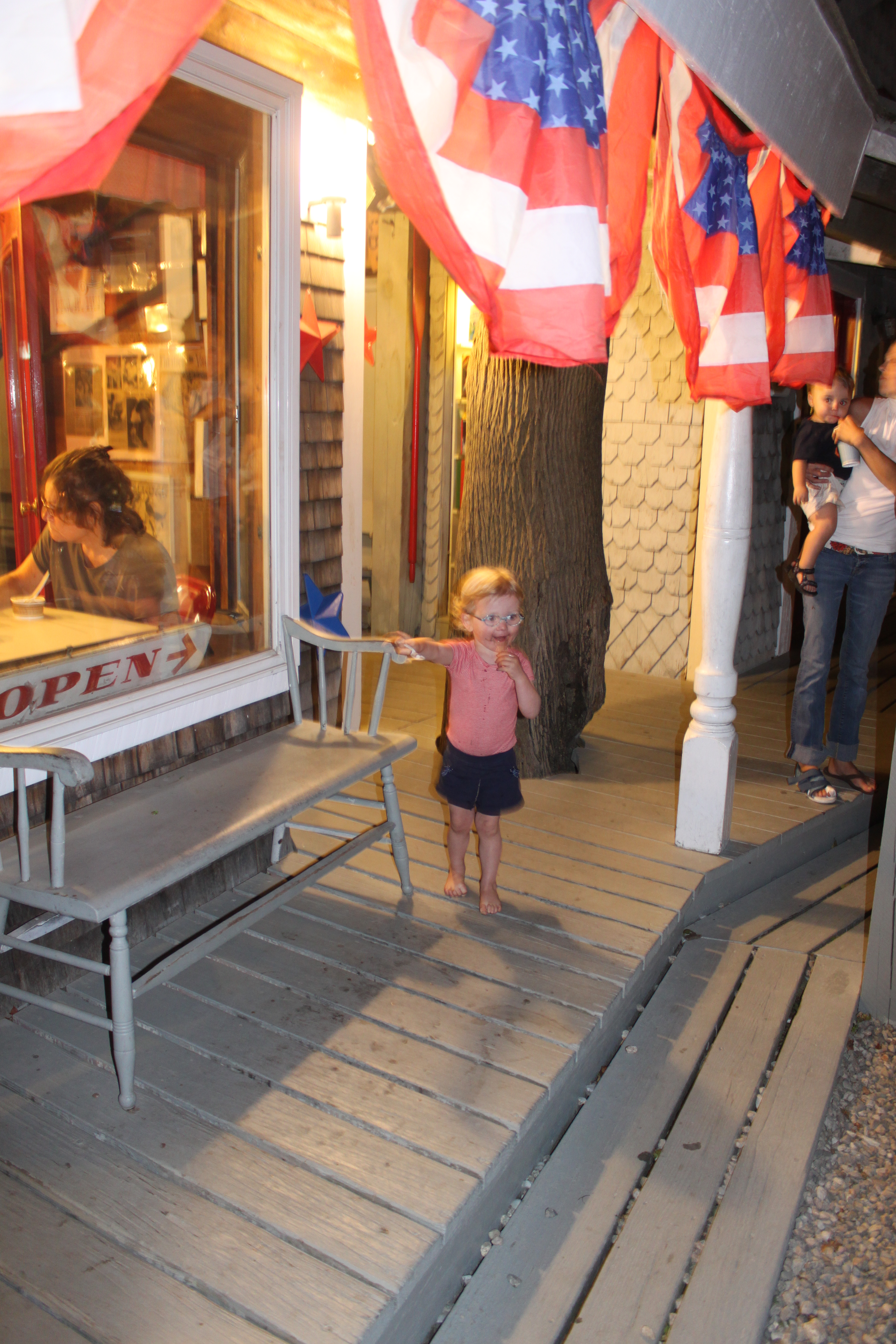
Stella ate her weight (27 pounds) in deliciously high-butterfat ice cream at FarFar's Danish Ice Cream Shop in Duxbury, MA.

Stella is two.

Stella is two. She wishes she lived at the beach.

Stella is two. She wishes she lived at the beach.

Stella turned two years old last week, during our beach vacation. She’s still singing happy birthday to herself, talking about birthday cake, and reminiscing about blowing out candles and good times with her “Happy Birthday balloon with smiley faces.” The balloon was accidentally released into the sky, but the sight of it drifting to ever more impossible heights pleased everyone, including Stella, and somehow seemed appropriate and celebratory. I know what you’re thinking. “How nice!” and “Hopefully no sea animals were killed by the balloon remnants.”

So Stella’s two now. All of sudden, she talks in complete sentences, giving crucial information, and answering questions. (Yeah, she shouts commands, but mastered that long ago. I guess they’re just more specific now.) Though she can string words together like a champ, it’s the short one-liners I enjoy most. Must be the advertising copywriter in me. Some examples of dialogue:

Me, in response to her crying: “What’s wrong?”
Stella: “My belly hurts! And my knee.”

or

Me: “Where are your glasses?”
Stella (walks over to the table, where her specs sit): “Right there!”

or

Stella: “I’m running! I’m running down the street!”
Me: “Yes you are running! Running down the street!”

or

Stella (returning to room after leaving for 5 seconds): “I’m BACK!”

Now that Stella is two, she treats her glasses with more care. She usually takes them off with two hands and carefully folds them before handing them to me. We switched to using magic tape over her right lens, instead of a solid patch, at her ophthalmologist’s suggestion. That’s made patching harder, I think because her right eye is still getting input but it’s really bad input, instead of being totally blocked out. But overall, she’s patching like a champ. When she peeks over the top of the glasses, I say “No peeking,” and that usually stops it at least for a little while. I use screen time as the “patch game”… so if she peeks while watching say, “Here Comes Science” DVD, I say “No peeking,” and if she peeks again, I turn off the TV and say, “You’re peeking so the patch game is over.” It works pretty well! Stella’s doctor was very helpful in coming up with strategies like these.

Stella really likes to nap. She asks to nap often. I’ve heard patching causes strain that can make kids cranky and tired. Plus, we went on a long vacation that involved a three-hour time change. In any case, this kid knows when she’s tired, and I totally appreciate that.

Her raw/giant-carrot-chomping phase seems to have waned, but Stella is now eating lemons like they’re apples, waxy rind and all. Her current favorite foods are: chocolate ice cream, mac and cheese, vanilla ice cream, extra cheesy mac and cheese, sliced almonds, peaches, cheese in any form, ice cream, cottage cheese, bagels, and carrots. And ice cream and mac and cheese. We are so alike in some ways.

We gave her a really cute wooden play kitchen center thingee for her birthday. She loves it–washing dishes and putting lids on pots, turning stove knobs, and removing the faucet. I’ve been letting her play with dried beans and bowls and my large kitchen utensils for a while. She’s really kicking things up a notch now and pretending to cook. Though she hasn’t made anything but mac and cheese yet, I expect her to branch out soon, menu-wise.

Stella is completely, 110% obsessed with the aforementioned “Here Comes Science” DVD featuring music videos for science-centric songs by They Might Be Giants (TMBG). Against my idealistic intentions, I let her watch it every day, because it’s an effective way of launching the “eye patch game” (the game? wearing her patch). During vacation, she watched it two or three times a day. She watched more TV that week than the rest of her life combined. She was teething, jet-lagged, patching, and got a fever and gastro bug, so I just let her go nuts with it (though at times I really did just have to start cutting her off). It was all worth it because now I get to hear appropriately bespectacled Stella belt out scientific yet catchy gems such as:

“ROY G. BIV is a colorful man!”

“STEEEEEAM is a GAS!”

“Meet the elemeeeeeents!”

She is fiery and fabulous and has me by the balls. She’s sweet and strong and fast as lightening. She’s a ruthless tyrant and cuddly snuggler. A monkey and a mastermind. She’ll read book after book after book until the cows come home, then happily “moo” right along with them. I may be diagnosed with severe OCD for admitting this, but I say, mostly in my head but sometimes out loud, at least hundred times a day in the exact same way, “I sure do love my Stelly girl.” I really, really, really do.

***

For your enjoyment, in celebration of Stella’s 2nd birthday, here are the “music videos” (do they still call them that?) corresponding with the lyrics above:

ROY G. BIV

MEET THE ELEMENTS

SOLID LIQUID GAS

I’ll post a birthday pic

Free webinar by Susan Barry: How the system lets down children with vision problems

Here we go again. Like tube feeding, vision is an area in which children aren’t getting the care and solutions they need and deserve. Stella just started patching, because her brain was starting to favor her right (strong) eye. And it’s already become clear (fun with puns!) that without extra effort and research on my part, her outcome, even though we are patching as directed, would be far less than optimal. Thankfully, I have the time and ability and insurance coverage to make it all happen. But I keep wondering, what about the many parents of children with vision and feeding tubes and other health issues who don’t?

Luckily for us anyway, three recent and perfectly timed events have made me feel that I’m on the right track in terms of how to approach Stella’s treatment…

1.) We recently chose a new eye doctor for Stella (our third opinion became our number one choice!) who emphasizes vision therapy in treating eye issues like Stella’s (conditions like strabismus, accommodative esotropia, ambylopia, etc. etc.). She was vastly superior to the others in terms of her attentiveness to Stella as a human being, her ability to do vision therapy with the very young (our second opinion did vision therapy, but said Stella wouldn’t be eligible for years), and her support and tips on how to patch successfully. Seattle Children’s Hospital? They just handed me some adhesive patches to stick on Stella’s almost-two-year-old eyes, with almost no explanation or and certainly no acknowledgement of how big a deal it was, noting only that patching is “not that bad.” Bullshit.

2.) I’m currently reading a ray of hope in paperback form, Fixing My Gaze by neuroscientist Susan Barry. She couldn’t see in 3D until her late 40’s (she had strabismus from early on, like Stella). The ability to see in three dimensions affects life in a myriad of ways, including the abilities to read, drive and play most sports. The book is as much about neuroplasticity as it is about vision, and I have found most of it fascinating (some of it a bit dense and technical and hard to follow). It has opened my eyes (the puns are too easy to resist here, sorry) in so many ways.

3.) Yesterday, I received an email from Stella’s new eye doctor telling me (and all her patients) about a free webinar being given by Barry, author of Fixing My Gaze, on Thursday. I was thrilled! The email, besides letting me in on a great opportunity to learn from a true knowledge leader in the field, confirmed that we’d found one of the rare doctors who can help Stella achieve her own personal best in terms of vision.

The meeting’s name pretty much says it all: “School Crossings: A Neurobiologist’s View of How Our System Fails Children With Vision Problems.” I was so thrilled to find out about this, and again, to get assurance that we’d found a wonderful doctor for Stella. One of the rare few who are truly informed about vision therapy, the kind that helped Barry see the world in full, volumous beauty.

I have only a basic understanding at this point, though it’s growing all the time. But most opthalmologists (including the one we saw at Seattle Children’s) and optometrists seem to heavily rely on patching (often alone) to address situations where the brain is favoring one eye, as is beginning to happen with Stella. When the vision imbalance is left untreated, blindness in the weak eye is likely. However, patching is not a real solution or adequate treatment for many, as upon completion of occlusion, the brain slowly reverts to favoring the same eye. Both eyes are strong after months or years of patching, or have equalized (sometimes the strong eye deteriorates due its suppression) but the brain has not learned to use the eyes together. Vision therapy is needed to get the formerly weak  (“lazy” or ambylopic) eye to coordinate with the  strong eye and create a complete, stereopic view of the world. Proper therapy often results in a long-term cure, enabling 3D vision and other vast improvements. So many children are having to settle for significant, even quality-of-life-reducing vision impairment when in fact, they could see major improvement or perhaps complete resolution of their issues.

Many doctors still believe that there is a small window in early childhood during which eye problems must be addressed, lest be rendered irreversible. Barry’s research and personal experience shatter this falsehood. For the benefit of children like Stella, Barry is shouting her discoveries from the mountaintop, and I am extremely grateful. On the other hand, as we recently embarked on the patching journey, which I was not expecting at all–I was truly blindsided (ugh, another pun?), the book has scared me and made me cry. It’s made me realize the full scope of how Stella’s vision and life experience could be impacted if she is not properly supported. Seriously, I’ve been listening to Celine Dion’s “That’s the Way It Is” and bawling, about once a day. And I’m not a Celine Dion type of person. I’m a Neko Case fanatic. But, “it’s an uphill climb and I’m feeling sorry, but I know it will come to you, yeah” kind of hits the nail on the proverbial, three-dimensional head. I’m working hard and it feels like, once again, there’s a lot on the line and if I don’t stay vigilant and question everything every doctor tells me, Stella will suffer.

Anywho, I’ve signed up for the webinar and encourage other parents of children facing visual challenges to do the same! Virtual “seating” is limited. I will blog about the talk here, in case you miss it. The details, from the original email announcement from the College of Optometrists in Vision Development (COVD):

School Crossings: A Neurobiologist’s View of How Our System Fails Children With Vision Problems
 
Hear Dr. Susan Barry answer questions about difficult school experiences that resulted from her vision problems; how, for example, she was mislabeled as a low aptitude student and assigned to a special problems class, and what her mother did to help her child succeed. And more….. including what you can do to help your child succeed!

TO REGISTER FOR THE MEETING:  Go to www.joinawebinar.com, fill in the meeting ID number 547-423-251 and your email address, click on “CONTINUE,” then fill out the brief form that comes up next and at the bottom of that screen be sure to click on “REGISTER.” 
If you have ANY difficulty registering or any problems during the webinar, contact TECH support for gotowebinar.com at 800-263-6317.

Click here to read the full press release, including more information about Susan Barry (aka “Stereo Sue”).

Back into battle! I think I’ll call it “Operation Shark Patch.”

I’m not even going to pretend to be positive right now. I’ll get there. But not yet. Because I’ve just been asked to do the equivalent of putting mascara on a shark. For hours each day.

Yesterday we found out that Stella is starting to favor her right eye–her left eye is just ever so slightly starting to be tuned out by the brain. So we have to patch Stella’s right eye for three to four hours daily, to force her slacker eye to work harder and get tuned back in. My first, very gentle attempts at encouraging patch use reminded me of the horrors of inserting Stella’s NG tube into her nose when she was three months old. The screaming and utter rage and fear and defiance. She will not let me stick that thing to her face–not even if it’s pink and red with music notes and hearts on it. No. Way. So I’m taking a step back and re-grouping. Ordering books about patching and pirates. Buying her a pirate costume and a DVD featuring a cast of patched puppets. Ordering five different types of patches–namely, a pirate-style patch, two styles of cloth patches that go over the glasses, and two styles of cloth patches that go under the glasses. Anything but adhesive on Stella’s skin. Seriously, F THAT. Been there, done that, and have pictures of redness and irritation to prove it. I’m not even going to TRY to patch Stella again until my patch propaganda has been absorbed, and the non-sticky patches are in hand.

Yeah. So I’m just going to go ahead and say that this blows. I was blindsided by this news in yesterday’s follow-up appointment at Seattle Children’s ophthalmology. I didn’t think this was on the horizon for Stella. Yes, a military metaphor is probably wildly inappropriate in this situation but I can’t help it: I thought we’d won the war. I had a “MISSION ACCOMPLISHED” banner hanging in our living room. Through much “strategerizing”, focus, effort, and expenditures, we got her to wear her glasses! Her eyes stopped crossing! But holy crap there is a huge battle is ahead. Could it be our toughest yet? Doesn’t matter. We have no choice! To save Stella’s vision, particularly that of her weaker left eye, we must patch her strong eye. No effing way am I going to let her eyesight and quality of life go downhill. Not when there is something I can do about it! Even if it’s as insane and seemingly impossible as putting an eye patch on the eye of a small tornado.

Guess I better set my ring tone to “Eye of the Tiger,” smear on some war paint, and do some push-ups and wind-sprints and shit. Oh wait–this is the new type of war. Where brute force is obsolete. I must infiltrate the mind and culture of my target (check! i.e. puppet DVD, books, pirate garb) and win her heart. Again. Possibly with chocolate and a new play kitchen. War really is expensive and good for the economy.

May God have mercy on our souls.

Put me back together.

Ouch.

"Stella! No, use two hands! Gentle! Ah, crap. Just hand them to me."

Cody, Stella and I were all over at Cooper’s house the other day while his parents enjoyed a date night, an event that Cooper (Stella’s best bud and play-date companion)  refers to as an “update,” which really makes sense if you think about two parents going out and spending time together away from their one-year-old. Music is almost always playing while Stella and Co0per are together, because they love to dance (which looks a look like jogging–actually, sprinting–in place) during play dates and within five minutes of arrival one or the other starts in with, “Music? Musiiiiiiiic?” So, we’re intermittently bopping to the music and sending miniature skateboards down ramps when this irresistibly sweet, poppier-than-pop song by Meaghan Smith comes on. The chorus innocently asks, “What’s the use in fixing what’ll only break again?”  And good lord did it hit the proverbial nail on the head. Pesky tears invaded my eyes and a boulder lodged in my throat and I just danced toward the corner until it passed.

As you now know, Stella got her glasses on Friday. We were in the optical shop for an adjustment today, Monday. Already. At first, on Friday morning, I thought she was taking to them amazingly well. She wore them for a long stretch on the playground, briefly removed them and asked me to put them back on while in the car, and she wore them all through lunch. But now I’m realizing that her initial interest can be chalked up to sheer novelty. The more she realizes they’re sticking around, the less wants to do with them. Usually, she’ll wear them for two to five minutes before ripping them off with one hand, stretching the frames in a way that looks like nails on a chalkboard sound. It’s excruciating to see her twist and throw them. But it’s not just that. It’s tough because it’s such a battle, actually more of a war with many, many battles taking place and well-thought out strategies and tactics required for victory. It’s stressful and exhausting to see her tear them off, and then my brain starts whizzing, as in, “Okay, how long can I give her before I put them back on? How long before her eyes are in danger of crossing? What will I distract her with this time–a book? No, we’ve gone though all her favorites already. Stickers! I’ll try the stickers.  What if she doesn’t let me put them on–for the fourth time in a row during these last few minutes? Should I put them in the case for a while or is that like giving up? Wait–have I eaten yet today? When does Stella need to eat? Maybe she’ll wear them if I give her some chocolate chip.” Cue the screaming.

Like a well-programmed mombot with super human strength and endurance (but not really), I automatically bend over backwards to repair a fragile something that is forever poised to break. The glasses. But also something in me (and maybe Stella, too?). When Stella got over her feeding aversion, no longer required a feeding tube and learned to enjoy eating, I thought we were clear. We were going to be okay from then on. But it wasn’t true. That’s impossible, and every parent on earth faces the same perilous reality. There’s always another challenge, frustration, or heartbreak around the corner. Thank god they’re so damn cute and resilient. And for every soul-searing ER visit and agonizingly difficult hurdle that you somehow muster the strength to clear, there’s–oh, where to begin–thousands of laughs that lift you up so, so high, dozens and dozens of triumphs that affirm you, your child, and life itself, and about seven hundred smiley, silly dances. Not a bad bargain at all, even if the song makes me cry.

She’s worth it a million times over.

Strabismus confirmed. Glasses ordered.

Didn't you know? Cool characters wear glasses.

Didn't you know? Cool characters wear glasses. And have yogurt on their faces.

On Thursday afternoon, Stella’s eyes started rolling in again. All our questions evaporated. She has emerging accommodative esotropia. She really needs glasses. And that’s that.

So on Friday morning, we skipped Gymboree and went to find specs for Stella. She tried on three pairs.

Go ahead and judge me–I’ve watched “Say Yes to the Dress” once or twice. And our trip to the optical shop, in the Children’s Eye Care office in Kirkland, was a lot like that show. Except instead of catty commentary in the air and mimosas in our hands, there was extremely enthusiastic, high-pitched encouragement and a light-up spinning ball wand (which, somehow, is almost as intoxicating as OJ and bubbly).

The first and second pairs were total disappointments. Which in hindsight was perfect. Great for building suspense (and ratings). And then, as if scripted, we found the ones. They are French and fabulous. They are blue (also clear, white, purple and green) and if I described them in any detail, they would just sound crazy and over-the-top. But they are not. They work. Tim Gunn would most definitely approve–in fact, I bet he’d be super jealous. I am. As soon as the optician put those beauties on Stella’s face, she and I both knew. We just knew. We didn’t cry tears of joy, but we should have. Because audiences eat that up.

Her Parisian pair will be ready on Wednesday or Thursday of this week, barring any issues. You will want to wear glasses if you don’t. You may even view Stella as a budding fashion icon.* Stay tuned for the big reveal!

* All of this is assuming I’m able to get the glasses on her face for more than three seconds (the current record during try-ons).