The stubborn determination of hope

Good news. Stella is back to taking in about half of her daily calories from the bottle, just as she did before the recent regression.

However.

My feeling is that the tube is preventing her from recovering completely. I believe that it exacerbates her reflux and makes swallowing more difficult. I found and paid for two medical research papers that support my beliefs. I hope that she proves me wrong, and soon, but I am unconvinced that our current mode of treatment will enable Stella to return to 100% normal bottle feeding. I am ready to take urgent action. I am questioning the medical establishment and ready to try something else.

I learned about and have been in touch with a renowned feeding clinic in Austria. Their cold-turkey approach to tube weaning is radically different that what is practiced here in the states. They believe that the baby or child must drive their own intake, rather than the tube. They share my belief that tubes, over time, worsen aversions and lead to tube dependency. They have studied the topic for over 15 years and have a success rate of 92-95%, depending on the age group. The doctor who runs the feeding clinic told me that Stella’s age is ideal for weaning and that we may be able to achieve it through email coaching, rather than having to go all the way to Austria–although I am eager and willing to go to Pluto if that’s what it takes.

The drawback to this method, what is called the “Graz” approach, is simple. The babies and children treated may not gain weight for a month or two. I believe that Stella would be on the shorter of those timeframes, since she already takes half of her formula orally and the clinic treats many children who are 100% tube fed. Stella will be hungry and not fed until she asks for food. This may seem harsh to some, but I believe it makes sense. I believe that Stella, if able to have more control over her eating and freed from the discomfort and difficulties of the tube, would respond very well. But she would need some time to pull through once the tube is removed. Most doctors here are not willing to let a baby have low or no weight gain for any period of time, so the tube stays in. They, of course, have the babies’ best interests in mind, but they seem beholden to the tube and unaware of, or too willing to overlook, its detrimental effects in the name of weight gain. I believe that any short term weight gain delay would be more than made up for with the restoration of a healthy relationship with food and the resulting appropriate, baby-driven weight gain that would follow.

Stella’s life was never in danger. The tube was placed for therapeutic purposes, not just to help her gain weight. The tube was helpful in allowing Stella to say “no” and be heard, instead of constantly being force-fed, which must’ve been very traumatic for her. The tube took the fight away from eating. The tube has enabled her to make progress. But I believe that we have reached a point at which the tube’s negatives outweigh the positives. And I am ready to take bold action in the face of a lot of opposition in order to do what I believe is best for her.

Cody and I are going to consult with her occupational therapist and pediatrician on this. We will continue to bring Stella to a cranial osteopath. We are going to do some research into the Graz method and the Austrian clinic. And then we are going to decide how to proceed. Of course, in the meantime, we would love to see Stella down bottles left and right, thereby eliminating the need for tough decisions or new approaches.

Even on gut-wrenching days when Stella resists the bottle like it’s full of toxic waste, there is an incredibly wishful part of me that looks to the next bottle as a possible turning point. There is a clump of raw hope that sits smoldering in my chest like an ember in the darkness. It’s always there. And it’s going to light the way to a tube-free Stella.

We set ’em up. Stella knocks ’em down.

Another triumphant feeding! Daddy and Stella celebrate after Stella takes 135 mls from the bottle!

Another triumphant feeding! Daddy and Stella celebrate after Stella takes 135 mls from the bottle!

Cody, Stella and I had a relaxing holiday weekend. I’m sad that it’s over and that Cody will have to return to work tomorrow. He’s been working a lot, which has been tough. Just having him around makes me feel better, and Stella loves it, too.

When I get down, he helps pick me up, and vice versa. Of course, when feeding doesn’t go well, we both feel discouraged and can sometimes work together to find the positives and pull ourselves up together.

This weekend, we realized that our standards had really risen in regards to Stella’s eating. We found ourselves feeling bummed when she took “only” 70 to 80 mls. We had to step back and remind ourselves that not long ago, that was considered a good feeding! 

Today is an interesting example. She had only four bottles because she slept so much, and because we gave her the usual two feedings via pump while she slept. The average number of mls she took per bottle was 111.75 (yes, we are that exact). Remember, her formula has 24 calories per ounce instead of the usual 20 calories per ounce, so she gets more calories with less volume–big feedings can really exacerbate reflux.

She complained a bit before her first feeding, but other than that, she accepted the bottle right away and was very comfortable while eating. Stella has come so very far! This whole feeding fiasco–or should I call it a “challenge” instead–has been an exercise in the power and importance of positive thinking. Slowly but surely, I’m learning.

Tonight, I returned the hospital grade breast pump that I rented two months ago. I was surprised by how emotional I got during this seemingly simple errand. I cried a lot and it really caught me off-guard. Then again, that pump and I, we spent so much time together. We worked so hard! We were side by side through the scariest times with Stella. When she didn’t want to eat and I thought her health was in serious danger and that it was my fault. When my milk supply was low because she wasn’t taking enough. When we had no idea what was going on with Stella and were desperate to get answers.

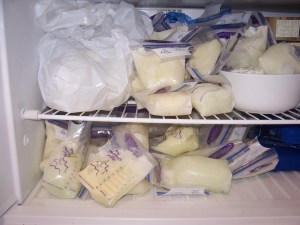
I tried. I really, really tried. Hundreds of ounces of breastmilk still sit in our freezer.

I tried. I really, really tried. Hundreds of ounces of breastmilk still sit in our freezer. Just can't bring myself to dump it. Too much effort and love went into making it. I'm wondering if I can donate it somewhere.

That huge, yellow pump became a fixture in our living room. It represented my long, last, and intense effort to continue breastfeeding Stella–and I suppose I had a hard time letting the pump go for that reason. Breastfeeding was what I wanted for her, and for me. I really miss the closeness that we enjoyed through breastfeeding. The proud and assured feeling that I was giving her the very best nutrition. The knowledge that I was nurturing her in such a direct and intimate way. I am grieving the loss of breastfeeding, though it’s not as sharp as when she had her first bottle of formula, or when I stopped pumping a couple of weeks ago. Even though formula truly helped Stella thrive by getting her comfortable and willing to eat, part of me really feels like Stella and I are missing out on something. However, toward the end of my time with this impressive piece of machinery, pumping was taking away more than it was giving us. 

At the hospital,  Stella was put on hypoallergenic formula “temporarily” to see how she’d do and to allow the doctors to do their assessment. (Of course, it didn’t turn out to be temporary, as stool testing showed that the switch helped Stella in many ways. I think that deep down, I actually knew that it would not be temporary, or at least I feared that would be the case.) I was pumping eight times a day even though it wasn’t clear if she’d ever safely be able to enjoy breastmilk again without jeopardizing her comfort and willingness to eat. I’d given up soy and dairy for the cause, which was difficult but wouldn’t have been as big a deal if anxiety wasn’t already beating the crap out of my appetite. 

Feeding Stella with the bottle, then the tube/pump is time-consuming and then to have to pump myself–it was too much for me to handle. I wanted more time to spend just being with and enjoying Stella instead of operating various pumps for hours a day. I needed rest, which was impossible with having to wake up to feed her via tube and stay up to pump. As my friend and cousin Regan pointed out, breastmilk is very beneficial to babies. But just as if not more beneficial? Happy, healthy moms.

Happy and healthy is how we can now describe Stella. Sure, I wish breastfeeding worked out for us. But it didn’t. It’s that pesky parenting lesson that keeps popping up! In short, sometimes things don’t work out like you planned or hoped or envisioned, and you just have to make the best of it. Besides, I have three months of fond breastfeeding memories to hold onto. I remember nursing her for 30 minutes right after she was born. I remember her first few weeks, when she’d wake up hungry in the middle of the night, and Cody would change her diaper and then place this beautiful, tiny, wriggling little baby next to me. She’d be crying and squirming and sucking on her hands–and then she’d latch on and suddenly be so peaceful. Later, that all changed and breastfeeding was not so peaceful, of course. But I’m so glad we had those early experiences together. And, stepping away from my emotional attachment to breastfeeding, I’m so very glad that the formula took away much of the pain Stella was experiencing.

She may no longer get my milk, but she’ll always get my best! I just love her so much. And that’s really all there is to it.

Lucky 14?

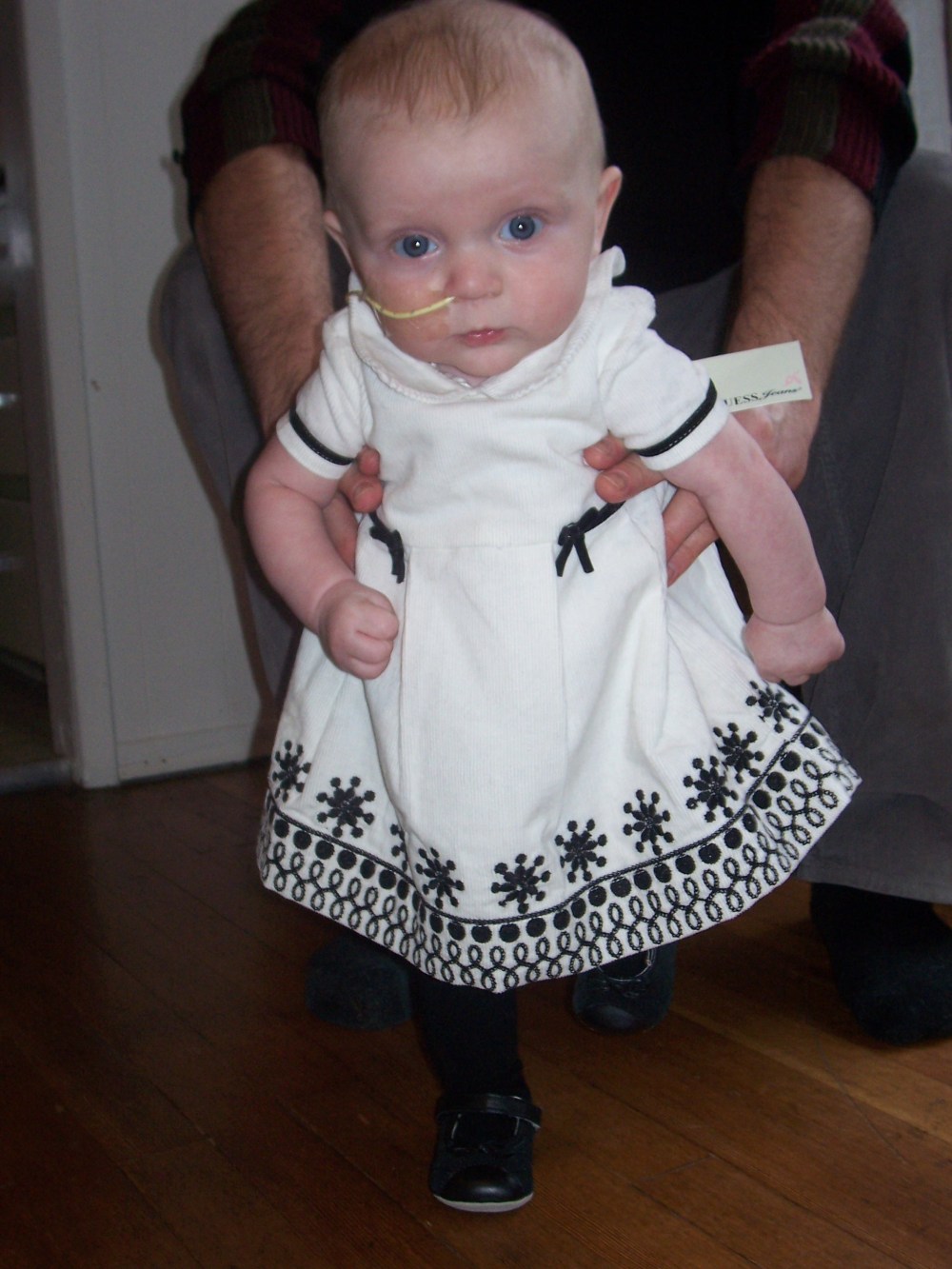
Stella takes a step forward...

Stella takes a step forward...

It’s great that my appetite is back. Because I have some words to eat. In my last post, regarding Friday’s doctor appointment and weigh-in, I stated, “I’m certain that she won’t have gained the ounce per day that the doctor would prefer to see.” Over the two previous weeks, she’d gained ten ounces total, or five ounces a week. So I expected more of the same, since we’d only increased her intake by about 20 mls a day. It had been exactly one week since her last appointment, so a good gain would’ve been seven ounces. Well, Stella somehow managed to gain 11 ounces! She now weighs 14 pounds! We were amazed and encouraged.

Her doctor said that this type of weight gain suggests that there’s no obstruction or other structural problem. The food is passing through her system and being digested and utilized for growth. (Though, Stella will still have an abdominal ultrasound on Wednesday, just to be sure.) As her reflux and cow’s milk protein intolerance have been treated, the good doctor believes that this is now strictly a feeding issue that will resolve in time.

Friday’s second appointment, our foray into Cranial Osteopathy, was fascinating and uplifting. We are now seeing Dr. Devorah Steinecker, a holistic pediatrician–an M.D. with additional training in neurology, developmental pediatrics and pediatric osteopathy.  She was incredibly optimistic about Stella’s condition and totally confident in her ability to resolve Stella’s feeding issue.

I learned so much at this appointment, about an area of medicine I didn’t even know existed until a few days ago. My understanding is very limited, but in a nutshell, Dr. Steinecker believes that Stella’s issues were caused or exacerbated by compression to the skull that occurred during birth. An intense, 32-hour labor and the transverse (sideways)  positioning of Stella’s head put a ton of extra stress on her skull, focused mainly on the the occipital (rear) bone (which is composed of four parts in newborns), where the nerves controlling swallowing, appetite and digestion are located. The plates of the skull are designed to move and compress during birth, but Stella was subjected to an extreme amount of pressure, resulting in more compression of the bones and nerves in that area. Through gentle, hands-on manipulation, Dr. Steinecker can make tiny adjustments to the bones’ positioning, restoring balance, relieving tension, and freeing those nerves to function properly. That’s just my basic, quasi-ignorant understanding. If you have a question, please leave it in a comment and I’ll do my best!

We went back to Dr. Steinecker for a second appointment the next day, on Saturday evening, to speed things along. I’m almost afraid to say this, but we may already be seeing improvement. On the way home from yesterday’s appointment, Stella seemed hungry so I offered her the bottle. She took 50 mls while in her carseat, as we were driving. She didn’t fight the bottle, and gulped it down quickly and comfortably. This is pretty much unheard of. To feed Stella, I have to hold her in my right arm while standing and performing deep squats to provide her with a calming, steady bouncing motion while facing Christmas lights or another mesmerizing visual distraction. Later that evening, she took 100 mls, easily. As you may recall, her first bottle of the day is “always the worst” (more words to eat?). But this morning, she took an entire 115-milliliter bottle in five minutes. At her second bottle, she took 85. Holy crap.

Of course, other efforts may help explain this apparent upswing in bottle feeding. The new ratio of formula to thickener (one packet of Simply Thick to eight ounces of formula) along use of a number three Dr. Brown’s brand nipple (instead of a number two) seems to be a great combination for Stella. We don’t want to get ahead of ourselves, and we anticipate more ups and downs, but we are seeing progress!

Last night, it snowed in Seattle. The first flakes fell as we left her appointment with Dr. Steinecker. Snow always sparks excitement in me, probably due to giddy memories of sledding and snow days, crucial parts of any east coast upbringing. At the same time, snow makes the world seem more peaceful. At that moment, as we walked outside and admired the flurry illuminated in the street light, all seemed right in the world. Tube and all. There was, and is, a sense that the tube will be gone soon. When Stella is ready.

A memory from our hospital stay

During our stay at Children’s, blood, stool and urine samples were taken and tested for literally dozens and dozens of things. Dr. Lindsay Fox was kind enough to review the findings with us, and she couldn’t help but wonder aloud about one of the results.

With a gentle but quizzical look on her face, Dr. Fox said, “I’m not sure why, and it’s really nothing to worry about at this point, but Stella’s triglycerides are pretty high.”

I was quite surprised and said something like, “Wow, that’s so strange! Why on earth would that be?”

Cody raised his eyebrows at me and asked, “Really? You don’t know why?”

I just stared at him with a perplexed and expectant expression, as he’d obviously figured it out and couldn’t wait to tell me why her triglycerides were high.

“It’s all the bacon you’ve been eating!”

Dr. Fox gave me a sympathetic look. “Well she has to be able to eat something!”

Cody was right. Because I’d been off dairy, I’d turned to bacon for solace. Cody had been frying it up for me in a desperate attempt to get me to eat. (He’d also fry eggs in the bacon fat and try to get me to eat those too.) As I explained previously, anxiety took my appetite away almost completely. Bacon and Kettle Chips were the only foods I could swallow without gagging.

Of course, Stella is now on formula and not breastmilk. I’m guessing her arteries are quite relieved.

How Stella went from the boob to the tube.

Where to begin? Somehow, we moved from exclusive breastfeeding, the most “natural” thing in the world, to formula feeding through a nasogastric tube, a medicalized method of feeding that we’ve yet to make peace with and hope to leave behind soon.

Stella stopped wanting to eat sometime ago. It began slowly. Practically imperceptibly. At around 5 1/2 weeks, I noticed she’d cry sometimes while nursing. She’d gag or choke on the milk a bit. So I tried nursing her in different positions, in an effort to slow down the flow of milk. It seemed to help, but she wouldn’t eat for very long. Of course, we’d seen a lactation consultant early on who told us with much enthusiasm that Stella was an incredibly efficient nurser who managed to take in a lot of milk in a little time, so it seemed okay.

Then, there was the ER trip in early October when she was eight weeks old. She vomited and had blood and diarrhea in her diaper. After x-rays, blood work and a stool sample came back looking good, they suggested that I stop eating dairy as lactose intolerance was the most likely explanation. I would go on to give up dairy for two months. (As a friend put it, this was “a fate worse than death.”)

Soon after, at her two-month appointment, we learned that she wasn’t gaining weight as quickly as expected. She’d dropped from the 50th percentile to around the 25th. We were alarmed, but she seemed happy and didn’t seem have too much trouble eating at that point, so we didn’t panic. However, week after week of slow weight gain along with Stella’s increasing aversion to eating soon made it clear that something was wrong. We had to do something. But what?

Well, first we switched doctors. Her pediatrician was nice enough, but didn’t take our concern very seriously. He said, and this is a direct quote, “Just keep feeding her.” Sigh. I also met with two lactation consultants several times each. Meanwhile, I spent all day every day just trying to feed her. The stress was unbearable. My milk supply had gone down in response to her taking in less, so I was pumping around the clock as well. A typical day entailed monumental, constant feeding efforts. I fed her by breast, often with a leaky, pain-in-the-ass supplemental nursing system, by bottle (though she really didn’t accept it from me), and even one milliliter at a time via medicine dropper, all in a desperate attempt to provide her with adequate calories. I was on the verge of a nervous breakdown.

Finally, one of the lactation consultants witnessed Stella’s refusal to eat and was convinced that she suffered from reflux. Because Stella didn’t spit up or vomit, her reflux was harder to detect (it’s called “silent reflux”). Soon after, Stella’s new doctor prescribed Zantac to reduce the acidity of her stomach contents and therefore alleviate the pain of reflux. She also recommended that we collect a stool sample for a “reducing substances” test that could shed light on whether she was lactose intolerant. After weeks of trying, we finally got one, and testing showed that there was indeed lactose in her stool. The lactose wasn’t being broken down, indicating temporary (or secondary) lactose intolerance–the kind caused by damage to the GI tract, which babies outgrow by around one year of age. (Later we would learn that it wasn’t that simple, but it was nice to finally discover a big piece of the puzzle.)

Also at the suggestion of the lactation consultant and in cooperation with Stella’s doctor, we got in to see a feeding specialist–a renowned occupational therapist–at Seattle Children’s Hospital. She was struck by Stella’s intense level of upset and adamant refusal to eat. A few days later, after another week of low weight gain, we were admitted to Children’s for what ended up being a four-day stay. They placed the nasogastric tube (so traumatic!), through which she is fed hypoallergenic Elecare formula. Whatever she refuses to take orally, she gets through the tube. (Mistakes were made at the hospital which painted an inaccurate picture of her status and therefore resulted in less than optimal decision-making. I will explain all of this in a future post. None of the missteps were devastating, but I believe that sloppiness and inattention clearly diminished the value of our stay. )

The formula has helped. She is a lot more comfortable now. For several reasons, we moved on to a new pediatrician who has more direct connection and access to Children’s. He has seen this in many babies, and believes that Stella has a cow’s milk protein intolerance (simply put, dairy is one of the only things that passes through in breastmilk without being broken down), which irritated her gut and impaired her ability to break things down, including lactose and fatty acids, which were both detected in her stool sample. A stool sample taken after a couple weeks on the formula came back normal, so as emotionally difficult as it was to move away from breastmilk, we know the formula has made a clear difference.

At this point, reflux and eating refusal remains. During and immediately after her hospital stay, her intake by bottle had improved a great deal. But since then, it has regressed, a difficult reality for Cody and me to accept. However, her doctor, who is wonderful, says that many babies regress while on the tube, but that she should rebound and pull through in time. Our biggest challenge these days is to stay positive and to keep the faith even when eating doesn’t go well.

We see both her doctor and occupational therapist (who provides us with new strategies aimed at making eating more enjoyable for Stella) weekly. We will meet with a pediatric gastroenterologist at the end of the month. We are strongly considering allergy testing, craniosacral work, and an adjustment in her reflux meds. We track every milliliter that she takes and doesn’t take, enter it into an Excel spreadsheet and analyze it in graphs and charts. At night, we wake up every three hours to feed her by pump so that she can get enough calories and a good night’s rest. We are doing everything we possibly can. We have gone above and beyond since the beginning of all this in an attempt to help Stella thrive. There is a sense of peace that comes with knowing this.

People called me a warrior after Stella’s 32-hour, unmedicated birth. But, looking back, it wasn’t true. I didn’t become a warrior, or earn my stripes as a mom, until all hell broke loose. Until Stella struggled, and I proved that I would move heaven and earth to help her even just a little bit. I’m proud of that. I’m proud of Cody for his incredible sacrifice, support and efforts. And I’m proud of Stella. She’s happy, healthy and sweet as can be. She is doing the best she can given her early, unfortunate experiences with eating.

Her mom is as stubborn as they come. So it really comes as no surprise that our little girl is as strong-willed as can be. She is such a wonderful, strong character. As hard things are right now, one thing is for sure: she is going to be just fine.

Much more to come.